
Review · KATHMANDU
Annapurna Circuit with Tilicho Lake
The biggest draw here is the route itself: Tilicho Lake at 4,949 meters, the high Thorong La crossing, and sunrise from Poon Hill all fit into one long Himalayan journey. You move from subtropical river valleys to dry, high mountain country, then return through rhododendron forests and the villages around Pokhara.
I like the careful acclimatization plan, especially the rest day in Manang and the return from Tilicho Lake to a lower sleeping point. I also like the practical coverage: airport transfers, permits, guides, porters, teahouse rooms, and three daily meals on the trek are included.
The main caution is the pace. This is not a gentle walking holiday. The 3 a.m. start for Thorong La, several long days, rough sections near Tilicho, and the high sleeping altitudes demand solid fitness and a sensible approach to altitude.
Key points at a glance
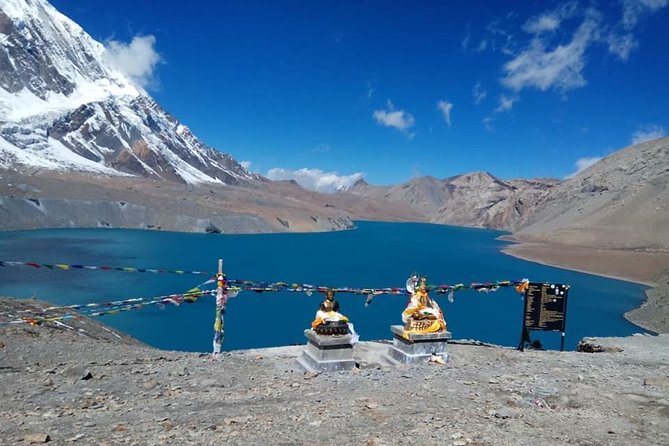
- Tilicho Lake at 4,949 meters: Reach one of the world’s highest lakes on an out-and-back side trip from Manang.
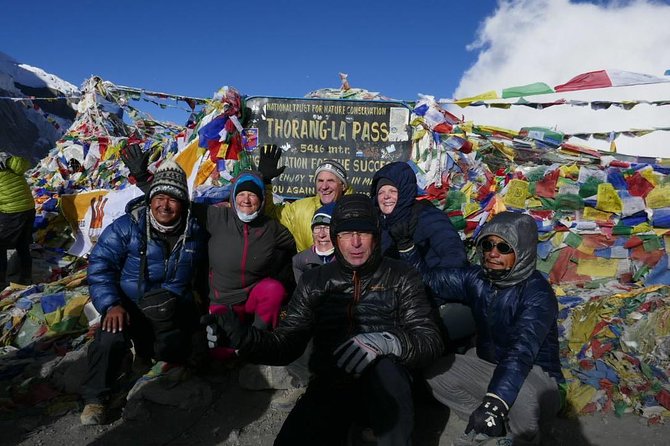
- Thorong La at 5,416 meters: Cross the trek’s highest point before descending to sacred Muktinath.
- Poon Hill sunrise: Finish with an early climb for views of Annapurna, Dhaulagiri, Machhapuchhre, and Manaslu.
- Two very different mountain regions: See the dry Tibetan-influenced Manang and Mustang areas, then walk through wetter forest and terraced farmland.
- Guided logistical support: The $1,599 price includes permits, porters, teahouses, meals during the trek, and much of the ground transport.
- A real acclimatization stop: Manang gives you time to hike to Gangapurna Lake or Bhojo Gumba before going higher.
What this 19-day Annapurna route is really like
This trip combines three strong sections of Nepal trekking. The first follows the classic Annapurna Circuit from the lower Marsyangdi Valley toward Manang. The second leaves the main route for Tilicho Lake. The third rejoins the circuit, crosses Thorong La, and then turns south toward Poon Hill.
That variety is the reason to choose this trip instead of a shorter Annapurna trek. You see waterfalls, farm fields, pine forest, Tibetan-style villages, dry high-altitude valleys, a sacred Hindu and Buddhist site, rhododendron forest, and several of Nepal’s best-known mountain viewpoints.
You should also understand what the $1,599 buys. The package includes three-star hotels in Kathmandu and Pokhara, teahouse accommodation on the trail, breakfast in the cities, all three meals during the trek, private airport transfers, a guided Kathmandu tour, trekking permits, staff costs, and porter service at a ratio of one porter for two trekkers.
It does not include international flights, the Nepal visa, travel insurance, rescue insurance, personal drinks, showers, laundry, phone calls, battery charging, tips, or lunch and dinner in Kathmandu and Pokhara. Bottled or boiled water is also extra. For a nearly three-week private trip with staff and permits arranged, the price is reasonable, but your personal extras can add up.
The experience is private to your group. The operator provides an English-speaking, government-licensed trek leader and assistant coverage at one assistant for every four trekkers. Guides connected with this company have included Bishnu, Ganesh, and Sanam Sherpa. The guide can make a real difference here, particularly when the weather changes or someone begins to feel the altitude.
More Annapurna Treks in Kathmandu
- Annapurna Circuit Trek with Tilicho Lake
★ 5.0 · 368 reviews - Annapurna base camp trek 5 Days
★ 5.0 · 252 reviews - 14-Day Private Annapurna Base Camp Trek
★ 5.0 · 180 reviews
Kathmandu gives you a useful start
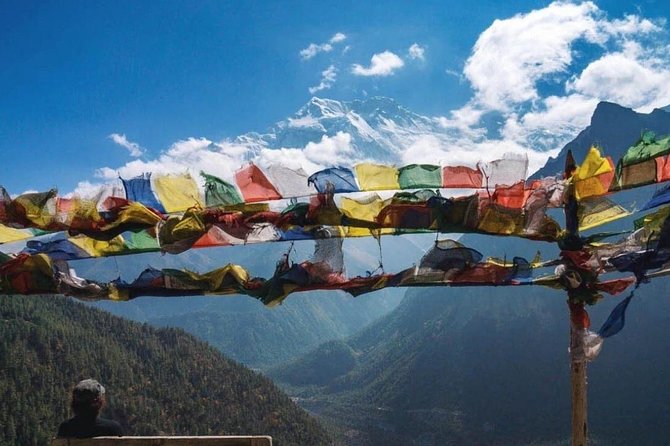
Your first day is simple. A representative meets you after customs at Tribhuvan International Airport and takes you to your hotel in Thamel. The transfer takes about 25 minutes, though Kathmandu traffic can make the city feel slower than the clock suggests.
Day two brings a guided city tour by private vehicle. You visit Boudhanath Stupa, Pashupatinath Temple, Patan Durbar Square, and Swayambhunath, often called the Monkey Temple. These are not filler stops before the trek. They introduce the Buddhist and Hindu traditions that continue into the mountain villages and make Muktinath more meaningful later.
The city tour lasts about five hours. You also have a trek briefing and a chance to meet the guide and other team members. Use this time to check the day-by-day plan, ask about food and water, and make sure you understand what your porter will carry.
The long road to Syange and the Marsyangdi Valley
Day three is mostly a road day, with roughly eight to ten hours from Kathmandu to Syange. You pass terraced farms, rivers, villages, and green hills. It is scenic, but it is also tiring, and road conditions can affect the schedule.
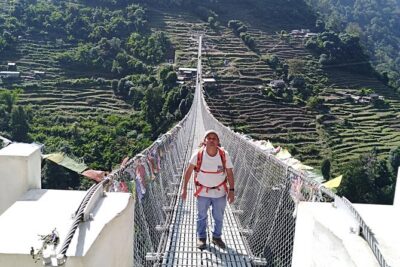
From Syange, the walking begins. The route toward Dharapani crosses suspension bridges and climbs through Tal, where waterfalls spill toward sandy riverbanks. Barley, rice, and potato fields show how much farming depends on these narrow valleys. Kodo is one of the larger villages in the Manang region, and Dharapani marks a more definite transition into the high mountain route.
The itinerary gives this day about seven to eight hours of walking, while another schedule lists closer to five hours. That difference tells you something useful: exact times depend on the chosen path, road conditions, breaks, and the group’s pace. You should judge the trip by the elevation gains and terrain, not just the advertised hours.
Chame and Pisang bring the first big mountain views
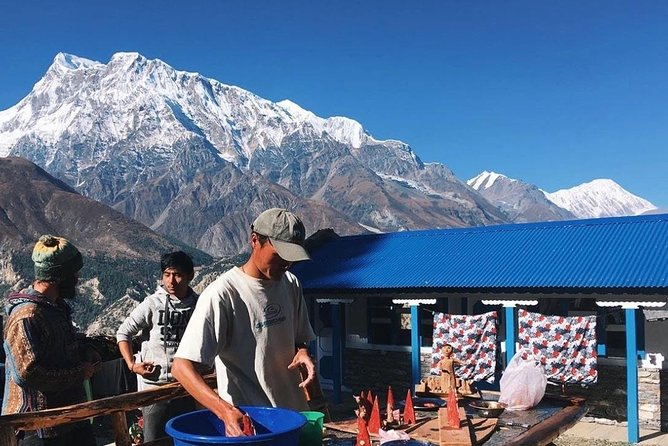
The walk to Chame passes through pine, fir, oak, and maple forest, with steep ridges and landslide areas along the way. Chame is the headquarters of Manang District, and it brings views of Lamjung Himal, Annapurna II, and Annapurna IV. A small hot spring offers a welcome pause, though you should not expect a resort-style bathing facility.
The next day to Pisang narrows into a dramatic valley below the Paungda Danda rock face. This huge curved wall rises about 1,500 meters above the river. Annapurna II and Pisang Peak appear as the valley opens.
At Pisang, the route choice matters. The upper trail through Geru is more demanding than the lower option, but it gives you stronger views of Annapurna II, III, and IV, Gangapurna, Tilicho, and Pisang Peak. The air becomes colder and drier, and the villages begin to show stronger Tibetan cultural influence.
A visit to Barge Monastery adds a worthwhile cultural stop. It is described as the largest monastery in Manang District. Keep your expectations practical: the pleasure is in the setting, local religious life, and the chance to walk through an old settlement, not in a long formal tour.
Same trailhead, a different route:
- Everest Base Camp Trek – 14 Days
★ 5.0 · 1,499 reviews - Everest Base Camp Trek
★ 5.0 · 842 reviews - Everest Base Camp Helicopter Tour landing at Everest View Hotel
★ 5.0 · 668 reviews - Everest Base Camp Trekking
★ 5.0 · 485 reviews
Manang is the trip’s important breathing space
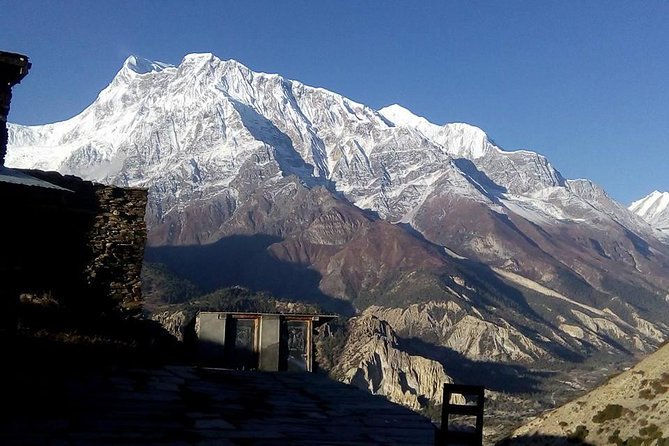
You spend two nights in Manang, with an acclimatization day between the approach and the higher Tilicho section. This is one of the best features of the plan.
You may hike to Gangapurna Lake and its base camp, walk to Bhojo Gumba, explore Manang village, or visit the Himalayan Rescue Association in nearby Vraga. The medical briefing covers acute mountain sickness, its symptoms, and ways to reduce the risk. Take it seriously. At this altitude, a slow pace and a willingness to stop are more valuable than proving anything.
The walk to Gangapurna Lake also lets you gain some height during the day while sleeping back in Manang. That is a sensible pattern before you spend nights above 4,000 meters.
Manang itself is one of the most interesting settlements on the route. The vegetation thins, the air feels dry, and the surrounding peaks become more severe. You are no longer just walking through a green river valley. You are entering high mountain country where weather, appetite, sleep, and energy can change quickly.
The Tilicho Lake side trip is the route’s special prize
From Manang, you leave the main circuit and head toward Khangsar and Siri Kharka. The trail crosses coniferous forest before reaching the Tibetan-influenced settlement of Khangsar. From there, the route climbs toward Siri Kharka, with Gungang Himal and Chulu visible in the distance.
The walk to Tilicho Base Camp is not necessarily steep throughout, but it can be tiring because sections cross loose scree and landslide terrain. The path passes through a broad area of unstable rock with striking formations. This is where good footwear and careful footing matter more than speed.
Day eleven begins early. From base camp, expect a steep, steady climb of about two to three hours before the trail eases in places. The lake sits below the north face of Tilicho Peak at 4,949 meters. Snow-covered peaks, open slopes, and the large reflective lake create one of the trip’s strongest views.
The route returns the same way to Siri Kharka. The out-and-back design is a drawback for anyone who dislikes retracing steps, but it is also the practical way to reach the lake while keeping the main circuit intact. Starting early helps you avoid stronger afternoon winds and leaves some margin for the return.
One detail deserves correction in your expectations: the schedule lists the lake visit as six minutes in one place, clearly a timing error. Plan on roughly five to six hours for the full base camp, lake, and return day, as the detailed route description indicates.
Yak Kharka and Thorong Phedi prepare you for the pass
After Siri Kharka, the route descends toward Khangsar and passes Tare Gumba, an old monastery said to be about a thousand years old. Khangsar is largely uninhabited except for occasional herders during festival periods, which gives this section a spare, remote feel.
You cross into the Thorong Khola Valley and climb to Yak Kharka. The route offers views of the Annapurna range, and the area is associated with blue sheep. A snow leopard sighting is possible but should be treated as luck, not part of the plan.
The next day to Thorong Phedi is shorter, around three to four hours, but it gains elevation. You cross a suspension bridge, pass Ledar, and continue below high cliffs. Thorong Phedi is the last settlement before the pass and the final place to rest before the hardest day.
Your body may appreciate the shorter schedule, but do not mistake it for an easy day. At about 4,420 meters, even a modest uphill walk can feel slow. Eat, drink, organize your pack, and follow your guide’s advice about the early start.
Thorong La is the hardest and most memorable day
You wake around 3 a.m. for the crossing to Thorong La. The pass reaches 5,416 meters, or about 17,764 feet. You cross from east to west, from Manang toward Muktinath, the direction generally used for this route.
The climb is demanding because of the altitude, cold, darkness, and long upward effort. The view from the top reaches toward Tibet, while the Annapurna peaks remain behind you. A few photos and a short rest are enough. The pass is not the place to linger if the weather turns.
The descent to Muktinath is long, but the drop in elevation usually feels welcome. Muktinath matters to both Hindus and Buddhists. Hindus know it as a sacred place of liberation, while Buddhists call it Chumig Gyatsa, meaning Hundred Waters.
This day is listed at seven to eight hours, though conditions can make it feel longer. The early start is not glamorous, but it gives you the best chance of completing the pass before wind and cloud build later in the day.
Muktinath, Tatopani, and the return to greener country
You visit Muktinath Temple in the morning, then take road transport toward Tatopani. The drive can last six to eight hours and is a sharp change from walking. The package includes public transportation for this section, rather than a private vehicle.
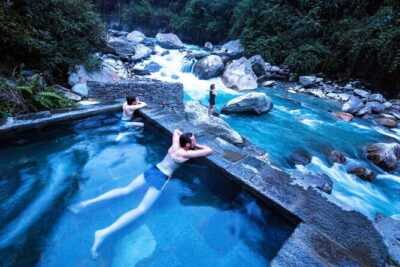
Tatopani is known for its natural hot springs. After the pass and long descent, this is a welcome chance to soak. The accommodation and facilities remain part of a mountain trip, so keep expectations modest.
The next day climbs through Sikha and Chitre toward Ghorepani. Terraced farmland replaces the dry high valleys, and the route passes through rhododendron, birch, and magnolia forest. In bloom, rhododendrons can cover the hillsides with pink or red flowers.
This is another long walking day, around seven to eight hours. The climb may surprise you after the major pass is already behind you. Ghorepani sits on a ridge and makes a good base for the final sunrise walk.
Poon Hill gives you a strong finish
You leave early for Poon Hill at 3,210 meters. The viewpoint is famous for sunrise over Annapurna, Dhaulagiri, Machhapuchhre, Manaslu, and the surrounding rice terraces.
The climb is short compared with Thorong La, but you still need warm layers and a headlamp. Sunrise is the point, so the early start is part of the deal. If clouds block the peaks, the walk can feel less rewarding, but the viewpoint remains an important close to the trekking route.
After Poon Hill, you descend through rhododendron forest toward Nayapul and continue by vehicle to Pokhara. The schedule gives five to six hours of walking and about one to two hours of driving. Pokhara provides a softer landing, with a hotel and breakfast included.
The following day is a five to seven-hour tourist bus ride back to Kathmandu. A 25-minute flight is available at extra cost. The bus costs less, but the flight saves a full day of road travel. The final night in Kathmandu includes a farewell dinner in the detailed plan, while meals in Kathmandu are generally excluded from the package, so confirm exactly what is covered.
Accommodation, food, guides, and what you pay extra for
Teahouse accommodation means simple mountain lodging, usually with shared facilities in many places, though the exact room and bathroom arrangements can vary. One past account specifically praised thick blankets and some rooms with attached toilets, but you should not assume that standard at every stop.
Three daily meals are included during the trek. That is valuable because food costs rise in remote areas and you do not need to negotiate every meal separately. Breakfast is included in Kathmandu and Pokhara, but lunch and dinner in those cities are your responsibility.
Porter service is included at one porter for two trekkers. Pack carefully and keep essential items, medication, documents, and warm layers in your day bag. Your personal allowance should be confirmed before departure.
You also need travel and rescue insurance. The operator provides a medical kit carried by the trek leader, but that is not a replacement for insurance. Tips for guides, porters, and drivers are extra, as are drinks, hot showers, laundry, phone calls, battery charging, and extra porters.
The cancellation terms are simple: cancel at least 24 hours before the start time for a full refund. Changes or cancellations inside that window are not accepted for a refund.
Who should book this trek
I would choose this trip if you want a full Annapurna experience with two major additions, Tilicho Lake and Poon Hill. It suits you if you can handle repeated five to eight-hour walking days, steep climbs, rough trail sections, and sleeping at high altitude.
It is also a good choice if you want arrangements handled locally. The airport pickup, city tour, permits, staff, meals, transport, and teahouses reduce the number of details you must manage yourself.
I would hesitate if you want flexible rest days, private luxury lodging, or short walking stages. The route includes a very early Thorong La start, a high lake reached by a demanding out-and-back climb, and a long return by bus. The itinerary also has a few timing inconsistencies, so ask the operator to confirm the final schedule before you pay.
Should you book the Annapurna Circuit with Tilicho Lake?
Book it if you want variety, high passes, serious mountain scenery, and a route that links Manang, Tilicho, Muktinath, and Poon Hill in one trip. The strongest reasons are the well-placed Manang acclimatization day, the support of local guides and porters, and the number of major sights included for $1,599.
Do not book it simply because the price looks good or because you like the idea of a Himalayan photo album. You need the fitness, patience, and insurance for a high-altitude trek. If you are ready for that, this is a demanding but thoughtfully arranged way to experience several of Nepal’s best-known mountain routes.
FAQ
How long is the Annapurna Circuit with Tilicho Lake tour?
The tour is scheduled for approximately 19 days, from airport arrival in Kathmandu through departure. Some route descriptions refer to a 20-day journey, so confirm the final schedule with the operator.
Is Tilicho Lake included in the tour?
Yes. The route travels from Manang to Siri Kharka and Tilicho Base Camp, then makes an early morning visit to Tilicho Lake at 4,949 meters before returning to Siri Kharka.
What is the highest point of the trek?
Thorong La is the highest point, at 5,416 meters. Tilicho Lake is at 4,949 meters.
Are meals included?
Breakfast is included in Kathmandu and Pokhara. Breakfast, lunch, and dinner are included during the trek. Lunch and dinner in Kathmandu and Pokhara are not included.
Is airport pickup provided?
Yes. Airport pickup and drop-off are provided in a private vehicle. A representative meets you after arrival and customs clearance at Tribhuvan International Airport.
What is not included in the $1,599 price?
International airfare, the Nepalese visa, travel and rescue insurance, personal expenses, drinks and water, showers, laundry, phone calls, battery charging, tips, extra porters, and lunch and dinner in Kathmandu or Pokhara are not included.
Just added around Kathmandu
- Everest Base Camp Trek★ 5.0 · 3 reviews
- Everest Base Camp Trek★ 5.0 · 7 reviews
- 15 Days Private Everest Base Camp Trek★ 5.0 · 30 reviews
- Everest Base Camp Trek★ 5.0 · 57 reviews
- 14 Days of Adventure Trekking to Everest Base Camp★ 5.0 · 2 reviews
- 14-Day Everest Base Camp Trek★ 5.0 · 20 reviews
- From Kathmandu: Private 14-Day Everest Base Camp Trek★ 5.0 · 20 reviews
- 14 Days Everest Base Camp Trek★ 5.0 · 4 reviews
Annapurna Base Camp Treks, compared.
Trekking in Annapurna/Langtang/Everest/Upper Mustang regions
Read our review →
Kathmandu to Annapurna Base Camp (ABC) 5-Day Trek
Read our review →Browse the lists this trek appears in