
Review · KATHMANDU
Annapurna Base Camp Trek
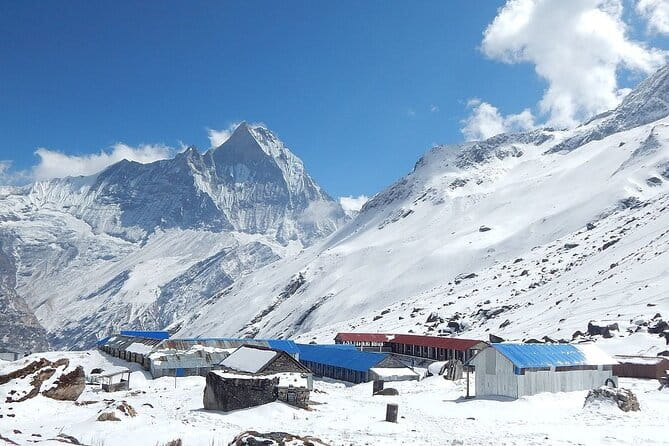
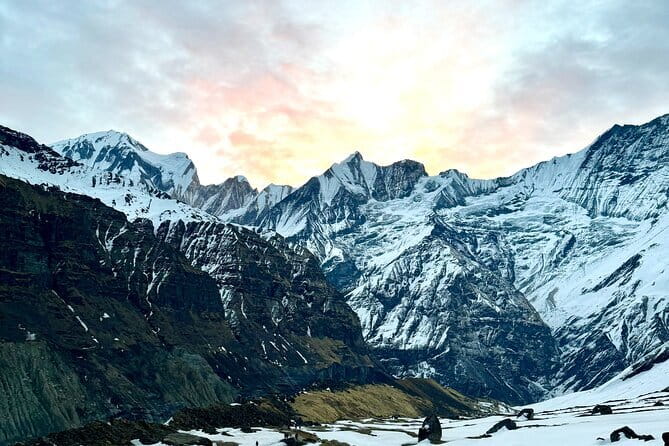
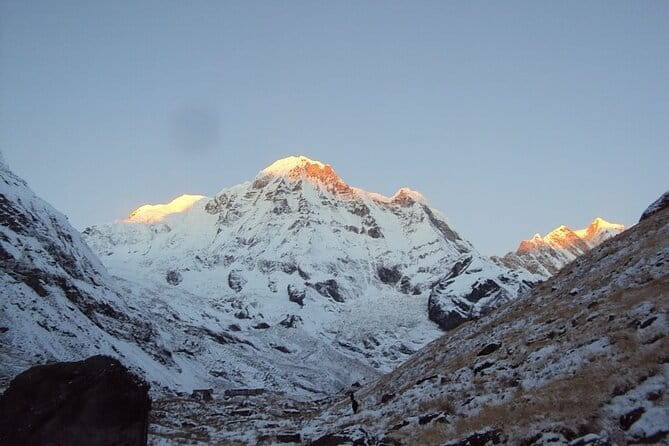
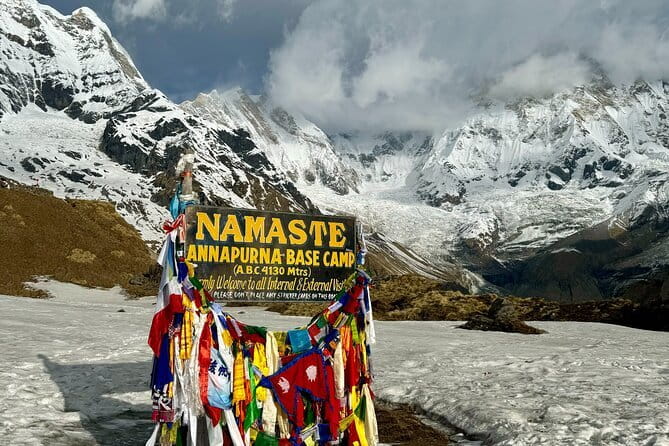
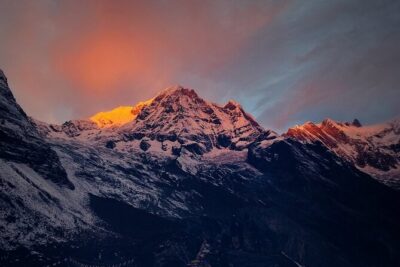
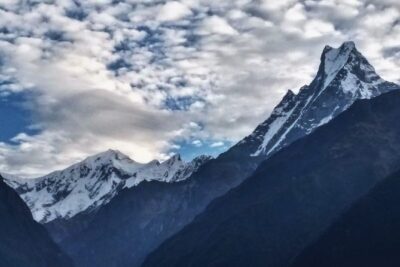
The payoff here is Annapurna Base Camp at 4,130 meters, a mountain amphitheater ringed by Annapurna I, Annapurna South, Machapuchhre, and Hiunchuli. You walk through village life, rhododendron forest, bamboo groves, and steep Himalayan valleys before reaching a place that feels wonderfully enclosed by peaks.
I like the smart route design: Poon Hill adds a sunrise mountain view, while the return through Jhinu Danda gives you a chance to soak in natural hot springs. I also like the practical support, with a licensed guide, one porter for every two clients, permits, meals, and transport arranged for you.
The main drawback is the physical work. The route has long stair sections, steep climbs and descents, and a rapid return from high altitude. The itinerary also includes a long bus ride between Kathmandu and Pokhara, so this is an active trek rather than a relaxed holiday with a few scenic walks.
Key points to know before you book
- ABC reaches 4,130 meters: The highest overnight point is high enough that altitude, cold, and fatigue need to be taken seriously.
- Poon Hill is an excellent bonus: You get a sunrise viewpoint before turning deeper into the Annapurna Sanctuary.
- The route mixes comfort and simplicity: Three-star hotels cover Kathmandu and Pokhara, while mountain nights use basic guesthouses and dormitory rooms.
- Porter support reduces your load: One porter is provided for every two clients, but you still need to pack carefully and respect the weight they carry.
- The support team is a major part of the experience: Guide teams have included Ramesh Karki, Maddy, Raj Kumar, Shyam, Ganesh, and others, with assistant guides and porters helping groups through difficult sections.
- The $1,350 price covers a lot: Transport, lodging, permits, guides, porters, breakfasts, most lunches and dinners, and airport transfers are included, but insurance, drinks, tips, and some city meals are extra.
Why the Annapurna Sanctuary route works so well
The Annapurna Base Camp Trek is popular for a good reason. It gives you a striking range of scenery in about two weeks without requiring a flight to a remote mountain airstrip. You begin in Kathmandu, pass through Pokhara, walk along river valleys and forest paths, and finish inside a high mountain bowl.
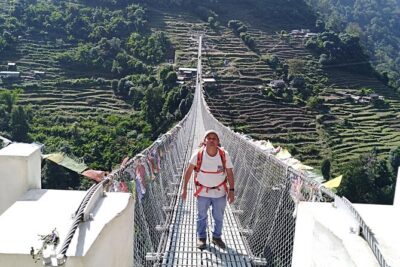
This route also gives you more than a high viewpoint. The villages of the lower trail are home to Gurung and Magar communities, and the path passes tea houses, small shops, farms, suspension bridges, and local lodges. The experience is not just about reaching a sign at base camp. It is about seeing how people live in steep hill country.
I particularly like the change in scenery. The early days feel green and inhabited. Higher up, the forest thins, the valleys narrow, and the mountains take over. The return journey then changes the mood again, with warmer air, waterfalls, bamboo, and the hot springs at Jhinu Danda.
More Annapurna Treks in Kathmandu
- Annapurna Circuit Trek with Tilicho Lake
★ 5.0 · 368 reviews - Annapurna base camp trek 5 Days
★ 5.0 · 252 reviews - 14-Day Private Annapurna Base Camp Trek
★ 5.0 · 180 reviews
Kathmandu arrival and the first practical meeting
Your trip begins with pickup at Tribhuvan International Airport. An Ace the Himalaya representative meets you outside the terminal with a sign and takes you to your Kathmandu hotel in a private tourist vehicle.
There is a pre-trip meeting either on arrival day or the following day. This is when you meet your guide and handle the practical paperwork. Bring your passport, three passport photos, and a readable copy of your travel insurance policy.
You also need insurance that covers emergency high-altitude rescue and evacuation. This is not included in the tour price, and it is one of the most important things to arrange before leaving home. You may also need to clear any remaining balance and sign the trip forms at this meeting.
The first night is useful for getting organized, not sightseeing. You receive a duffel or kit bag and sun hat, meet the team, and prepare for an early start.
Day 2: Kathmandu to Pokhara by tourist bus
The morning starts early. Staff collect you around 6:30 a.m. and take you to the tourist bus station. The bus to Pokhara generally leaves around 7:30 a.m., and the journey takes most of the day.
Pokhara is a pleasant change from Kathmandu. It sits beside Phewa Lake and offers views toward Annapurna, Machapuchhare, Dhaulagiri, Lamjung Himal, and Manaslu when the skies cooperate. The town is smaller and less hectic, with plenty of places to eat, walk, and prepare for the trail.
The bus ride is the least glamorous part of the trip, but it keeps the cost reasonable and connects the two cities without adding a domestic flight. If you dislike long road journeys, this is worth considering before booking. On the other hand, arriving by road lets you see the change from Kathmandu Valley to the lower Himalayan foothills.
Days 3 and 4: Nayapul, Tikhedhunga, Ulleri, and Ghorepani
From Pokhara, a private vehicle takes you to Nayapul, where the walking begins. The first section follows the Modi Khola before reaching Birethanti, a large village with shops and tea houses. From there, the trail follows the Bhurungdi Khola toward Hille and Tikhedhunga.
This first walking day is short and comparatively gentle. That is helpful because you are still learning the pace, adjusting to your boots, and finding out how your body handles the repeated climbs. Do not mistake the easy opening for a preview of the whole route.
The next day brings the famous climb to Ulleri. The trail rises steeply through and above the large Magar village, then becomes more manageable as it passes through oak and rhododendron forest. Banthanti and Nangethanti provide useful points to stop before the final walk to Ghorepani at 2,840 meters.
Ghorepani is an important overnight stop because it sets up the early morning walk to Poon Hill. It is also where the route starts to feel properly alpine. The forest is beautiful, but the stone steps make this a tiring day. Pack your water and rain layer where you can reach them without emptying your bag.
Same trailhead, a different route:
- Everest Base Camp Trek – 14 Days
★ 5.0 · 1,499 reviews - Everest Base Camp Trek
★ 5.0 · 842 reviews - Everest Base Camp Helicopter Tour landing at Everest View Hotel
★ 5.0 · 668 reviews - Everest Base Camp Trekking
★ 5.0 · 485 reviews
Day 5: Poon Hill sunrise and the trail to Tadapani
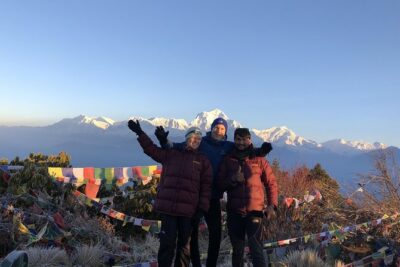
The Poon Hill start is early, usually before sunrise. The walk takes about an hour, and the effort is rewarded with a broad view of the high Himalayas as the light changes across the peaks.
Poon Hill is not the highest point of the trek, but it is one of the best viewing spots. The short climb gives you a clear mountain panorama without waiting until the end of the journey. For many people, this is the first big visual reward.
After returning to Ghorepani for breakfast, you climb along ridges and pass through pine and rhododendron forest toward Deurali. The trail then descends to Banthanti before turning toward Tadapani.
This is a long and varied day. The early start can leave you tired before the main walking begins, so use the breakfast stop well. The route also gains and loses height repeatedly, which can feel harder than a steady uphill climb.
Day 6: Forest paths and Chhomrong
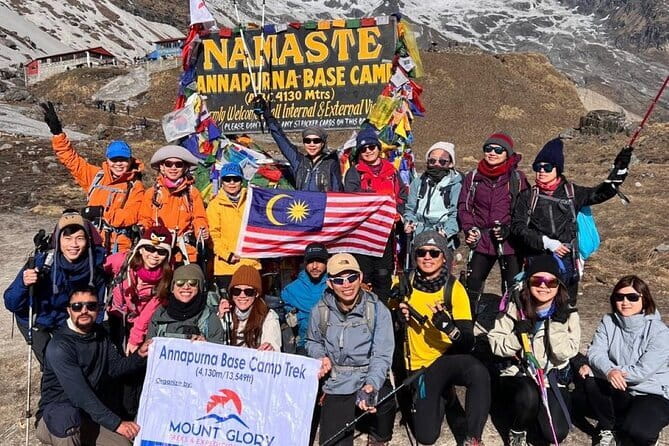
Leaving Tadapani, you descend through rhododendron forest toward Gurjung, a village associated with the Gurung people. The trail then becomes easier as it heads toward Chhomrong at 2,140 meters.
Chhomrong is a key staging point for the Annapurna Sanctuary. It is also a reminder that this trek is full of height changes. You may descend several hundred meters only to climb again the next day. That rhythm is normal here and can be surprisingly demanding on the knees.
The village setting gives you a chance to slow down and look beyond the peaks. Stone houses, terraced hills, and everyday mountain life are part of the route. I would treat Chhomrong as a proper recovery stop, even if the schedule does not include a separate acclimatization day.
Days 7 and 8: Dovan, Machhapuchhare Base Camp, and ABC
From Chhomrong, the trail drops to the Chomrong Khola, then climbs toward Khuldighar. It passes through bamboo and rhododendron forest and follows the gorge toward the Himalayan Hotel and Dovan.
This section feels more enclosed. The steep valley, thick forest, and river below create a strong sense of moving into a remote mountain sanctuary. You will also encounter abrupt stairs and rocky sections, so steady pacing matters more than speed.
The following day takes you past Hinko Cave and Deurali to Machhapuchhare Base Camp. The name can be misleading because climbing Machhapuchhare is not permitted, so this is not a launch point for an ascent. It is a high stopping place surrounded by peaks.
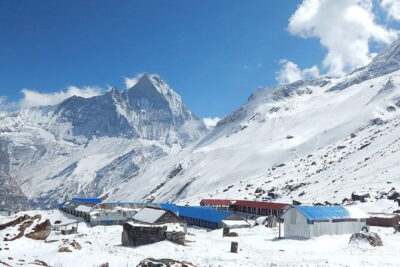
From there, it takes about two hours to reach Annapurna Base Camp at 4,130 meters. The setting is the heart of the trek. Annapurna I rises to 8,091 meters, while Annapurna South, Machhapuchhre, and Hiunchuli form the surrounding walls.
The view is impressive because the mountains feel close and enclosing rather than distant. Give yourself time to look around, take photographs, and notice how quickly the conditions can change at this height. The overnight at ABC is a serious part of the trip, not just a photo stop. Cold, thin air, and accumulated fatigue may affect sleep and appetite.
The itinerary does not include a separate acclimatization day at base camp. Your guide should monitor how you are doing, but you also need to speak up early about headache, nausea, unusual tiredness, or other altitude problems. Do not treat reaching ABC as more important than your health.
Days 9 and 10: A steep return through Bamboo and Jhinu
The return begins on the same trail, dropping roughly 1,700 meters toward Bamboo at 2,345 meters. Descending is often harder on the knees than climbing, especially after a night at high altitude.
Bamboo offers basic tea house and lodge accommodation. These mountain lodges are practical rather than polished. You should expect simple rooms, shared facilities in some places, and a more limited choice of food and drinks than in Pokhara or Kathmandu.
The next day continues toward Chomrong before descending steeply to Jhinu Danda. An experimental sheep farm lies beyond Khuldighar, and the route again passes through rhododendron and bamboo areas.
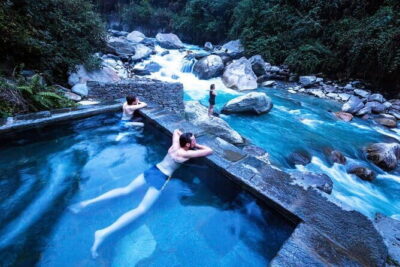
Jhinu’s natural hot springs are a welcome change after several hard days. The chance to bathe in warm water gives this section a clear sense of reward. Bring a swimsuit and keep your expectations sensible: this is a mountain stop, not a spa resort.
Day 11: Jhinu to Pokhara and the Phewa Lake outing
The walk from Jhinu follows the right side of the Modi Khola for about four and a half hours to Birethanti and then continues to Nayapul. This is described as one of the more relaxed walks of the trek, with the river and lower valley helping you ease back into life below the high mountains.
A private vehicle takes you from Nayapul to Pokhara. After checking into the hotel, the plan includes a walk to Phewa Lake and a boating trip to Barahi Temple.
This is a useful transition day. You have time to clean up, eat in a proper town, and enjoy water-level views instead of looking up at a mountain pass. The two included nights in Pokhara give you a more comfortable finish than a direct return to Kathmandu.
Day 12: Return to Kathmandu and the farewell dinner
You drive back to Kathmandu in the morning. The journey again takes a large part of the day, so do not plan an important international connection on this date.
The evening includes a farewell dinner at a traditional Nepalese restaurant with cultural performances. It is a pleasant way to close the trek, though the dinner is not the main reason to choose this package. The real value lies in the walking support and the amount of transport and lodging arranged around it.
If you have extra time, the company lists possible extensions including a Chitwan jungle safari, river rafting, a Kathmandu shopping tour, and mountain biking. These are options rather than part of the $1,350 package.
What the $1,350 price really covers
At $1,350 per person, this is not a bare-bones independent trek. The price includes airport transfers, two hotel nights in Kathmandu, two hotel nights in Pokhara, eight nights in guesthouses, a licensed English-speaking guide, one porter for every two clients, trekking permits, transport between Kathmandu and Pokhara, the Pokhara to Nayapul vehicle, most meals, government taxes, and service charges.
You also receive a duffel or kit bag and sun hat. Breakfast is included for all 12 nights of the scheduled trip, while nine lunches and nine dinners are included. Lunch and dinner in Kathmandu and Pokhara are not covered, along with drinks.
You still need to budget for international airfare, the Nepal entry visa, personal trekking equipment, alcoholic and other drinks, insurance, and tips. Tipping is expected for the trekking staff and driver, so do not treat the advertised price as your final travel budget.
The value is strongest if you want one company to coordinate the moving parts. You are paying for more than beds and meals. You are paying for a guide team, porters, permits, transport, and help when the trail becomes confusing or physically demanding.
Guides, porters, and the human side of the trek
The strongest part of this operation appears to be its field staff. Guide teams have included names such as Ramesh Karki, Maddy, Raj Kumar, Mahesh, Shyam, Ganesh, Resham, and assistant guides including Bhawishya KC. Porters named in trip accounts include Prakash, Bhagwan, Tenzing, Shantiraj, Ram Prasad, Tika Ram, Lumbu, Dilip, and others.
Your assigned team may be different. The meeting before departure is when you learn who will lead your group. Still, the repeated pattern is clear: encouragement, help during difficult climbs, attention to individual needs, and careful handling of logistics are central to the experience.
Group size is capped at 15 people. That is large enough for a social trek but small enough for the guide to keep track of the group. If you are booking as a private group, confirm the exact arrangement before paying.
The porters carry much of the shared load, but you should not use that as an excuse to overpack. One useful rule is to bring only what you will truly wear and use. The trail has many stairs, and every extra item adds weight somewhere.
Who should book this trek?
You should consider this trip if you want a structured Himalayan trek with reliable support and a clear route. It suits someone with moderate physical fitness who can handle repeated uphill and downhill walking, long days, basic mountain lodging, and a high overnight at 4,130 meters.
You do not need to be a mountaineer. This is a trekking route, not a technical climbing expedition. But you should train before arrival. Stair workouts are especially useful because the trail includes long sections of stone steps, and the descent can be just as tiring as the climb.
This may not suit you if you want private bathrooms, flexible daily schedules, short transport days, or a slow acclimatization plan with extra rest days. It also may not suit anyone unwilling to buy high-altitude evacuation insurance or accept that weather can affect the program.
The experience has a five-star rating from 107 reviews and a 100 percent recommendation figure, which supports the idea that the service is a major strength. Those figures do not remove the physical challenge, but they do suggest that the company’s organization and staff support are strong reasons to choose this package.
Small details that make the trip easier
Carry your passport, three passport photos, and a copy of your insurance policy to the pre-trip meeting. Keep your important items in your day bag rather than in the porter’s load.
Allow extra time around the Kathmandu to Pokhara drives. The schedule says 13 days, but the listed stop durations are sometimes inconsistent, so confirm the exact departure times and hotel details with the operator.
Use the two city stays wisely. Kathmandu is for arrival and preparation, while Pokhara gives you a softer landing after the trek. The boat trip on Phewa Lake and the Barahi Temple visit are a pleasant change after days on foot.
Cancellation is free if you cancel at least three full days before the start time. Changes or cancellations inside that window are not accepted for a refund, and poor weather may lead to a different date or a full refund.
Should you book the Annapurna Base Camp Trek?
I would book this trek if you want to reach a major Himalayan base camp without arranging every permit, transfer, meal, and lodge yourself. The combination of Poon Hill, village trails, forest, hot springs, and the enclosed mountain setting at ABC gives the route real variety.
The $1,350 cost is fair for the amount of support included, especially with guides, porters, lodging, permits, most meals, and transport covered. Just arrive prepared for long stair days, basic guesthouses, a demanding high-altitude section, and a long bus ride on either side of the trek.
Choose it for organized adventure, not luxury. If your fitness is moderate, your expectations are practical, and you want a capable field team around you, this is a strong way to experience the Annapurna Sanctuary.
FAQ
How long is the Annapurna Base Camp Trek?
The scheduled trip lasts approximately 13 days, including arrival and departure in Kathmandu, time in Pokhara, the trek, and the return to Kathmandu.
What is the highest point of the trek?
Annapurna Base Camp is at 4,130 meters, or 13,549 feet.
Is airport pickup included?
Yes. An airport representative meets you at Tribhuvan International Airport in Kathmandu and transfers you to your hotel. An airport drop-off is also included at the end.
Are meals included?
Breakfast is included for all 12 scheduled nights. Nine lunches and nine dinners are included. Lunch and dinner in Kathmandu and Pokhara are not included, and drinks are extra.
Is accommodation included?
Yes. The package includes twin-share or double rooms in three-star hotels for two nights in Kathmandu and two nights in Pokhara. The mountain portion uses guesthouses with twin-share and dormitory rooms for eight nights.
Is travel insurance included?
No. You must arrange your own travel insurance, and it needs to cover emergency high-altitude rescue and evacuation.
How many people can join the group?
The maximum group size is 15 people. The package includes one porter for every two clients and a licensed English-speaking trekking guide.
Just added around Kathmandu
- Everest Base Camp Trek★ 5.0 · 3 reviews
- Everest Base Camp Trek★ 5.0 · 7 reviews
- 15 Days Private Everest Base Camp Trek★ 5.0 · 30 reviews
- Everest Base Camp Trek★ 5.0 · 57 reviews
- 14 Days of Adventure Trekking to Everest Base Camp★ 5.0 · 2 reviews
- 14-Day Everest Base Camp Trek★ 5.0 · 20 reviews
- From Kathmandu: Private 14-Day Everest Base Camp Trek★ 5.0 · 20 reviews
- 14 Days Everest Base Camp Trek★ 5.0 · 4 reviews
Annapurna Base Camp Treks, compared.
Trekking in Annapurna/Langtang/Everest/Upper Mustang regions
Read our review →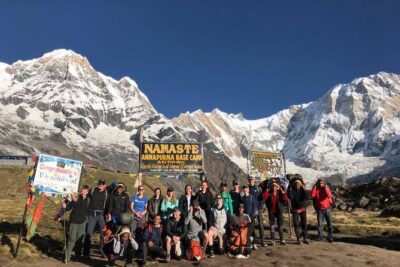
Kathmandu to Annapurna Base Camp (ABC) 5-Day Trek
Read our review →
Browse the lists this trek appears in