
Review · KATHMANDU
Annapurna Base Camp Trek
The great appeal of this 14-day Annapurna Base Camp trek is the variety packed into one route. You move from Kathmandu to Pokhara, walk through the Gurung villages around Ghandruk and Chomrong, climb toward Poon Hill, and finish at Annapurna Base Camp at 4,130 meters. It is a proper Himalayan trek, but not an expedition.
I like the mix of mountain scenery and village life, and I like that the private format allows the guide to adjust the pace to your group. Damu, the guide associated with Mission Summit, is repeatedly praised for clear planning, humor, patience, and long experience. The main drawback is the physical demand: long walking days, cold and changing weather, steep altitude gain, and several costs such as lunch, dinner, drinks, and snacks are not included.
Key points to know before booking
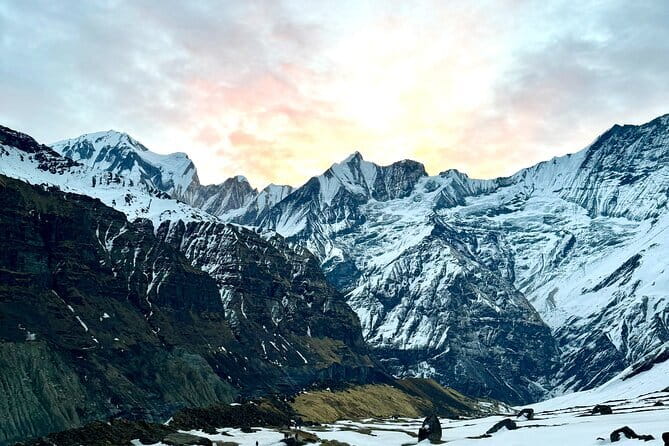
- Poon Hill adds a sunrise mountain view before the trail turns toward Annapurna Base Camp.
- The route reaches 4,130 meters, so altitude and cold deserve serious preparation.
- Damu and his porter team are the main strength of the operation, with praise for organization, communication, and personal care.
- This is a private trek, so only your group participates.
- The $769.24 price covers breakfast, an air-conditioned vehicle, and listed fees and taxes, but not lunch, dinner, drinks, or snacks.
- The itinerary includes road travel, including a roughly six-hour drive from Kathmandu to Pokhara and a return drive at the end.
Why this Annapurna route is so appealing
Annapurna is popular for a good reason. The route combines high peaks, wooded hills, terraced slopes, stone villages, and changing mountain weather without asking you to commit to a technical climbing trip. The Annapurna Conservation Area also gives the journey a broader setting, with protected natural areas and communities connected to Gurung culture.
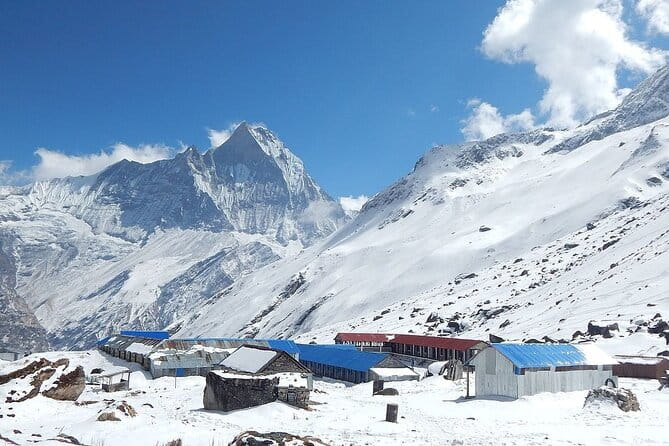
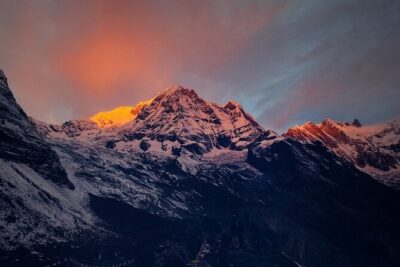
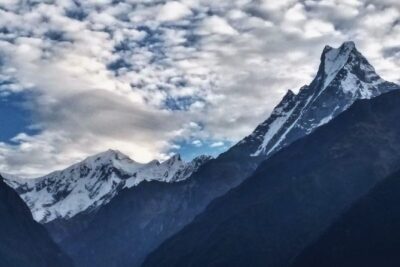
The scenery changes often enough to keep the walking interesting. Near Pokhara, the hills feel lower and more settled. Around Ghorepani and Poon Hill, the views open toward the Annapurna range, Dhaulagiri, and Machhapuchhre, the distinctive fish-tail mountain above Pokhara. Farther up, the route becomes more about altitude, cold, and the huge bowl of peaks around base camp.
I especially like the way the trip builds gradually. You do not land in Kathmandu and immediately start walking uphill. The first road days give you time to reach Pokhara and the trailhead. Still, the schedule is not a relaxed sightseeing holiday. The walking days range from about four to seven hours, and the altitude rises sharply over the middle of the trip.
More Annapurna Treks in Kathmandu
- Annapurna Circuit Trek with Tilicho Lake
★ 5.0 · 368 reviews - Annapurna base camp trek 5 Days
★ 5.0 · 252 reviews - 14-Day Private Annapurna Base Camp Trek
★ 5.0 · 180 reviews
Days 1 and 2: Kathmandu to Pokhara
Day 1 is arrival in Kathmandu at about 1,350 meters. The plan does not list a major touring program for this day, so you should treat it as an arrival and orientation day rather than a full sightseeing day. It is useful time to meet the team, check equipment, and settle into the rhythm of the trip.
On Day 2, you drive about 220 kilometers to Pokhara, at roughly 860 meters. The stated travel time is six hours, although road conditions can affect any journey in Nepal. The air-conditioned vehicle is a practical inclusion here, especially after an international flight or before the walking begins.
Pokhara is more than a transport stop. It is the gateway to the Annapurna region and a lower, gentler contrast to the trail ahead. You will want to use this stage to organize any personal snacks and drinks, since those are not included in the package.
Days 3 and 4: Nayapul, Hille, and Ghorepani
Day 3 begins with a drive to Nayapul, followed by about four hours of trekking to Hille village at 1,496 meters. This is a manageable introduction to the route. You begin walking through the lower Annapurna foothills, with the satisfaction of leaving the vehicle behind and settling into a steady pace.
Day 4 is harder. The walk to Ghorepani rises to 2,840 meters and takes about seven hours. This is one of the longest days on the schedule, and the elevation gain matters. You should not judge the trek by the easy start from Nayapul. Ghorepani puts you much higher, and your legs will feel the difference.
Ghorepani is valuable because it positions you for the early Poon Hill walk. It is also a useful point to watch how your body handles altitude. The itinerary does not specify accommodation details, so confirm sleeping arrangements, room standards, and whether breakfast is provided at each stop before paying.
Day 5: Poon Hill and Tadapani
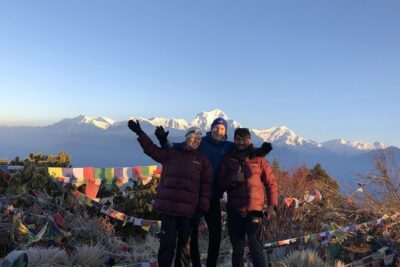
The morning hike to Poon Hill is one of the signature moments of the route. You then continue to Tadapani at 2,520 meters, with about five hours of trekking listed for the day.
Poon Hill gives you a high viewpoint before the trail moves deeper toward base camp. On a clear morning, you might see the Annapurna range, Dhaulagiri, and Machhapuchhre catching the first light. Weather is never guaranteed, so keep your expectations sensible. The appeal is the chance of a wide Himalayan view, not a promise of perfect visibility.
The walk to Tadapani helps connect the famous viewpoint with the more continuous trekking section. This is also one of the places where the route feels less like a single scenic stop and more like a journey through villages and mountain paths. Your guide’s pacing matters here, especially after the early start at Poon Hill.
Same trailhead, a different route:
- Everest Base Camp Trek – 14 Days
★ 5.0 · 1,499 reviews - Everest Base Camp Trek
★ 5.0 · 842 reviews - Everest Base Camp Helicopter Tour landing at Everest View Hotel
★ 5.0 · 668 reviews - Everest Base Camp Trekking
★ 5.0 · 485 reviews
Days 6 and 7: Sinuwa and Deurali
On Day 6, you trek to Sinuwa at 2,340 meters for about five hours. The altitude is still significant, but the day is shorter than the previous one. It gives you a chance to keep moving without the schedule becoming an exhausting march.
Day 7 takes you to Deurali at 3,230 meters in about seven hours. This is another long day, and the steady rise becomes more noticeable. The route is preparing you for Annapurna Base Camp, so patience is more useful than speed.
I would pay close attention to the guide’s advice during these two days. Damu is praised for explaining the plan, answering questions, and adjusting to personal needs. That matters on a trek like this, where a sensible pace can make the difference between enjoying the final climb and merely enduring it.
Day 8: Annapurna Base Camp at 4,130 meters
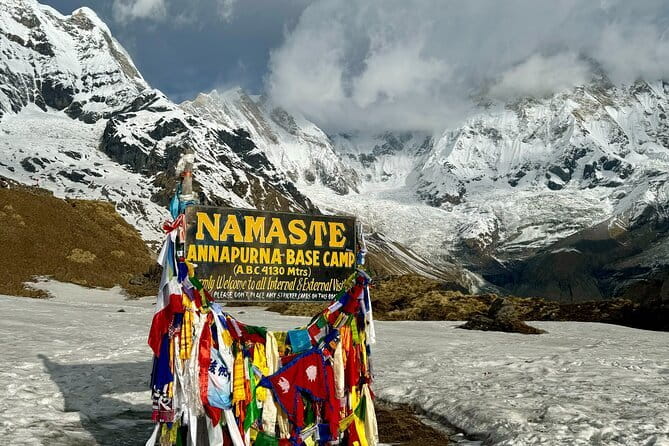
Day 8 is the emotional high point: about four hours to Annapurna Base Camp at 4,130 meters. The walking time is shorter than on several earlier days, but altitude makes the effort serious. A four-hour climb at this elevation is not comparable to four hours at home.
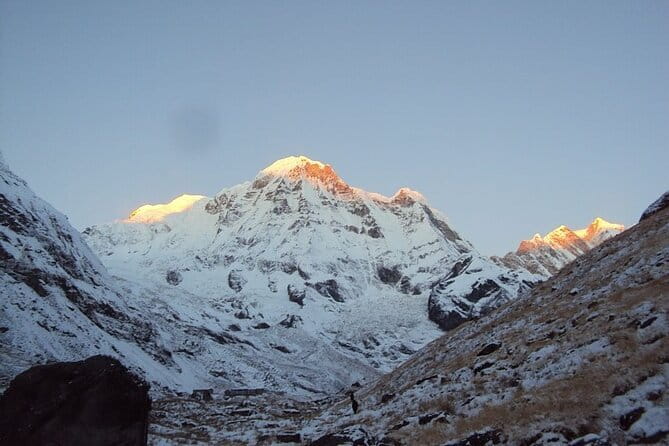
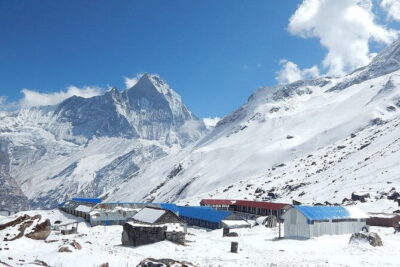
Base camp gives you the mountain setting the entire route has been building toward. The Annapurna peaks and surrounding rock walls create a powerful finish to the upward section. You have also passed through lower villages, forests, and high viewpoints, so the arrival feels earned rather than simply scenic.
Cold and weather can change the character of this day. Several accounts connected with the trek describe unexpected snow and bad weather, including a cancelled helicopter in one case. That is a reminder to keep your plans flexible and carry suitable warm clothing. The itinerary itself does not promise helicopter evacuation, so you should not treat that as a standard feature.
Days 9 and 10: Returning through Bamboo and Chomrong
Day 9 descends to Bamboo at 2,050 meters in about six hours. Descending is easier on the lungs, but it can be tough on knees and thighs. You still need proper footwear and a measured pace.
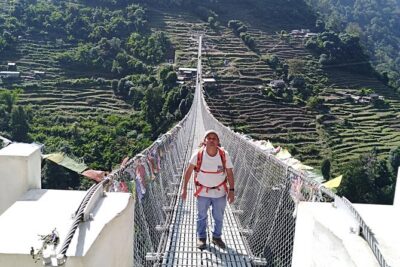
Day 10 continues to Jhinu Danda at 1,700 meters via Chomrong, with about six hours of trekking. Chomrong is one of the best-known villages on the route and gives you another look at the communities that shape the Annapurna experience. The journey is no longer about gaining height. It is about retracing the mountain corridor while noticing how different the lower elevations feel after base camp.
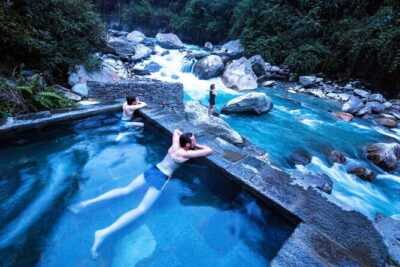
Jhinu Danda is listed as the overnight destination, but the information does not specify whether hot springs or other local activities are included. Ask before booking if those details matter to you. Do not assume every attraction associated with a destination is part of the package.
Days 11 to 14: Trailhead, Pokhara, and Kathmandu
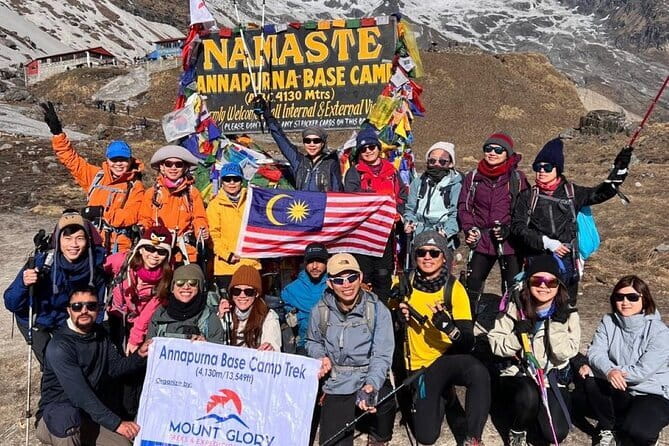
Day 11 combines trekking to Nayapul with a drive to Pokhara, listed as an eight-hour day. That is a full schedule, so you should expect a practical transfer day rather than a leisurely afternoon. The air-conditioned vehicle is useful after the final trail section.
Day 12 is the drive back to Kathmandu. Day 13 is a rest day in the capital, which is a welcome buffer after the mountain route. It also helps protect your departure plans if road travel takes longer than expected.
Day 14 is the final departure day. The activity begins and ends at the Kathmandu meeting point, listed as Kathmandu 44600, Nepal. The published operating dates run from July 17, 2019, to June 6, 2026, with Monday hours shown as 9:30 AM to 7:45 PM. Since the trek itself is a multiday private arrangement, confirm the exact pickup time for your booking rather than relying on the general opening hours.
What the $769.24 price really covers
At $769.24 per person, the price can be good value if you want a private guided trek with road transport and basic included services. The package includes breakfast, an air-conditioned vehicle, and all listed fees and taxes. It also gives you a guide and porter support through a private group arrangement, according to the supplied details.
The important catch is the food list. Lunch, dinner, snacks, bottled water, coffee, tea, and alcohol are excluded. That means the advertised price is not your final trip budget. You need money for daily meals and drinks, plus any personal gear, tips, or other expenses not stated in the package.
Accommodation is not described in the supplied information. That is one of the first things I would clarify. Ask what type of lodging is included, how many nights are covered, and whether breakfast is provided every morning or only in specific places. The same applies to permits, porter baggage limits, and emergency arrangements. The listing says all fees and taxes are included, but it does not spell out every individual permit or service.
The guide and private format
The guide can make or break a Himalayan trek. Damu is identified as the owner or guide connected with Mission Summit, and the supplied feedback repeatedly highlights his planning, punctuality, English, humor, and care. One account describes returning for a second ABC trek with him, while others mention his ability to explain each day and respond to questions.
That personal contact is especially useful when the weather changes. The trip has experienced unexpected snowfall and cancelled flights in past situations, so you want a guide who communicates clearly rather than simply following a printed schedule.
The private format is another advantage. You are not tied to a large group’s slowest or fastest walker. The data says only your group participates, though it does not state the maximum group size. Ask how many people will be in your party and how many porters will support it.
Fitness, weather, and practical preparation
The stated requirement is a moderate physical fitness level. Read that carefully. You do not need to be a mountaineer, but you do need to handle repeated walking days, steep sections, altitude, and a seven-hour schedule on more than one day.
A useful preparation list includes:
- Broken-in hiking shoes with dependable grip
- Warm layers for 4,130 meters
- Rain and snow protection
- A small daypack
- Personal snacks, since snacks are excluded
- A refillable water bottle, since bottled water is excluded
- Cash for meals and drinks not included
- Medication and personal health supplies
The route is not described as wheelchair accessible, and the moderate fitness requirement suggests that it is designed for people who can walk on uneven mountain trails. Service animals are allowed, and the meeting point is near public transportation, but neither detail changes the physical nature of the trek.
Cancellation is flexible only up to a point. You can cancel at least 24 hours before the experience start time for a full refund. Cancellations or changes made less than 24 hours before the start are not accepted for a refund, with cut-off times based on local time.
Who should book this trek?
I would recommend it to you if you want a private, guided introduction to the Annapurna region and like the idea of combining famous viewpoints with village walking. It suits people who want a substantial mountain trip but do not want a technical climb.
It is less suitable if you want a short holiday, fixed luxury standards, or an all-inclusive price. The route has long days and high altitude, while several everyday costs are left to you. You should also be comfortable with road travel and with the possibility that weather may change the plan.
Should you book the Annapurna Base Camp trek?
Book this trek if Poon Hill, Gurung villages, Machhapuchhre, and a 4,130-meter base camp sound more appealing than a tightly managed sightseeing tour. The guide support, private format, and carefully staged route are the strongest reasons to choose it.
Before paying, get written confirmation of accommodation, permits, porter arrangements, meal coverage, and the exact transport schedule. If those details match your expectations and you are prepared for the physical work, $769.24 offers a strong starting value for a two-week Annapurna adventure. If you need every meal and overnight detail included, compare the final cost rather than the headline price.
FAQ
Where does the Annapurna Base Camp trek start?
The activity starts at Kathmandu 44600, Nepal.
Where does the trek end?
The activity ends back at the Kathmandu meeting point.
How long does the experience last?
The published duration is approximately 14 days.
What is the highest point on the itinerary?
The highest listed point is Annapurna Base Camp at 4,130 meters.
Does the trek include Poon Hill?
Yes. The itinerary includes a morning hike to Poon Hill on Day 5 before continuing to Tadapani.
Is transportation included?
Yes. An air-conditioned vehicle is included. The itinerary includes drives between Kathmandu, Pokhara, Nayapul, and the trekking route.
Are meals included?
Breakfast is included. Lunch, dinner, snacks, bottled water, coffee, tea, and alcoholic drinks are not included.
Is this a private tour?
Yes. Only your group participates in the activity.
What fitness level is required?
The stated requirement is a moderate physical fitness level.
Can I cancel for a full refund?
Yes, if you cancel at least 24 hours before the experience start time. Cancellations or changes made less than 24 hours before the start are not accepted for a refund.
Just added around Kathmandu
- Everest Base Camp Trek★ 5.0 · 3 reviews
- Everest Base Camp Trek★ 5.0 · 7 reviews
- 15 Days Private Everest Base Camp Trek★ 5.0 · 30 reviews
- Everest Base Camp Trek★ 5.0 · 57 reviews
- 14 Days of Adventure Trekking to Everest Base Camp★ 5.0 · 2 reviews
- 14-Day Everest Base Camp Trek★ 5.0 · 20 reviews
- From Kathmandu: Private 14-Day Everest Base Camp Trek★ 5.0 · 20 reviews
- 14 Days Everest Base Camp Trek★ 5.0 · 4 reviews
Annapurna Base Camp Treks, compared.
Trekking in Annapurna/Langtang/Everest/Upper Mustang regions
Read our review →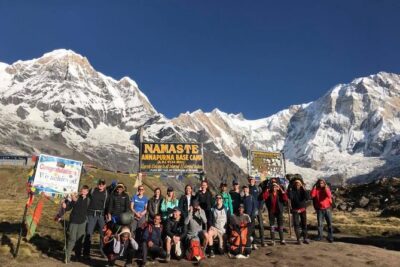
Kathmandu to Annapurna Base Camp (ABC) 5-Day Trek
Read our review →Browse the lists this trek appears in