
Review · KATHMANDU
Annapurna Base Camp Trek
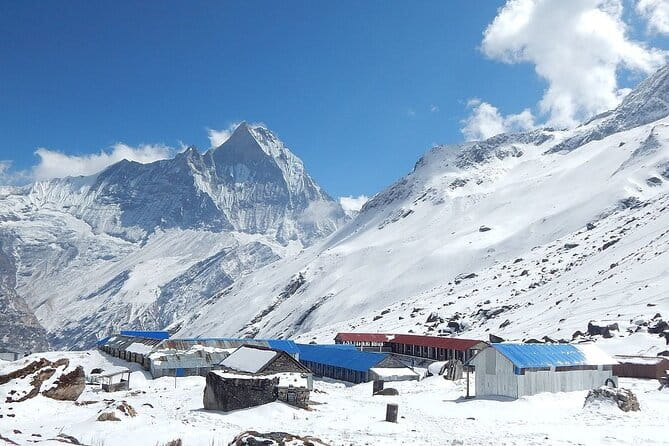
Annapurna Base Camp is the kind of trek that gives you big Himalayan scenery without requiring a major expedition setup. You walk through rhododendron forests, Gurung villages, river valleys, and high mountain country, with Poon Hill at 3,210 meters and Annapurna Base Camp as the twin highlights.
I like the small group size of 10 or fewer, which leaves room for personal help from the guide. I also like that meals, teahouses, hotels, transfers, and airport pickup are arranged. The tradeoff is real: you will hike 4 to 7 hours a day, climb and descend many stone steps, and sleep at basic teahouses in the mountains.
Key points to know before you book
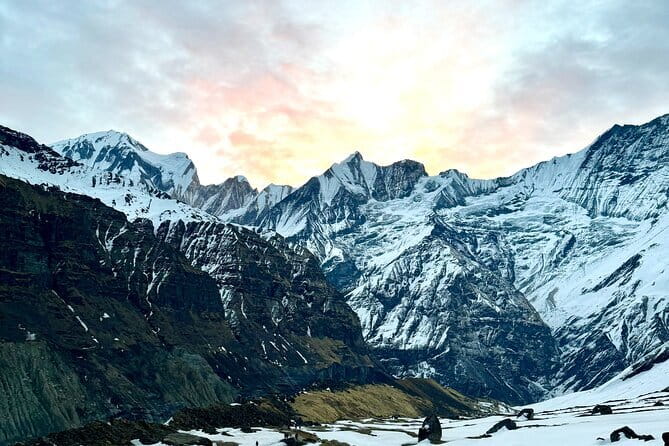
- Poon Hill adds a superb sunrise viewpoint to the route, with views toward Dhaulagiri, Machhapuchhre, and the Annapurna range.
- Annapurna Base Camp is a moderate high-altitude trek, not a casual walking holiday.
- The group is limited to 10 people, useful if you want guide support without joining a large crowd.
- Teahouse accommodation keeps the price reasonable, but mountain lodging is simple rather than luxurious.
- Meals are included during the trek, while lunch and dinner in Kathmandu and Pokhara are extra.
- Guides such as Krishna, Tulsi, Suvi, and Anil have led similar Green Valley trips, with Arjun often handling communication and planning.
Why this route works so well in 14 days
This itinerary combines three good parts of Nepal in one trip. Kathmandu gives you an introduction to the country, Pokhara provides a softer lakeside pause, and the Annapurna trail supplies the real walking challenge.
The route is also smart in another way. You do not go straight to Base Camp and back. You first climb through Ghorepani and Poon Hill, then continue toward Chhomrong and the sanctuary below Annapurna. That gives you changing scenery rather than two weeks of similar trail.
The walking days generally run from four to seven hours. That may sound manageable on paper, but the stone stairs, steep drops, altitude, and repeated climbs make the trek tiring. You need moderate physical fitness and a willingness to keep moving when the trail becomes rough.
The group limit matters here. A small group makes it easier for the guide to adjust the pace, answer questions, and notice when someone is struggling. Previous trips have included guides named Krishna, Tulsi, Suvi, and Anil, with Arjun helping coordinate arrangements. The exact guide for your departure may differ, so ask when booking if that matters to you.
More Annapurna Treks in Kathmandu
- Annapurna Circuit Trek with Tilicho Lake
★ 5.0 · 368 reviews - Annapurna base camp trek 5 Days
★ 5.0 · 252 reviews - 14-Day Private Annapurna Base Camp Trek
★ 5.0 · 180 reviews
Kathmandu arrival and the first night in Thamel
Your trip begins at Tribhuvan International Airport, where an airport representative meets you and arranges transport to the hotel. The first day is intentionally light. You can rest after the flight or visit the office for a detailed briefing.
That is useful because Kathmandu can feel hectic at first. A clear meeting with the tour team gives you a chance to confirm the walking plan, ask questions, and make sure you understand the days ahead.
Your first night is in Thamel, Kathmandu’s main tourist district. The program includes accommodation, but lunch and dinner in Kathmandu are not covered. Keep some money available for those meals, along with personal drinks and other small purchases.
The airport pickup is a practical touch, especially if you arrive tired or late. It saves you from negotiating your first ride in Nepal while carrying trekking gear.
The six-hour road to Pokhara
After breakfast on day two, you travel by tourist bus from Kathmandu to Pokhara. The road journey is about 200 kilometers and takes around six hours, with lunch along the way.
This is not a scenic train ride or a quick domestic flight. Road conditions can make the journey feel long, so bring water, snacks, and something to occupy you. The upside is that you move directly into the trekking region and avoid arranging transport yourself.
Pokhara provides a welcome change of pace. You stay overnight in a guesthouse, and the city gives you a chance to rest before the walking begins. Lunch and dinner here are not included, so you can choose your own food and budget.
The itinerary later returns you toward Kathmandu by road, with a lunch stop at Malekhu. That town is known for fish and fish products. It is a brief stop, but it breaks up the journey and gives you a small look at ordinary roadside life outside the main tourist centers.
From Nayapool to Ghorepani through forest and villages
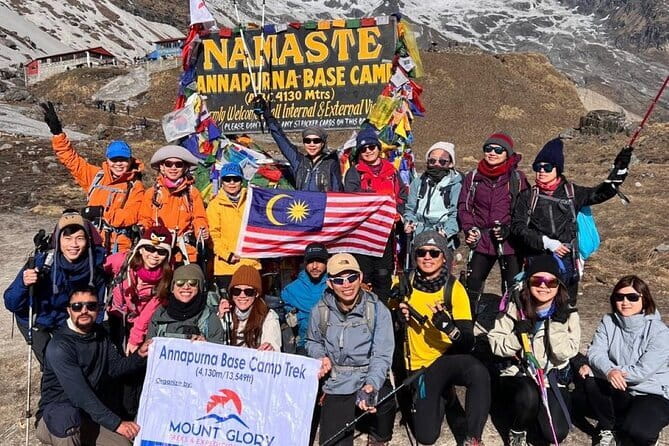
On day three, the drive from Pokhara to Nayapool takes about an hour. From there, you begin walking beside the Modi River and reach Birethani, where teahouses line the route.
This first walking stage introduces the basic rhythm of the trek. You move from road access into villages and forest, with places to stop for food and rest. The presence of teahouses means you are not carrying a full camping operation, but you still need to carry your day pack and personal essentials.
The next section takes you from Ulleri through rhododendron and oak forest toward Banthanti and Ghorepani. The trail is described as a gentler ascent after Ulleri, but do not confuse gentle with flat. The route includes stone steps, and the early mountain days can feel demanding while your legs adjust.
Ghorepani is important because it connects directly with the Poon Hill viewpoint. You sleep in a teahouse, not a city hotel, so expect a simpler room and a more basic setting. That is part of the value of this route: you stay close to the trail instead of commuting from a large town.
Same trailhead, a different route:
- Everest Base Camp Trek – 14 Days
★ 5.0 · 1,499 reviews - Everest Base Camp Trek
★ 5.0 · 842 reviews - Everest Base Camp Helicopter Tour landing at Everest View Hotel
★ 5.0 · 668 reviews - Everest Base Camp Trekking
★ 5.0 · 485 reviews
Poon Hill and the first big mountain view
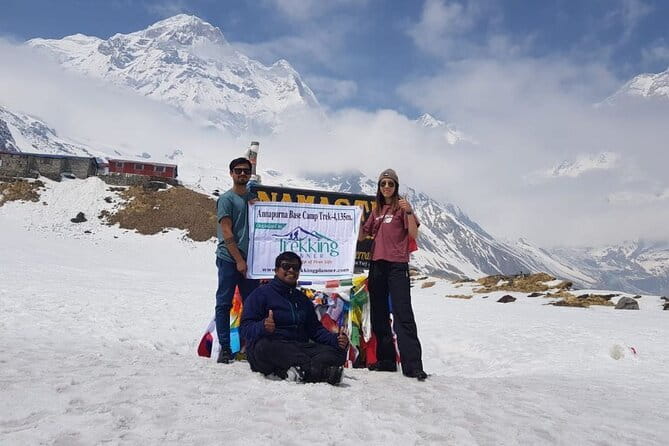
The Poon Hill walk begins early. The climb to the viewpoint takes about 45 minutes and reaches 3,210 meters. It is the best viewpoint on this part of the route and one of the most rewarding short climbs in the entire program.
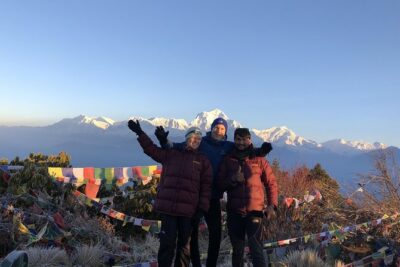
Bring warm layers and keep your camera ready. Poon Hill is known for broad views toward Dhaulagiri, Machhapuchhre, and the Annapurna peaks. The appeal is not only the height. You get a wide Himalayan panorama without spending a full day on a difficult summit trail.
After Poon Hill, you continue through the Annapurna region toward Tadapani. This section keeps the route varied, with forest, mountain villages, and changing views. Poon Hill also gives you an early taste of altitude before the route moves higher toward Base Camp.
The early start can be hard if you are not used to hiking before breakfast. Still, this is one place where the effort makes sense. I would treat Poon Hill as a required part of the trip, not an optional extra.
Tadapani, Chhomrong, and the Gurung villages
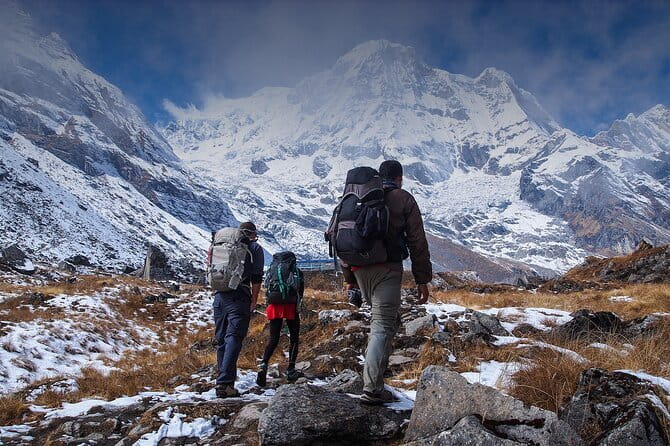
From Tadapani, the trail descends through rhododendron forest, crosses the Kimsung River, and climbs toward the Gurung village of Gurjung. From there, a direct climb brings you to Chhomrong.
Chhomrong is spread across a hillside with views toward the Annapurna peaks and Machhapuchhre. It is one of the route’s most memorable villages because the setting feels open and dramatic, while the trail still has a strong local character.
The climb into Chhomrong is a good example of why this trek is rated moderate rather than easy. You may lose height, cross a river, and then gain it again. On paper, the distance may not look extreme. On foot, the repeated up-and-down movement takes work.
The walking plan includes lunch in Chhomrong on the return route. The village also helps break up the trip into manageable sections. You are not racing from Pokhara to Base Camp in a few days, and that slower pace gives you more time to recover.
Bamboo, Dovan, and the quiet forest trail
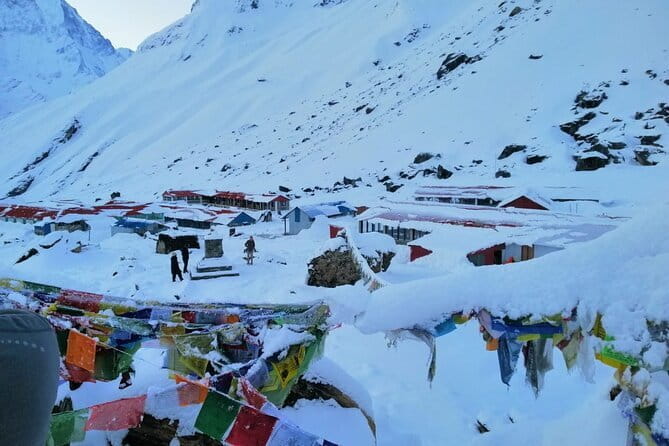
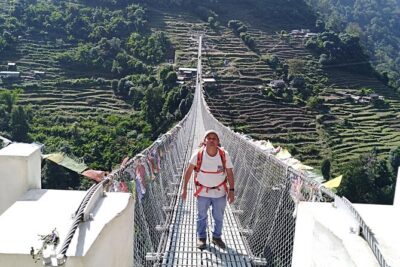
From Chhomrong, stone steps descend to the Chhomrong Khola. After crossing a suspension bridge, the trail climbs toward Sinuwa, then continues through jungle to Bamboo.
This is one of the route’s more demanding transition days because a long descent is followed by another climb. The steps are not a minor detail. They are the sort of feature that makes trekking poles useful, although poles are not listed as an included item.
From Dovan toward Himalaya, the trail becomes quieter. The route passes through bamboo forest and then rhododendron forest. Near a temple, hikers are asked not to make loud noise, which adds a calm and respectful mood to this section.
You should not expect constant mountain views here. Forest days are part of the route, and they provide shade and a change from exposed ridgelines. The trees, river crossings, stone steps, and small settlements keep the walk interesting even when the peaks are hidden.
The teahouse system also becomes more important at this stage. You are farther into the mountains, and accommodation is practical rather than polished. The benefit is that you can focus on the trail without searching for a room at the end of every day.
Machhapuchhre Base Camp and Annapurna Base Camp
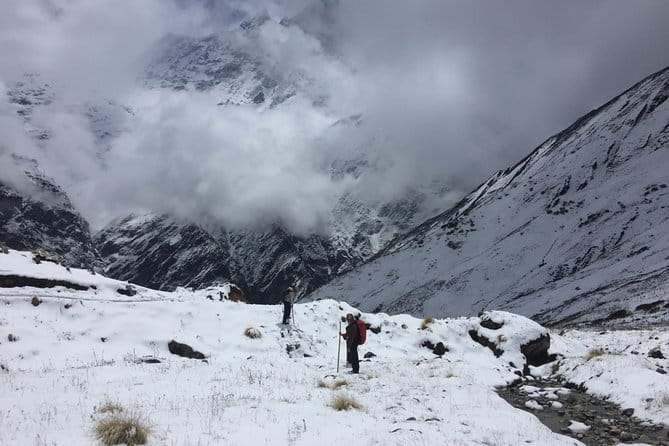
From Deurali, the trail passes through a river bed before a tiring climb to Machhapuchhre Base Camp. Here, mountains surround you on all sides, with views toward Annapurna, Machhapuchhre, Gangapurna, and Himchuli.
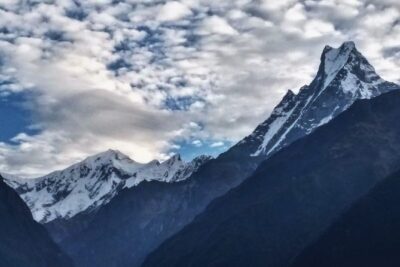
Machhapuchhre, also called Fishtail, is one of the most recognizable peaks in Nepal. Reaching its Base Camp area gives you a major visual payoff before the final approach to Annapurna Base Camp.
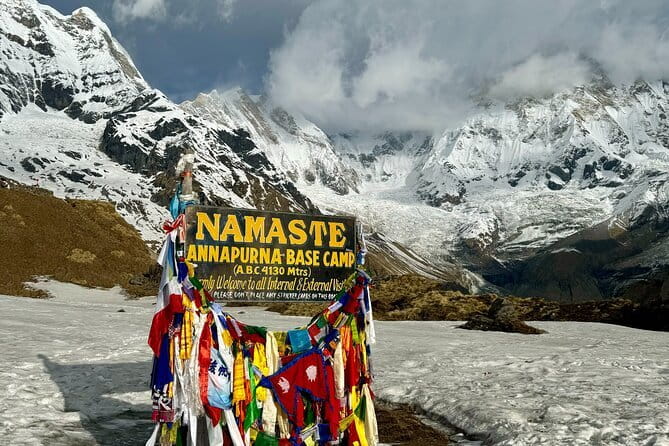
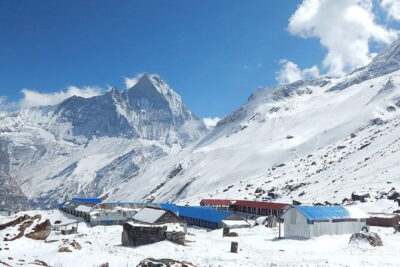
The next stage takes you into the high mountain bowl of Annapurna Base Camp. This is the emotional center of the trip. The setting feels enclosed by huge peaks rather than spread across a distant horizon, which makes the arrival especially powerful.
Altitude is the main concern here. The program calls this a moderate high-altitude trek, but moderate does not mean effortless. The route includes long walking days, cold conditions, and less oxygen than you are used to at home. Follow your guide’s advice, keep your pace steady, and tell the guide quickly if you feel unwell.
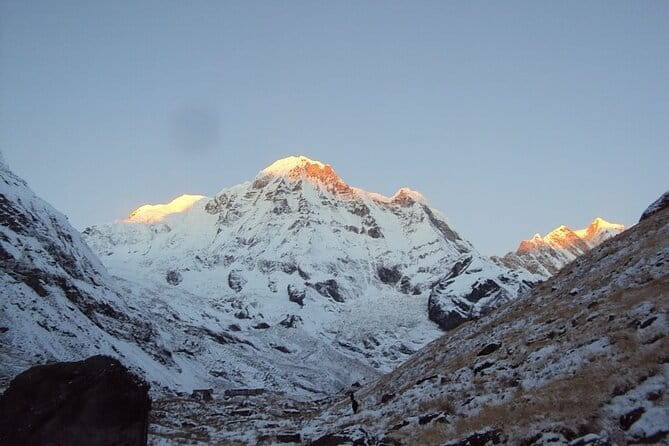
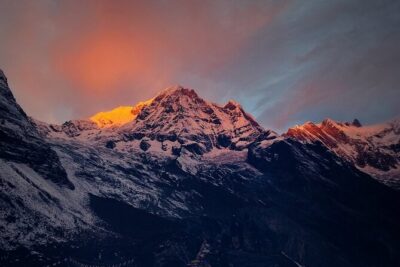
The itinerary allows you to see sunrise from Annapurna Base Camp before starting the return. That timing is valuable. Morning light can change the color and shape of the surrounding peaks, and you do not need to add a separate sightseeing day.
The long return through Sinuwa and Chhomrong
After sunrise, you retrace the trail through Machhapuchhre Base Camp, Deurali, Himalaya, and Bamboo, continuing toward Sinuwa. Much of the day is downhill, which sounds easy but can punish tired knees.
The return route uses the same trail, so you will recognize places you passed earlier. That can be comforting, but it also means the scenery is not entirely new. The reward is seeing familiar forests and valleys from a different direction and knowing that the highest section is behind you.
The following day brings you back through Chhomrong, where lunch is planned. The hillside position gives you another chance to take in views of Annapurna and Machhapuchhre before the trip moves toward the road and lower elevations.
This part of the itinerary is one reason the full 14-day plan works better for many people than a rushed Base Camp schedule. You have time to return on foot instead of trying to force a rapid exit.
Jhinu Danda and the natural hot springs
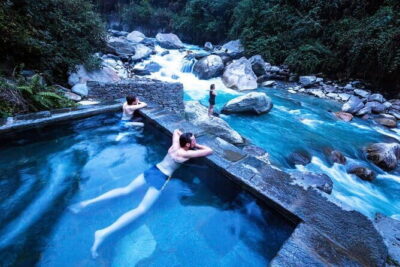
At Jhinu Danda, you can walk about 20 minutes from the hotel to natural hot spring pools beside the Modi River. After several days of climbing and descending, this is a welcome way to loosen tired muscles.
The hot springs are included as part of the route rather than treated as a separate luxury stop. Bring suitable swimwear and a small towel if you plan to use the pools, although those items are not listed as provided.
Jhinu Danda also gives the trek a gentler ending. You move away from the highest mountain sections and toward road travel, but the trip still includes a distinct local experience rather than ending abruptly at a bus stop.
What the $925 price really covers
At $925 per person, this is not simply a guide fee. The price includes accommodation, professional guiding, taxes and handling charges, round-trip shared transfers, 13 breakfasts, 10 lunches, and 10 dinners.
It also includes hotels in Kathmandu and Pokhara, teahouse accommodation on the trek, the airport meeting service, and transport between the main points. For a two-week Nepal trip, that package can offer solid value because the major arrangements are handled in advance.
You still need to budget for lunch and dinner in Kathmandu and Pokhara. Personal drinks, snacks, equipment, tips, and other personal expenses are not specified as included, so ask the operator for the current full packing and cost list before departure.
A small group adds value if you want close guide support. It may be less appealing if you prefer complete independence or a private itinerary. The group maximum is 10, which is small enough for personal attention but not the same as traveling alone.
Who should book this trek?
I would recommend it to an active person who wants a serious Himalayan walk but does not want to organize every hotel, transfer, meal, and trail stop alone. It suits someone comfortable with four to seven hours of hiking per day and basic teahouse accommodation.
It is also a good choice if you want more than one headline moment. Poon Hill provides an early mountain view, Chhomrong adds village life and broad peaks, the forest sections give the route texture, and Annapurna Base Camp supplies the main goal.
I would think twice if you dislike long bus journeys, steep stairs, shared mountain logistics, or simple accommodation. This is not a sightseeing tour with occasional walks. The walking is the trip.
Past departures have been praised for careful organization and supportive guides. One useful practical detail is the flexibility shown when a participant became unwell after arrival and arranged a porter close to departure. That does not guarantee the same change for every booking, but it suggests you should speak up early if you need extra carrying help or a change in pace.
You can cancel for a full refund up to 24 hours before the start time. Within 24 hours, changes and refunds are not accepted. Poor weather may lead to a different date or a full refund, which matters in a mountain region where conditions can change.
Should you book it?
Book this Annapurna Base Camp trek if you want a well-organized route with Poon Hill, teahouse stays, mountain villages, and Base Camp in one 14-day plan. The included meals, transfers, hotels, and guide support make the $925 price reasonable for an active hiker who values simplicity.
Skip it if you want luxury, private transport throughout, or short walks. For the right person, this is a practical way to see a great section of the Himalaya while still leaving room for real effort, quiet forest trails, and memorable mornings above the clouds.
FAQ
How long is the Annapurna Base Camp trek?
The full experience lasts approximately 14 days, including arrival in Kathmandu, the journey to Pokhara, the trek, the return journey, and the final stop near Pashupatinath Temple.
What is the maximum group size?
The group has a maximum of 10 people. A professional guide accompanies the group.
How many hours do I walk each day?
The trek involves approximately 4 to 7 hours of walking each day. A moderate level of physical fitness is required.
Are meals included?
Breakfast is included throughout the itinerary, along with 10 lunches and 10 dinners. Lunch and dinner in Kathmandu and Pokhara are not included.
Where do I sleep during the trip?
Accommodation includes hotels in Kathmandu and Pokhara and teahouses during the mountain trek.
Is airport pickup provided?
Yes. An airport representative meets you at Tribhuvan International Airport in Kathmandu, and transport to the hotel is arranged.
Can I cancel for a full refund?
You can cancel at least 24 hours before the experience start time for a full refund. Cancellations or changes made within 24 hours are not refunded. If poor weather causes the experience to be canceled, you will be offered another date or a full refund.
Just added around Kathmandu
- Everest Base Camp Trek★ 5.0 · 3 reviews
- Everest Base Camp Trek★ 5.0 · 7 reviews
- 15 Days Private Everest Base Camp Trek★ 5.0 · 30 reviews
- Everest Base Camp Trek★ 5.0 · 57 reviews
- 14 Days of Adventure Trekking to Everest Base Camp★ 5.0 · 2 reviews
- 14-Day Everest Base Camp Trek★ 5.0 · 20 reviews
- From Kathmandu: Private 14-Day Everest Base Camp Trek★ 5.0 · 20 reviews
- 14 Days Everest Base Camp Trek★ 5.0 · 4 reviews
Annapurna Base Camp Treks, compared.
Trekking in Annapurna/Langtang/Everest/Upper Mustang regions
Read our review →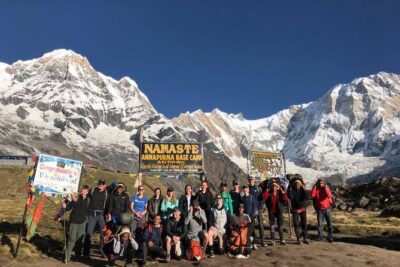
Kathmandu to Annapurna Base Camp (ABC) 5-Day Trek
Read our review →Browse the lists this trek appears in