
Review · KATHMANDU
Annapurna base camp trek
The Annapurna Base Camp trek gives you a lot of Nepal in one trip: sunrise at Poon Hill, traditional villages, high mountain views, hot springs, and a final walk into a great natural amphitheater at 4,130 meters. It is not a gentle sightseeing holiday, but the route offers a satisfying mix of culture and scenery.
I especially like the two-part route. You begin with the famous Poon Hill climb, then continue into the high Himalaya toward Machhapuchhre Base Camp and Annapurna Base Camp. I also like the chance to slow down in Pokhara, where lakes, caves, restaurants, museums, paragliding, and other activities give you breathing room before or after the trek.
The main caution is physical effort. You’ll walk about five to six hours on many trekking days, with a moderate fitness requirement and substantial altitude gain. October can be busy, winter can be cold, and the package information leaves some day-by-day details open, so ask for the exact itinerary before paying.
Key points at a glance
- Poon Hill at 3,210 meters: Begin the mountain section with a sunrise or sunset view across the Annapurna and Dhaulagiri ranges.
- Annapurna Base Camp at 4,130 meters: The high point of the walk sits among some of Nepal’s most famous peaks.
- Machhapuchhre Base Camp: A memorable bonus stop beneath the distinctive fishtail-shaped Machhapuchhre.
- Gurung and Magar villages: See traditional housing, local food, and Hindu and Buddhist customs along the route.
- Jhinu hot springs: Use the natural hot water to ease tired legs on the return journey.
- Small-group format: The maximum group size is 15, with a guide, driver, accommodation, breakfast, entrance fees, and hotel transfers included.
Why this trek works so well in Nepal
The Annapurna Base Camp route is a strong choice if you want a classic Himalayan walk without committing to a very long expedition. You start near Pokhara, rather than spending the entire trip on a remote mountain road, and the route brings together several distinct settings.
The lower section passes through villages and forest. Rhododendrons, figs, bamboo, juniper, and other plants line parts of the trail. Higher up, the trees thin out and the views open toward Machhapuchhre, Dhaulagiri, Annapurna, Neelgiri, and Himchuli.
That change is part of the appeal. You are not simply walking toward one viewpoint. You move from cultivated hillsides and village paths into a colder, more rugged mountain zone, with the scenery changing as your altitude increases.
The cultural side matters just as much. Gurung and Magar communities live along parts of the route, and the trip introduces you to homes, food, hospitality, and religious customs shaped by both Hindu and Buddhist traditions. You should treat village life as more than scenery. Walk quietly, ask before taking close-up photographs, and dress with respect.
More Annapurna Treks in Kathmandu
- Annapurna Circuit Trek with Tilicho Lake
★ 5.0 · 368 reviews - Annapurna base camp trek 5 Days
★ 5.0 · 252 reviews - 14-Day Private Annapurna Base Camp Trek
★ 5.0 · 180 reviews
Kathmandu to Pokhara: starting with a softer landing
The meeting point is the parking area at the domestic terminal of Tribhuvan International Airport in Kathmandu. From there, the trip begins with transport toward Pokhara, Nepal’s well-known lake city.
Pokhara is more than a transfer stop. You can visit lakes, caves, eateries, bars, museums, and paragliding areas. The city also offers activities such as hot-air ballooning, paragliding, and a zip flyer, although these are not listed as included parts of the trek.
I like having Pokhara at the front end of a demanding walk. You can enjoy a more relaxed setting before heading into the hills, and the city gives you a chance to see a different side of Nepal. If you are adding extra nights, Pokhara is the natural place to do it.
The package includes hotel pickup and drop-off, but the exact hotel arrangements should be confirmed in advance. Accommodation is included according to the itinerary, while the supplied details do not specify the names or standard of each property.
Nayapul and the first village paths
The walking section formally begins at Nayapul, about a two-hour drive from Pokhara. This is where the route leaves the city behind and enters the hill country.
The early section introduces you to the daily rhythm of a Himalayan trek. Expect walking through green forest and village country rather than immediate high mountain drama. The route includes colorful rhododendrons, bamboo, figs, and juniper, with views opening and closing as the trail rises and bends through the hills.
This is also where you begin to appreciate the practical side of a guided trek. A guide can help with the route, local customs, meals, accommodation, and the pace of the group. The operator limits the group to 15 people, which is small enough for personal attention but large enough that you should not expect a private walk.
The package includes a driver and guide, but no guide names are provided. If you care about language ability, guiding experience, or a particular group arrangement, ask those questions before booking.
Poon Hill at 3,210 meters
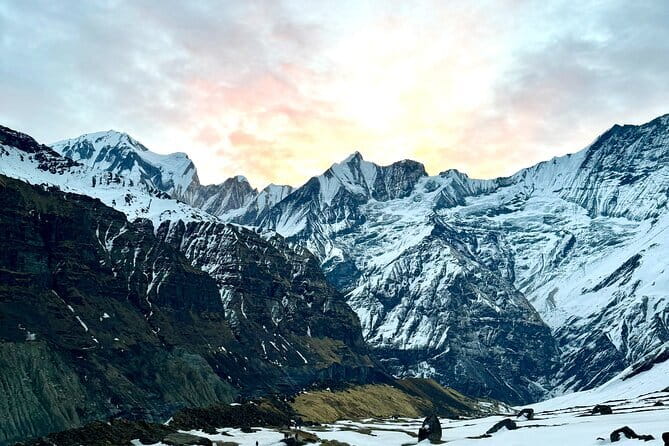
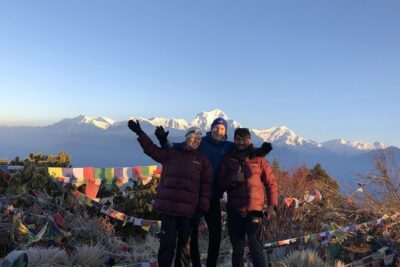
Poon Hill is the first major target and one of the most rewarding viewpoints on the route. The climb takes you to 3,210 meters, where the Annapurna and Dhaulagiri Massifs form the main display.
The most famous visit is at sunrise. The light changes quickly across the peaks, so the appeal is not just the mountain outline. You watch the ranges shift from shadow to warm morning color, often with a wide view over the surrounding hills.
The route description also refers to sunset views, so your exact experience depends on the schedule and overnight stops. Either way, Poon Hill gives you an important early taste of altitude before the trail moves higher.
This section is not a free extra. It adds effort to the itinerary, but that effort pays off with a major viewpoint before you reach base camp. It also breaks the trek into a useful first phase. You are not asked to reach the highest point immediately.
Same trailhead, a different route:
- Everest Base Camp Trek – 14 Days
★ 5.0 · 1,499 reviews - Everest Base Camp Trek
★ 5.0 · 842 reviews - Everest Base Camp Helicopter Tour landing at Everest View Hotel
★ 5.0 · 668 reviews - Everest Base Camp Trekking
★ 5.0 · 485 reviews
Through rhododendron forests and community villages
After Poon Hill, the route continues toward the higher Himalayan belt. Forest remains an important part of the walk for a time, and the plant life gives the trail a softer feel than the exposed high sections later on.
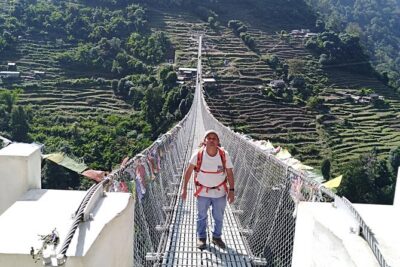
The villages are one of the best reasons to choose this trek over a route focused only on mountain views. Gurung, Ghale, and Magar culture appears through local buildings, food, and hospitality. The housing style is described as distinctive, so pay attention to how homes are built and arranged rather than rushing through with your camera pointed only at the peaks.
The trip also gives you contact with communities of Tibetan origin as you move farther north. That shift in culture and setting adds depth to the route. You see how mountain communities live in places where weather, altitude, and access shape everyday life.
Accommodation and breakfast are included according to the itinerary. Food and drinks beyond the included breakfast are not covered, so budget for meals and other purchases along the way. Alcoholic drinks are available to buy, and the minimum drinking age is 18.
The high route to Machhapuchhre Base Camp
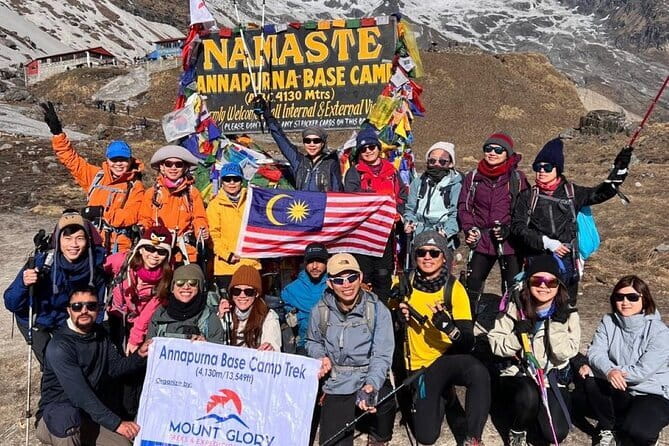
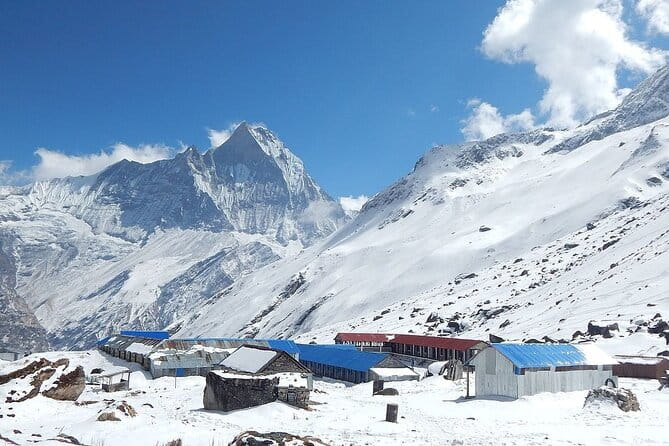
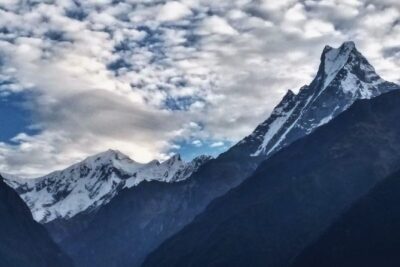
As the trail climbs, the focus turns from forest and village life to the major peaks. Machhapuchhre, also called Fishtail Mountain, becomes a central feature. The mountain’s sharp profile is one of the most recognizable sights in the Annapurna region.
Machhapuchhre Base Camp is a bonus within the larger route to Annapurna Base Camp. It gives you another important stop before the final destination and places you beneath a peak that has become closely linked with this part of Nepal.
You can expect the walking to feel harder here. The trip description calls the trek easy to moderate overall, but that label should not make you careless. A 4,130-meter destination, several hours of walking per day, and repeated climbs demand steady conditioning.
The stated walking time is about five to six hours per day, with some daily durations described more generally as five to twelve hours. Those figures suggest that days can vary quite a bit. Ask for the precise schedule, elevation profile, and rest arrangements, especially if you have limited mountain experience.
Annapurna Base Camp at 4,130 meters
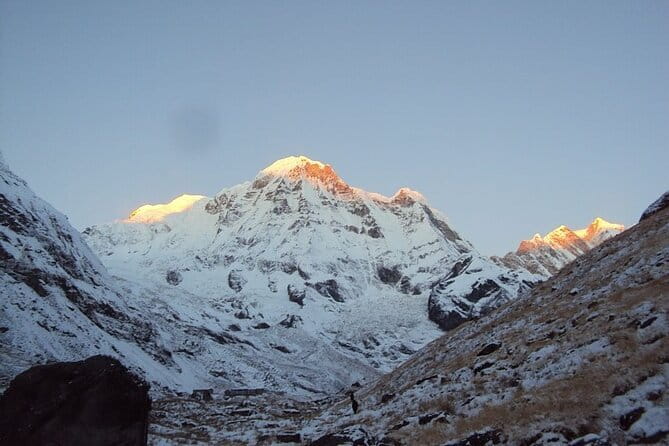
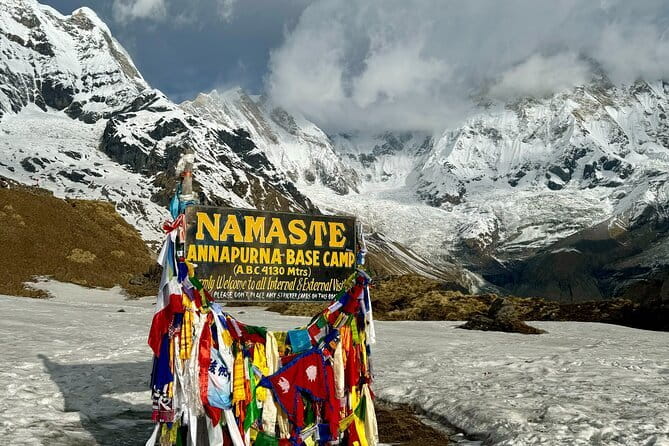
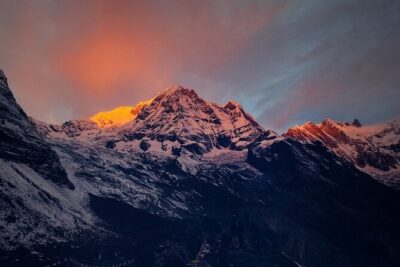
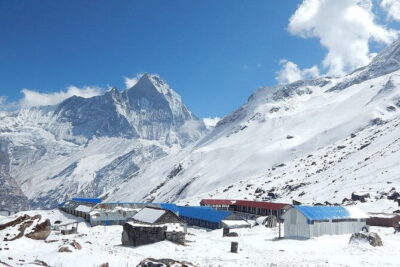
Annapurna Base Camp is the goal, and it earns its place at the end of the route. You arrive at 4,130 meters, surrounded by the Annapurna range and nearby peaks including Machhapuchhre and Himchuli.
The setting gives you a close view of the mountains rather than a distant panorama from a lower hill. Take your time with photographs, but do not let the camera replace the experience. The surrounding peaks, changing light, and sense of enclosure are the main reward.
Altitude is the serious point here. The information provided does not state a detailed acclimatization plan or medical support arrangement. You should ask how the operator handles altitude problems, what happens if someone needs to stop, and how the group pace is managed.
A moderate level of fitness is required, and the route involves a moderate amount of walking. The fact that a 12-year-old and a 14-year-old completed the trek in one family group shows that age alone does not decide suitability. Fitness, preparation, and the ability to handle long walking days matter more.
The return through Jhinu’s hot springs
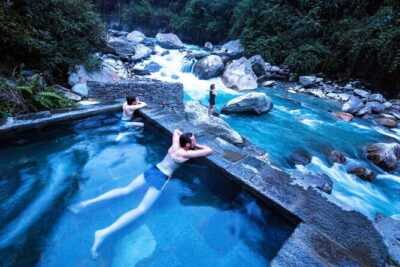
The return route includes the natural hot springs near Jhinu. This is a well-timed feature after the high section. Warm water can feel especially welcome after days of climbing and descending.
Do not think of the hot springs as a substitute for proper recovery. You will still need rest, food, water, and sensible pacing. But the stop gives the return journey its own reward instead of making it feel like a simple retreat from base camp.
The descent also lets you notice details that were easy to miss on the way up. Forest, homes, terraces, and village paths feel different when you are no longer focused on reaching the high point.
What $999 includes, and what it does not
At $999 per person, the price has to be judged against what is bundled into a roughly 15-day experience. The package includes accommodation, entrance fees, breakfast, a driver and guide, hotel pickup, and hotel drop-off. Those inclusions reduce the amount of planning you need to do yourself.
The value is strongest if you want organized transport and support rather than arranging each piece separately. A guide and driver are particularly useful for the transfer between Kathmandu, Pokhara, and the trailhead, while accommodation and breakfast simplify the trekking days.
You still need to budget for food and drinks beyond breakfast. Alcohol is extra, and activities in Pokhara such as paragliding, hot-air ballooning, and the zip flyer are also not stated as included.
The price does not tell you enough about the room standard, porter arrangements, permits, or exact transport schedule. Entrance fees are included, but the supplied details do not spell out every permit by name. Confirm these points before booking so you can compare the package fairly with other Annapurna routes.
Group size, fitness, and practical limits
A maximum of 15 people keeps the group from becoming unwieldy, but your experience will still depend on the pace and ability of the others. Ask how the guide handles different walking speeds and what happens if someone cannot continue on a planned day.
You should prepare for a moderate physical challenge. The route combines hills, stairs, forest paths, village tracks, and high-altitude walking. The information does not give a training plan, so regular walking with sustained uphill sections is the sensible preparation.
Pack clothing that can handle changing conditions. The supplied guidance specifically requires covered knees and shoulders in places of worship and selected museums. Shorts and sleeveless tops may lead to refused entry, so keep respectful clothing available for Kathmandu, Pokhara, and cultural stops.
The experience is offered with a mobile ticket and confirmation is received at booking. The activity begins and ends at the stated Kathmandu meeting point, although the package also includes hotel pickup and drop-off. Confirm the exact pickup procedure because the meeting point and hotel transfer details may serve different parts of the trip.
Best seasons and the question of crowds
October can be a popular month on the route, so you should be prepared to share the trail with many other walkers. That can mean a social atmosphere, but it may also make the main viewpoints and accommodation feel busier.
Winter offers a different tradeoff. The mountains may still be impressive, but cold conditions can make the trek uncomfortable, especially for anyone who dislikes low temperatures. Bring proper layers and ask what the operator recommends for winter departures.
The supplied information does not name a single best travel month or promise a fixed weather pattern. Flexibility is the safest approach. Mountain conditions can affect timing, views, and the precise feel of each day.
Who should book this Annapurna trek
I would point this trip toward you if you want a guided Himalayan route with a clear high point, meaningful village contact, and time in Pokhara. It suits someone who likes active travel but does not want to organize every transfer, room, and trail detail alone.
It can also work for fit teenagers and families, based on the family experience described, but you should judge your own group honestly. Long walking days and altitude are real demands, even when the route is called easy to moderate.
I would hesitate if you want luxury accommodation, a short walk, or a tightly specified day-by-day program. The package leaves several practical details open, and you should get those answers before committing.
Free cancellation is available if you cancel at least 24 hours before the experience start time. Cancellations or changes made inside that window are not accepted for a refund.
Should you book it?
Book this trek if you want the classic Annapurna combination: Poon Hill sunrise, high mountain views, village culture, Machhapuchhre Base Camp, Annapurna Base Camp, and Jhinu hot springs in one organized journey.
The strongest reasons to go are the variety of the route and the support included in the price. The main reasons to pause are the altitude, long walking days, extra costs for food and activities, and the lack of detail about the exact daily plan.
Before booking, ask for the full itinerary, accommodation standards, guide arrangements, permits, porter details, altitude procedure, and the exact meaning of the 15-day schedule. If those answers suit you, $999 can be a practical way to tackle one of Nepal’s best-known treks without building the whole trip from scratch.
FAQ
How long is the Annapurna Base Camp trek?
The experience lasts approximately 15 days. The supplied information also refers to shorter seven-day and longer 14-day trekking itineraries, so confirm the exact schedule attached to your booking.
What is the highest point of the trek?
Annapurna Base Camp is the highest stated point, at 4,130 meters.
Where does the walking begin?
The walking formally begins at Nayapul, about a two-hour drive from Pokhara.
Where does the experience start and end?
The stated meeting point is the TIA Domestic Terminal parking lot in Kathmandu. The activity ends back at the meeting point.
Is Pokhara part of the experience?
Yes. The trip begins with a visit to Pokhara, and the route from Kathmandu includes transport toward this lake city.
What is included in the price?
Accommodation according to the itinerary, entrance fees, breakfast, a driver and guide, hotel pickup, and hotel drop-off are included.
Are meals included?
Breakfast is included. Other food and drinks are not included. Alcoholic drinks are available to purchase, with an 18-year minimum drinking age.
How fit do I need to be?
You should have a moderate level of physical fitness. The trek involves a moderate amount of walking, with many walking days lasting about five to six hours.
Is the trek suitable for children or teenagers?
The supplied information describes a family completing the trek with children aged 12 and 14. You should still assess your own child’s fitness and ability to handle long walking days and altitude.
What is the maximum group size?
The maximum group size is 15 people.
Is cancellation free?
You can cancel for a full refund up to 24 hours before the experience start time. Cancellations and changes made less than 24 hours in advance are not accepted for a refund.
Just added around Kathmandu
- Everest Base Camp Trek★ 5.0 · 3 reviews
- Everest Base Camp Trek★ 5.0 · 7 reviews
- 15 Days Private Everest Base Camp Trek★ 5.0 · 30 reviews
- Everest Base Camp Trek★ 5.0 · 57 reviews
- 14 Days of Adventure Trekking to Everest Base Camp★ 5.0 · 2 reviews
- 14-Day Everest Base Camp Trek★ 5.0 · 20 reviews
- From Kathmandu: Private 14-Day Everest Base Camp Trek★ 5.0 · 20 reviews
- 14 Days Everest Base Camp Trek★ 5.0 · 4 reviews
Annapurna Base Camp Treks, compared.
Trekking in Annapurna/Langtang/Everest/Upper Mustang regions
Read our review →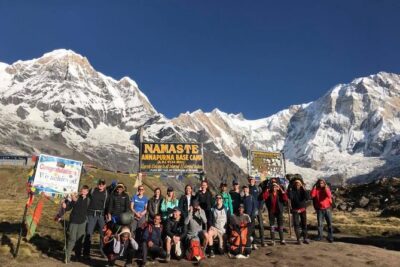
Kathmandu to Annapurna Base Camp (ABC) 5-Day Trek
Read our review →Browse the lists this trek appears in