
Review · KATHMANDU
Annapurna Tilicho Lake Trek
The main prize here is a two-part Himalayan trek: Tilicho Lake, high in the Manang district, followed by the famous crossing of Thorong La at 5,416 meters. You also get the sunrise walk to Poon Hill, so this trip packs several of Nepal’s best mountain experiences into one long route.
I like the steady change in scenery, from river gorges and oak forest to dry high-altitude valleys. I also like the built-in acclimatization day in Manang, plus practical support from an English-speaking licensed guide, porters, permits, a sleeping bag, and a down jacket. The catch is that this is a demanding trip, not a soft-focus mountain holiday. Meals on the trek, hot showers, Wi-Fi, insurance, and personal gear cost extra, and several days run for six to eight hours.
The essential points before you book
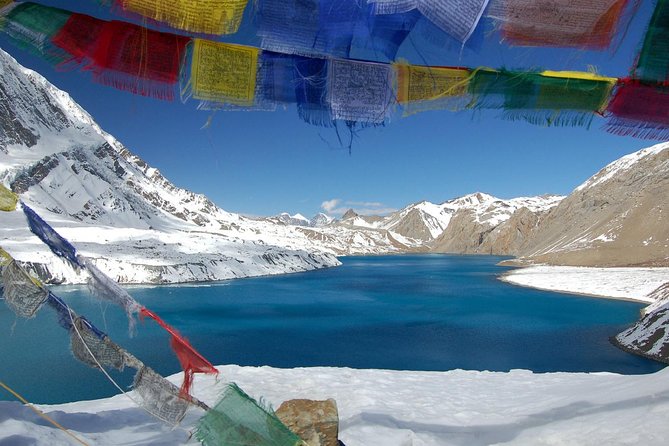
- Tilicho Lake adds a high, rugged side trip to the classic Annapurna Circuit route.
- Thorong La reaches 5,416 meters, making altitude the main physical concern.
- Poon Hill supplies a shorter, gentler finale with sunrise views of Annapurna and Dhaulagiri.
- The package supports groups of up to 12, with one porter for every two trekkers and an assistant guide for every four.
- $1,430 covers important trekking services, but not most food, insurance, drinks, or personal equipment.
- Manang acclimatization is not spare time. It is an important safety stop before Tilicho Lake and Thorong La.
What the $1,430 price really covers
At $1,430 per person, this is not an all-inclusive Nepal holiday. It is a supported trekking package, and the value depends on how much of the organizing you want someone else to handle.
The price includes an experienced English-speaking, government-licensed trek leader and assistant trek leader. Staffing is set at one assistant guide for every four trekkers and one porter for every two. That matters on a route with long walking days and high passes, since you can carry a smaller daypack rather than hauling every item yourself.
The operator also covers ACAP and TIMS permits, local and government taxes, staff pay, staff insurance, food, accommodation, and equipment. You receive a down jacket, sleeping bag, trekking bag or duffel, T-shirt, and trekking map. The jacket and sleeping bag are returned after the trip, while the bag, T-shirt, and map are yours to keep.
Two nights with breakfast at a deluxe Kathmandu Suite Home Hotel and one night with breakfast at a deluxe Mount View hotel in Pokhara are included. The package also covers transport from Kathmandu to Syange, a private transfer from Nayapul to Pokhara, and the tourist bus from Pokhara back to Kathmandu.
Read the food details carefully. Only three breakfasts are clearly included in the package description. Breakfast, lunch, and dinner during the trek are listed as excluded, along with cold drinks, hot showers, Wi-Fi, insurance, tips, and personal trekking equipment. Nepal’s entry visa is also separate, listed at $40 for a 30-day multiple-entry visa or $100 for 90 days, with passport photos required.
The price is reasonable for someone who wants permits, porters, airport transfers, equipment, and a managed route arranged in advance. It is less attractive if you already own trekking gear, prefer to arrange lodges and transport yourself, or expect meals to be covered.
More Annapurna Treks in Kathmandu
- Annapurna Circuit Trek with Tilicho Lake
★ 5.0 · 368 reviews - Annapurna base camp trek 5 Days
★ 5.0 · 252 reviews - 14-Day Private Annapurna Base Camp Trek
★ 5.0 · 180 reviews
Kathmandu to Syange: a long road into the mountains
Your first day is simple. A representative meets you at Kathmandu airport, holding an Accessible Adventure sign and your name, then takes you to your hotel in a private vehicle. The transfer takes about 30 minutes.
Day two is much longer. After breakfast, you leave Kathmandu and follow the Prithivi Highway beside the Trishuli River. The road passes hillsides, streams, small settlements, and green valleys before reaching Besisahar, the Lamjung district headquarters.
From there, you change to a local jeep for the rougher ride to Syange. The whole transfer takes about eight hours. This is not a sightseeing drive in the polished sense, but it gets you closer to the walking route without spending an extra day on foot.
The first night’s setting is modest Syange, known for waterfalls nearby. If you dislike long, winding road transfers, this will be one of the less pleasant parts of the trip. The payoff is starting the trek farther along the circuit.
Syange to Manang, with forest, waterfalls, and changing scenery
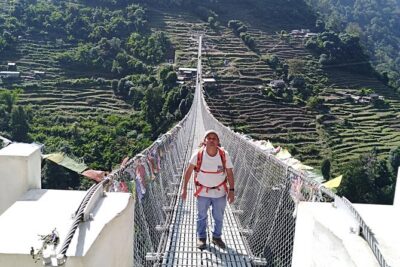
The walking begins with a six to seven-hour day toward Dharapani. You climb and descend through oak forest, cross suspension bridges, and pass through the narrow Marshyangdi gorge. Waterfalls become a regular feature, and the village of Tal sits below a large cascade at about 1,700 meters.
You cross the Marshyangdi several times before reaching Dharapani. Along the way, you pass mani stones and walls. Local custom asks you to walk on the left side of mani walls, a small point that shows why a local guide adds value beyond route-finding.
The next day to Chame is gentler in feel, though still around six hours. At Bagarchap, you begin to see Annapurna II. From Temang, look back toward the Manaslu range. Pine and fir replace the lower forest, and apple orchards appear near Thanchok.
The route passes Koto before reaching Chame, the administrative center of Manang district. This section gives you a useful sense of the trek’s changing plant life and mountain culture without yet demanding extreme altitude.
From Chame to Pisang, the trail runs through blue pine and fir forest beside the river. Brathang has an interesting past as a Tibetan resistance camp, though today it is mainly known for its apple orchard and tea houses. The path briefly clings to a cliff, then crosses a bridge with a striking view of Mui Tscho, also called Paunde Danda, rising about 1,500 meters above the valley floor.
After a steep forest climb, the setting changes quickly. Upper Manang becomes drier and more open, with broad views and fewer trees. The route reaches Pisang after about six hours.
The upper Manang valley and a useful acclimatization day
Pisang to Manang takes about five hours, but the route choice matters. The southern trail through Hongde is easier. The northern route through upper Pisang, Ghyaru, and Ngawal climbs more but gives better views.
The northern path passes villages perched above the river, with stone houses and a drier Tibetan-style setting. If your legs are feeling good, this is the more rewarding option. If the previous days have taken a toll, ask about the lower route. A strong itinerary should allow the guide to make that call sensibly.
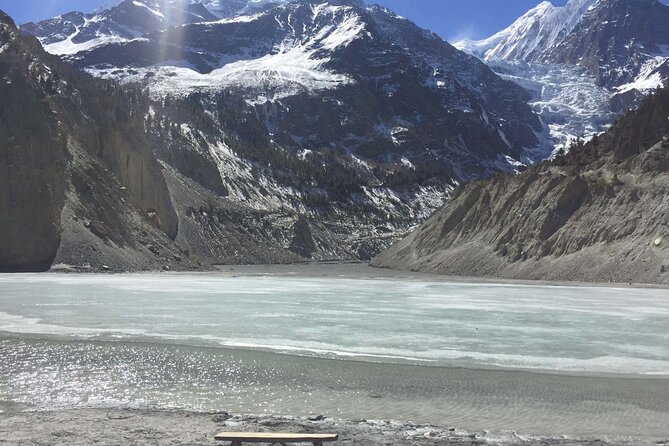
Manang receives a full acclimatization day. You are encouraged to stay active rather than spend the day in bed, with short walks to higher ground. Gangapurna Lake and Bodzo Gompa are suggested outings. The village also has a Himalayan Rescue Association presence during trekking seasons, with volunteer Western doctors working there.
I consider this stop one of the trip’s most important features. The following days bring a quick gain in altitude, and Manang gives you time to watch for headaches, unusual tiredness, or other signs that your body is not adjusting well. Do not treat the rest day as an optional luxury.
Same trailhead, a different route:
- Everest Base Camp Trek – 14 Days
★ 5.0 · 1,499 reviews - Everest Base Camp Trek
★ 5.0 · 842 reviews - Everest Base Camp Helicopter Tour landing at Everest View Hotel
★ 5.0 · 668 reviews - Everest Base Camp Trekking
★ 5.0 · 485 reviews
The Tilicho Lake side trip brings the hardest terrain
From Manang, the route leaves the main valley and heads west toward Khangsar. You cross the river and follow the southern side through conifer forest. One section crosses a steep, exposed scree slope, and the approach to Khangsar includes a climb from the Kangsar Khola bridge.
The next day, you continue toward Tilicho Base Camp for about seven hours. A newer path is preferred over the older route. The old trail crosses very steep scree, while the newer route climbs to a high crest before dropping by switchbacks into a side valley.
This is the kind of day where good boots, trekking poles, and patient pacing matter. The terrain is not difficult because of technical climbing, but loose rock and steep slopes can make every step tiring. At the bottom of the side valley, you reach Tilicho Base Camp.
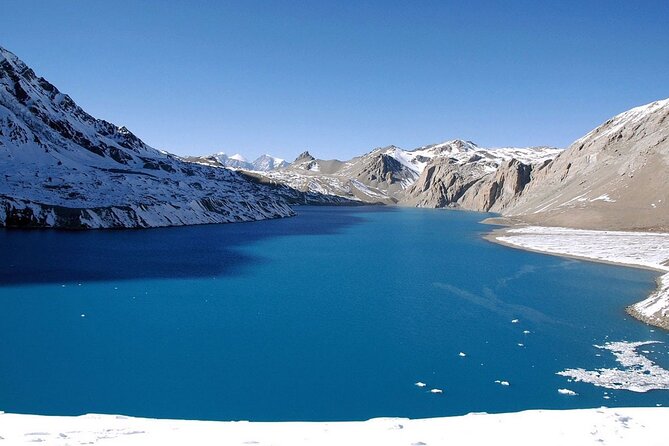
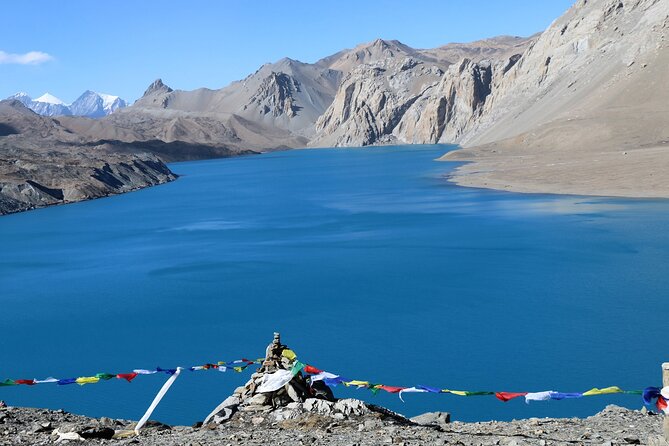
The following day is the big objective: Tilicho Lake. The path climbs steeply over loose scree and boulders, then reaches the lake. It is promoted as the world’s highest lake, and its high setting is the reason this side trip is so popular.
The route description includes a glacier section without crevasses, followed by saddles and a descent into a smaller valley. Conditions can make this a long and tiring day, so you should expect roughly seven hours and avoid racing to the lake. The visit is about the high mountain setting and the achievement of getting there, not a relaxed lakeside stroll.
Afterward, you return toward Kangsar and continue to Yak Kharka. The trail passes old mani walls, meadows, a river, and a small wooden bridge. The six-hour day is designed around a gradual ascent, which is exactly what you want after Tilicho Lake.
Thorong La is the trip’s serious test
From Yak Kharka, you walk about three to four hours to Thorong Phedi. This is a basic, busy settlement serving trekkers who are preparing to cross the pass. Some people push on to High Camp, but the route plan recommends sleeping at Thorong Phedi instead.
That choice is sensible. High Camp can shorten the next day, but sleeping higher brings more altitude stress. Staying at Thorong Phedi gives you a better chance of resting before the hardest day.
The crossing to Muktinath begins early. You climb past false summits and steadily higher slopes before reaching Thorong La at 5,416 meters. The walking time is listed at about six hours, though your pace, weather, and rest stops will affect the day.
This is the point where fitness and attitude matter most. The advice is simple: walk slowly, drink regularly, follow your guide’s instructions, and do not hide symptoms. Thorong La is not just a scenic viewpoint. It is a high pass that demands respect.
The descent to Muktinath brings a strong change in mood. Muktinath is a major sacred site, and the plan includes an early visit before breakfast. You then descend steeply toward Ekle Bhatti, where trekking poles are useful. The trail continues to Jomsom, a notably windy place in the valley.
A face mask and wind-stopper jacket are recommended for Jomsom. Afternoon winds can be strong, so keep your outer layer accessible rather than buried at the bottom of your bag.
Marpha, Kalopani, and the Kali Gandaki gorge
The walk from Jomsom to Marpha takes about seven hours. Marpha is known for apples, and the itinerary includes an apple-themed celebration. Local tea shops, apple brandy, tea, and coffee add a welcome change after the high pass.
From Marpha, the route follows a flatter section through Tukuche, Largung, and Kobang before reaching Kalopani. You get views toward Dhaulagiri and may see the Dhaulagiri icefall. There is also an optional visit to Tikuche Distillery, described as a local industrial stop connected with water supplies for nearby communities.
Kalopani offers views of Annapurna I before the route drops more than 1,000 meters toward Tatopani. On the way, you pass through Dana and see the Kali Gandaki gorge, described here as the deepest in the world.
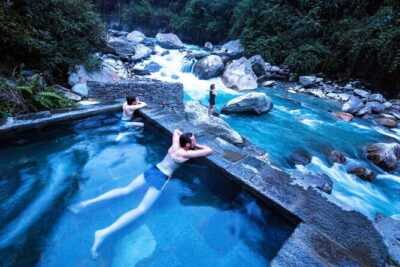
Tatopani is a welcome recovery stop. A natural hot spring gives you a chance to soak tired legs before returning to the local lodge. The day is mostly downhill and takes about five hours, but downhill walking can be hard on knees, especially after Thorong La.
Tatopani to Ghorepani, then the Poon Hill sunrise
The route changes character again as you climb from Tatopani toward Ghorepani. You rise from about 1,190 meters to 2,780 meters, crossing villages such as Ghare, Shika, Phalate, and Chhitre.
This seven-hour day passes through forest and narrow paths, with communities identified as mainly Magar and Gurung. You get mountain views along the way, but the best viewing is saved for the next morning.
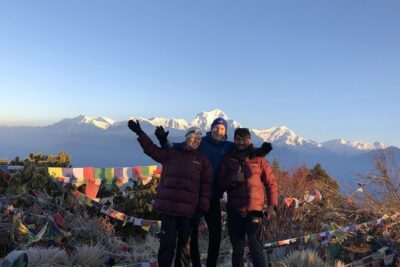
At Ghorepani, you should turn in early. The pre-sunrise walk to Poon Hill takes about 45 minutes to an hour. From the viewpoint, the sun comes up across the Annapurna range, with Dhaulagiri also part of the broad panorama.
After returning to Ghorepani for breakfast, you continue toward Nayapul through Ulleri, Tikhedhunga, and Birethanti. The full day is listed at about eight hours, so Poon Hill is not a quick add-on. It is an early start followed by a proper final trek.
A private vehicle takes you from Nayapul to Pokhara. The included Pokhara hotel night gives you a more comfortable finish after nearly three weeks of walking and road travel.
The final return to Kathmandu
On day 19, you take a tourist bus back to Kathmandu, leaving around 7:00 or 8:00 in the morning. The journey takes about seven hours and ends near the Icicles Adventure office. Staff can assist with the hotel transfer, and a farewell dinner at a cultural restaurant in Thamel is included.
Your final day is the airport transfer. You are taken from the hotel to Tribhuvan International Airport three hours before your international flight, with breakfast included.
The trip is described in places as a 17-day journey, but the full schedule is 20 days. The difference comes from the arrival day, acclimatization and rest stops, Pokhara, the return to Kathmandu, and departure. When comparing dates, treat this as a 20-day commitment.
What the support is like on the ground
The group limit is 12, small enough for a guide to keep track of people without creating a large procession. The porter ratio of two trekkers per porter is also useful, though you should still pack carefully and keep your daypack comfortable.
The local team has been described as supportive and organized, particularly when weather affected plans. Himal is specifically praised for keeping an itinerary in order, while Hari and the Accessible Adventure team are named in the company’s follow-up communication. Weather can change mountain plans, so a guide who communicates clearly is worth having.
Do not confuse organized support with a guaranteed fixed schedule. The route includes high passes, exposed slopes, local jeep roads, and weather-sensitive sections. A good guide may need to adjust timing or make a cautious decision.
Free cancellation is available up to 24 hours before the local start time. Changes or cancellations inside that window are not accepted for a refund.
Who should book this trek?
I would recommend it to you if you want one long Nepal trip that combines the Annapurna Circuit, Tilicho Lake, Thorong La, Muktinath, the Kali Gandaki valley, hot springs, and Poon Hill. It suits people with moderate physical fitness who are ready for repeated six to eight-hour walking days and basic lodge accommodation.
I would not choose it for a first mountain holiday if you dislike steep descents, rough jeep roads, cold nights, or altitude. The route is described as moderate in fitness terms, but Tilicho Lake and Thorong La make it far more demanding than a short Poon Hill trek.
At $1,430, the trip offers good value for guided logistics, porters, permits, equipment loans, airport support, and transport. You need to budget extra for trekking meals, drinks, insurance, tips, showers, Wi-Fi, visa costs, and gear. If you understand those extra costs and can handle the pace, this is a strong choice for a full Annapurna experience with two major high-altitude goals.
FAQ
How long is the Annapurna Tilicho Lake Trek?
The full schedule lasts approximately 20 days, including arrival in Kathmandu, the trek, a night in Pokhara, the return to Kathmandu, and departure. Some descriptions refer to the walking journey as 17 days.
What is the highest point on the route?
Thorong La is the highest point, at 5,416 meters. Tilicho Lake is also at high altitude and requires a demanding climb from Tilicho Base Camp.
Is food included during the trek?
Breakfast, lunch, and dinner during the trek are listed as excluded. The package does include three breakfasts, along with selected hotel breakfasts in Kathmandu and Pokhara.
Are permits and porters included?
Yes. ACAP and TIMS permits are included. Porter service is provided at a ratio of one porter for every two trekkers, and staff costs are covered.
What equipment is supplied?
A down jacket and sleeping bag are provided for the trek and must be returned afterward. A trekking bag or duffel, T-shirt, and trekking map are yours to keep. Personal trekking equipment is not included.
What is the group size?
The maximum group size is 12 people. The tour includes an English-speaking, government-licensed trek leader and assistant trek leader, with one assistant guide for every four trekkers.
Just added around Kathmandu
- Everest Base Camp Trek★ 5.0 · 3 reviews
- Everest Base Camp Trek★ 5.0 · 7 reviews
- 15 Days Private Everest Base Camp Trek★ 5.0 · 30 reviews
- Everest Base Camp Trek★ 5.0 · 57 reviews
- 14 Days of Adventure Trekking to Everest Base Camp★ 5.0 · 2 reviews
- 14-Day Everest Base Camp Trek★ 5.0 · 20 reviews
- From Kathmandu: Private 14-Day Everest Base Camp Trek★ 5.0 · 20 reviews
- 14 Days Everest Base Camp Trek★ 5.0 · 4 reviews
Annapurna Base Camp Treks, compared.
Trekking in Annapurna/Langtang/Everest/Upper Mustang regions
Read our review →
Kathmandu to Annapurna Base Camp (ABC) 5-Day Trek
Read our review →Browse the lists this trek appears in