
Review · KATHMANDU
15-Day Private Annapurna Circuit Trek from Kathmandu
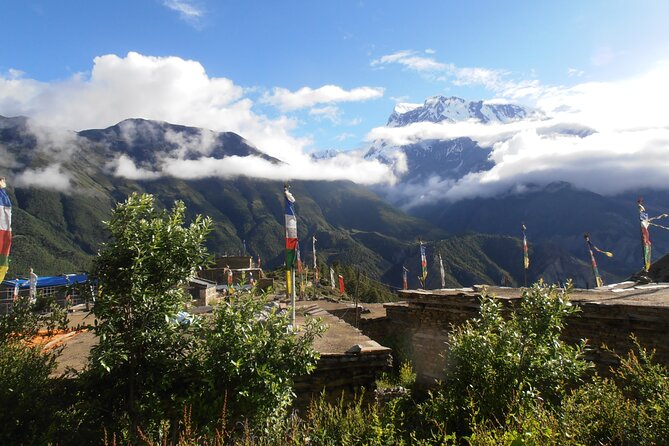
The big draw here is the full Annapurna Circuit in 15 days, including the 5,416-meter Thorong La Pass and a sunrise walk to Poon Hill. You move from river valleys and subtropical villages to dry high-country terrain, then descend through Mustang, hot springs, rhododendron forests, and Pokhara.
I like the practical package: meals, permits, transport, airport transfers, and a private guide are included. I also like the family-run touch, including help with simple Nepali language during the trip. The main caution is the pace. Several days are listed at about 12 hours, and the itinerary contains a few unclear place names and route changes that you should confirm before paying.
Key points to know before booking
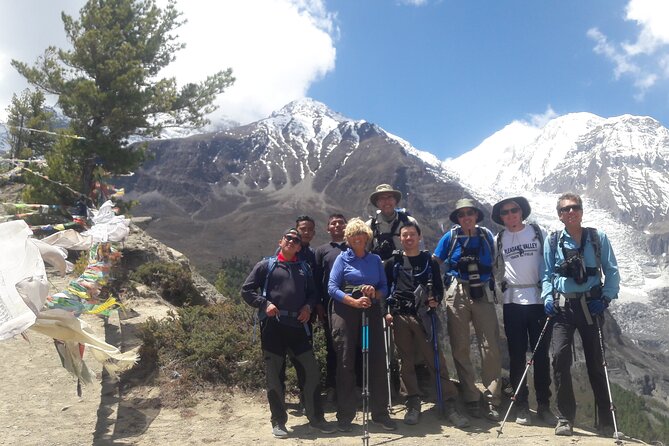
- Thorong La at 5,416 meters is the physical centerpiece, with an acclimatization day in Manang.
- Poon Hill sunrise adds a second famous mountain viewpoint after the circuit.
- All 15 breakfasts, lunches, and dinners are included, which makes budgeting easier.
- The private format means only your own group takes part, rather than joining a large fixed group.
- Transport is built in, from Kathmandu to the trailhead, Muktinath to Tatopani, Nayapul to Pokhara, and Pokhara back to Kathmandu.
- Porter service costs extra, so decide early how much you want to carry.
Why this Annapurna route is worth your time
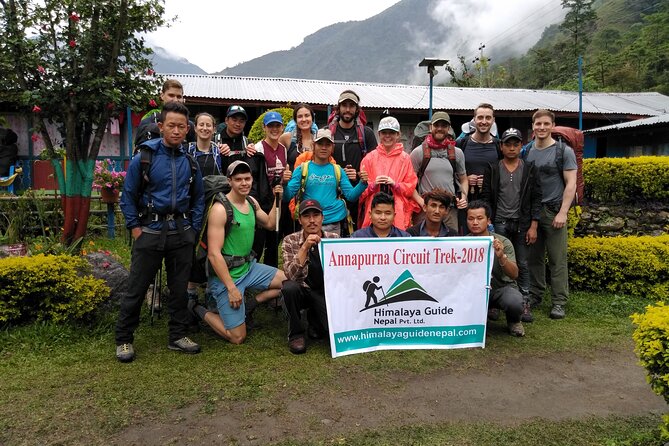
The Annapurna Circuit is rewarding because the scenery changes almost every day. You begin near the Marshyangdi River, where roads, suspension bridges, farms, and villages shape the walk. Higher up, the valley narrows and the air gets colder. Beyond Manang, the route turns more open and dry, with fewer settlements and a stronger sense of altitude.
After Thorong La, the character changes again. Muktinath and Jomsom sit in the rain-shadow region of Mustang, where the terrain is more arid and the Kali Gandaki corridor opens the route toward hot springs and lower valleys. The final days add terraced hills, Magar villages, pine, rhododendron, and the famous Poon Hill sunrise.
You are not simply walking to one viewpoint and returning. You are crossing a major Himalayan route with different climates, cultures, and elevations. That variety is the best reason to choose this trip instead of a shorter out-and-back trek.
The private setup matters too. You can walk at your own group’s pace, ask questions freely, and discuss options with your guide. It does not remove the hard parts, but it can make the long days easier to manage.
More Annapurna Treks in Kathmandu
- Annapurna Circuit Trek with Tilicho Lake
★ 5.0 · 368 reviews - Annapurna base camp trek 5 Days
★ 5.0 · 252 reviews - 14-Day Private Annapurna Base Camp Trek
★ 5.0 · 180 reviews
Kathmandu to Bulbule: a long first day on the road
The trip begins with airport pickup at Tribhuvan International Airport and transport toward Besisahar and Bulbule. The drive takes roughly six to seven hours by local bus, depending on road conditions and the selected departure time.
This is not a sightseeing day in the usual sense. It is a transition from Kathmandu into the mountain region, following the Trisuli River and crossing near Muglin before continuing along the Marshyangdi route. You will spend much of the day sitting, so keep water, snacks, and a light layer close at hand.
The included bus ticket is useful because arranging this connection yourself can add stress at the start of a trek. Still, local bus travel is not the same as a private vehicle. If comfort matters to you, ask exactly what bus service is planned and where the first night will be spent.
Days 2 to 4: river valleys, bridges, and village trails
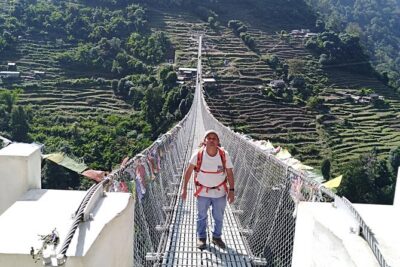
From the lower Marshyangdi valley, the walking begins in earnest. The route passes through Ghermu, Ngadi, Bahun Danda, and nearby settlements. You walk beside the river, climb toward hill villages, and cross suspension bridges that connect the two sides of the valley.
Bahun Danda, at about 1,270 meters, provides an early hilltop viewpoint and a natural place for lunch. This section is lower than the pass, but it is not flat. Roads and footpaths share the route, and the steady climbs can feel demanding before your body has settled into trekking rhythm.
The route then continues toward Chamje, passing Syange and crossing back over the Marshyangdi. Expect steep uphill sections and cliff-side trail. The short admission times shown for some stops should not be read as short walking days. The daily schedule is much longer, with several days listed at around 12 hours.
By the time you reach Chame, the scenery begins to feel more alpine. Dharapani, Bagarchhap, and Danque bring stone entrances, chortens, and traditional village features. Chame is the administrative center of Manang District and an important rest point before the valley rises higher.
This is one place where you should ask your guide for a clear daily walking estimate. The outline gives destination names, but not consistent start times, walking distances, or elevation gain. Those details matter more than the nominal 15-day length.
Days 5 and 6: entering the high country near Manang
The route continues through pine forest and a narrowing valley toward Pisang and Manang. One section crosses the Marshyangdi at around 3,038 meters and passes below a striking curved rock face rising sharply above the river.
Around Pisang, the route may use a lower path along the river or a higher option through the forest and villages. Both routes meet again near Mungji. This choice is important because the higher route can offer broader mountain views, while the lower path may feel less strenuous. Your guide can select the better option based on weather, energy, and acclimatization.
Manang is the key staging point before Thorong La. It is also where the physical character of the trip changes. The altitude is now serious enough that you need to watch for headache, nausea, unusual tiredness, or poor sleep. The schedule wisely places a second night around Manang for acclimatization.
One concern is that the day-by-day outline repeats Manang as the stop on several consecutive days. That probably reflects nights spent in the Manang area while moving toward higher villages, but the exact overnight points are not clear. Ask the company for the final route map and lodging plan.
Same trailhead, a different route:
- Everest Base Camp Trek – 14 Days
★ 5.0 · 1,499 reviews - Everest Base Camp Trek
★ 5.0 · 842 reviews - Everest Base Camp Helicopter Tour landing at Everest View Hotel
★ 5.0 · 668 reviews - Everest Base Camp Trekking
★ 5.0 · 485 reviews
Day 7: the acclimatization day you should not skip
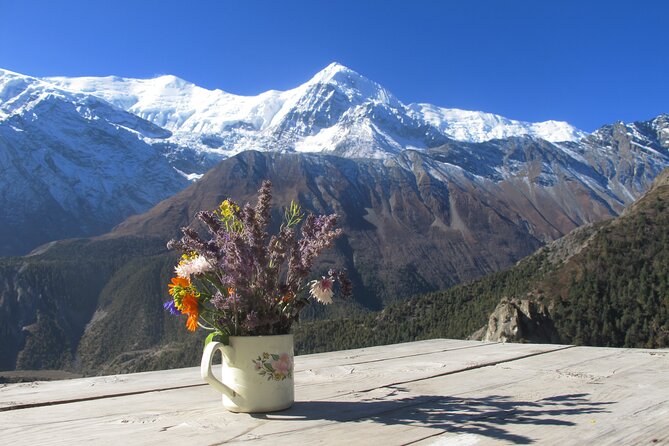
The rest day in Manang is not wasted time. It is the safety buffer that gives your body a better chance to handle the climb toward Thorong La.
The itinerary lists optional exploration, including a monastery visit with a 100-rupee donation. That small cultural stop fits the slower pace of the day. You may also use the time to wash clothes, charge devices, check gear, and speak with your guide about altitude symptoms.
Do not treat this as a day to walk hard. The best use of it is gentle movement, food, water, and rest. A private tour is especially helpful here because you can discuss how you feel without worrying about keeping up with strangers.
The company presents itself as family-run and offers some Nepali language teaching during the trip. That is a pleasant extra, but the main value is the personal contact. Learning a few greetings or food words can make lodge and village interactions more relaxed.
Days 8 and 9: toward Thorong Phedi
After Manang, the route heads toward Tanki and Ghungsang, then follows the Jar Sang Khola valley. The terrain becomes more open, with pastures, scrub, and fewer trees. You are now walking in the zone where altitude, wind, and cold can matter more than distance.
The plan includes the last camp before Thorong La, with a stop at a tea shop near Durali. The published schedule labels one day as Thorong La, but the description sounds like the approach to the pass rather than the crossing itself. This is another detail to confirm.
You should ask three direct questions before departure:
- Where exactly do you sleep before the pass?
- What is the planned start time for crossing Thorong La?
- What happens if weather or altitude makes the crossing unsafe?
These are normal questions for a high-altitude trek. The itinerary includes a guide, permits, food, and lodging, but it does not state a detailed emergency evacuation plan. Travel insurance is specifically excluded, so insurance covering trekking and altitude-related rescue is essential.
Day 10: crossing Thorong La at 5,416 meters
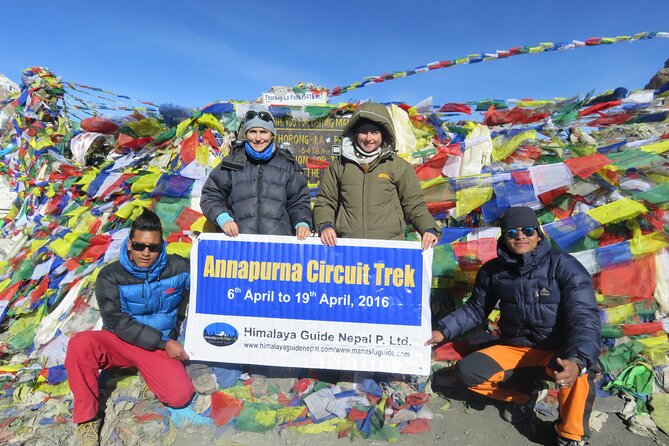
The pass day is the hardest part of the trip. The plan calls for an early start from Thorong Phedi or the nearby high camp, followed by a long climb to the 5,416-meter summit. From there, the route descends toward Muktinath.
This is a day for patience rather than speed. The trail can feel slow as the air gets thin. You should carry only what you need for the day, keep layers easy to reach, and follow your guide’s pace.
The reward is not just the pass sign or the height. You have crossed from the Manang side into the Mustang region, and the views and terrain change sharply. The descent can be hard on tired knees, even though breathing may become easier as you lose altitude.
The schedule also lists an admission ticket for the pass, though no separate cost is shown. Since permits are included, ask your guide what, if anything, is paid locally at the checkpoint.
Muktinath and Jomsom: a different side of Nepal
Muktinath is an important stop after the pass, and the route then continues toward Jomsom. From here, the trip offers several possible choices, including transport toward Tatopani or a flight from Jomsom to Pokhara.
The published plan includes public transportation from Muktinath to Tatopani, but it also describes optional routes and a possible flight. Do not assume every option is included in the $995 price. Confirm the exact transport chosen for your group, as well as any flight cost, schedule change, or extra night.
This section is valuable because it prevents the circuit from ending immediately after Thorong La. You get to see the Kali Gandaki corridor and Mustang’s drier surroundings before returning to greener lower valleys.
Tatopani to Shikha: hot springs and a change of pace
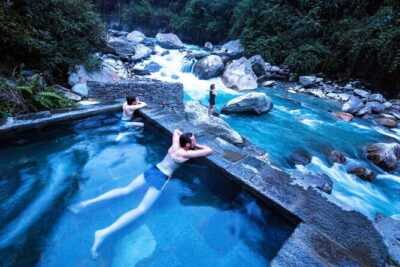
The plan includes a stop at Tatopani, known for its hot springs, followed by a descent toward Shikha. After high-altitude walking, a hot spring can be a welcome physical break, although it should not be confused with a full rest day unless the guide confirms that timing.
The route crosses a suspension bridge over the Kali Gandaki and follows the Burung Khola for part of the way. Lower elevations bring more vegetation and village life. The walk may feel warmer and more humid than the Manang section, especially during the monsoon period.
One past trip with this company took place during the end of the monsoon, when the lower route was hot and humid but waterfalls were especially full. That timing can offer dramatic water flow, but it may also bring wet paths and less predictable mountain views. If you are choosing dates, ask about current trail and road conditions.
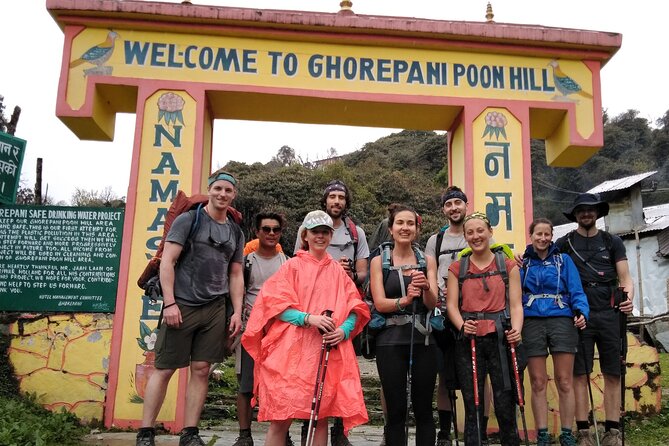
Ghorepani and the Poon Hill sunrise
The approach to Ghorepani passes through Magar villages such as Phalate and Chitre, then climbs through rhododendron and pine forest. This is a harder lower-altitude day because the route rises again after the long descent from Mustang.
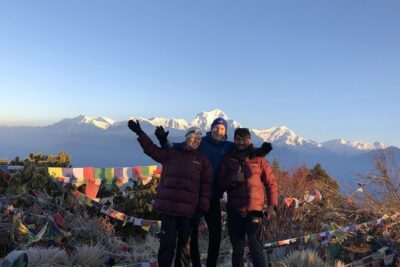
Ghorepani is the launch point for the early hike to Poon Hill. The climb takes about 40 to 50 minutes and reaches roughly 3,210 meters. The reward is a sunrise view toward Dhaulagiri, Tukuche Peak, Nilgiri, Annapurna South, and Hiunchuli.
Poon Hill is popular for good reason, but the morning can be cold and the viewpoint can feel busy during peak trekking periods. Bring a headlamp if your guide does not provide one, and keep warm clothing accessible. The walk is short compared with Thorong La, but the early start comes after several demanding days.
The combination of Thorong La and Poon Hill gives this itinerary extra range. You get a major high pass and a classic sunrise viewpoint, rather than only one headline attraction.
Pokhara and the return to Kathmandu
After Poon Hill, the trek finishes at Nayapul, followed by transport to Pokhara Lakeside. The package includes a car from Nayapul to Pokhara, which is helpful after a long descent.
Pokhara provides a softer ending: lakeside time, a hot shower if your accommodation arrangement allows it, and a chance to recover before the return journey. Extra nights and food in Pokhara are not included, so check whether the 15-day schedule gives you a full night there or only transit time.
The return to Kathmandu is by deluxe tourist bus. The itinerary lists this as a full 12-hour day, so do not plan an important international connection immediately afterward. The final evening includes a farewell lunch or dinner, depending on the schedule.
What the $995 price really covers
At $995 per person, the package offers solid value if you use most of the inclusions. It covers:
- Airport pickup and drop-off
- Kathmandu to Bulbule transport
- Lodge accommodation during the trek
- A private guide with salary, food, lodging, insurance, equipment, and transport covered
- ACAP permit and TIMS card
- All government taxes
- Public transport from Muktinath to Tatopani
- Nayapul to Pokhara by car
- Tourist bus from Pokhara to Kathmandu
- 15 breakfasts, 15 lunches, and 15 dinners
- A farewell meal and a small company gift
The important exclusions are just as clear. Kathmandu and Pokhara accommodation outside the trek is extra. Drinks, bottled water, beer, laundry, phone use, charging, showers, and boiled water are also extra. Porter service is not included, though the company can arrange one.
For a private trek, the included guide costs and permits make the price attractive. Still, ask for a written breakdown of lodging, transport alternatives, and any costs connected with the Muktinath to Jomsom or Tatopani section.
Guides, group size, and the family-run approach
This is a private activity, so only your own group participates. That is useful if you want flexible pacing, though it does not guarantee short walking days. The listed guide package includes equipment, insurance, food, lodging, and transport for the guide.
The company has used guides and porters including Pratap, Dinesh, Binute, and Bashudev on Nepal treks. Pratap has led Annapurna trips toward Tilicho Lake and Thorong La, while Dinesh and Binute have been praised for friendly service and careful attention to safety. Your assigned guide may be someone else, so request the name and experience of your actual guide before departure.
The family team also says it teaches Nepali language during the trip. That gives the journey a more personal feel than a purely transactional package, but service can still vary by guide. Clear communication before arrival remains important.
Who should book this trek?
You should consider this trip if you want a complete Annapurna route with a private guide, included meals, and arranged transport. It suits people with moderate fitness who are ready for repeated long walking days and a very high pass.
It is less suitable if you want leisurely walking, private rooms, luxury accommodation, or a short list of fixed daily distances. The phrase moderate fitness should not hide the challenge of 12-hour days and a 5,416-meter crossing.
You also need travel insurance that covers trekking and emergencies. The package does not include that protection, and the itinerary does not promise a helicopter evacuation plan or extra acclimatization days.
Should you book the 15-day Annapurna Circuit?
I would book this trip if you value a private format, a family-run operator, included meals, and help with the complicated transport around Thorong La. The combination of Annapurna Circuit, Muktinath, Mustang, hot springs, Ghorepani, and Poon Hill gives you a lot in 15 days.
Before booking, ask for a corrected day-by-day plan. Confirm the exact overnight villages, the pass-day schedule, the Muktinath transport option, and what happens if weather or altitude forces a change.
The free cancellation policy allows cancellation up to 24 hours before the start time for a full refund, subject to the stated minimum-group condition. That is useful flexibility, but the more important decision is physical readiness. If you can handle long days and high altitude, this is a well-priced way to see several sides of Nepal with one private team.
FAQ
Where does the trek begin?
The experience begins with pickup at Tribhuvan International Airport in Kathmandu. The listed start time is 10:15 am.
How long is the Annapurna trek?
The full experience lasts approximately 15 days. The schedule runs from Kathmandu to Bulbule, across the Annapurna region and Thorong La, then through Pokhara and back to Kathmandu.
Is the tour private?
Yes. Only your own group takes part in the activity.
Is a guide included?
Yes. An experienced guide is included, along with the guide’s salary, equipment, insurance, transport, lodging, and food.
Are meals included?
Yes. The package includes 15 breakfasts, 15 lunches, and 15 dinners. Drinks such as mineral water, soft drinks, beer, and other hot or cold beverages are not included.
Is a porter included?
No. Porter service is excluded, but the company can arrange a porter if you request one.
Is travel insurance included?
No. Travel insurance is not included. You must arrange your own insurance for the trek.
Can I cancel for a full refund?
You can cancel up to 24 hours before the experience start time for a full refund. Cancellations or changes made less than 24 hours before the start time are not accepted for a refund.
Just added around Kathmandu
- Everest Base Camp Trek★ 5.0 · 3 reviews
- Everest Base Camp Trek★ 5.0 · 7 reviews
- 15 Days Private Everest Base Camp Trek★ 5.0 · 30 reviews
- Everest Base Camp Trek★ 5.0 · 57 reviews
- 14 Days of Adventure Trekking to Everest Base Camp★ 5.0 · 2 reviews
- 14-Day Everest Base Camp Trek★ 5.0 · 20 reviews
- From Kathmandu: Private 14-Day Everest Base Camp Trek★ 5.0 · 20 reviews
- 14 Days Everest Base Camp Trek★ 5.0 · 4 reviews
Annapurna Base Camp Treks, compared.
Trekking in Annapurna/Langtang/Everest/Upper Mustang regions
Read our review →
Kathmandu to Annapurna Base Camp (ABC) 5-Day Trek
Read our review →Browse the lists this trek appears in