
Review · KATHMANDU
Adventurous Annapurna Base Camp Trekking
The great prize here is a night at Annapurna Base Camp, where Annapurna I, Annapurna South, Hiunchuli, Machapuchare, and other peaks form a huge natural bowl around you. The route also adds Poon Hill, Gurung villages, Kathmandu’s major sights, and a few days in Pokhara, so you get more than a single mountain walk.
I like the good variety: rhododendron forest, suspension bridges, stone steps, river gorges, hot springs, and snow peaks all appear in one trip. I also like the practical support, including airport pickup, a porter for every two people, permits, accommodation, and guides such as Raj, Deepak, Mahila, and Ram within the Adventure Thirdpole team.
The main drawback is the demanding schedule. Several days are listed as roughly 12 hours, and the climb from Ulleri begins with nearly 3,000 steps. The route suits you only if you have moderate fitness, and the itinerary contains a few confusing place names that you should clarify before paying.
Why This Annapurna Route Deserves Your Attention
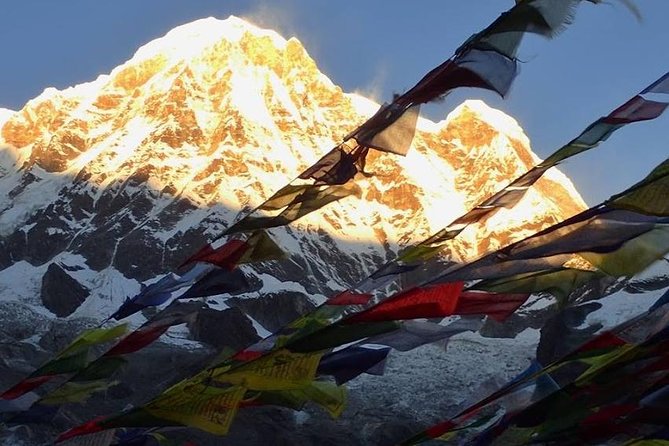
- Poon Hill at sunrise: A pre-dawn walk leads to a classic view of the Dhaulagiri and Annapurna ranges.
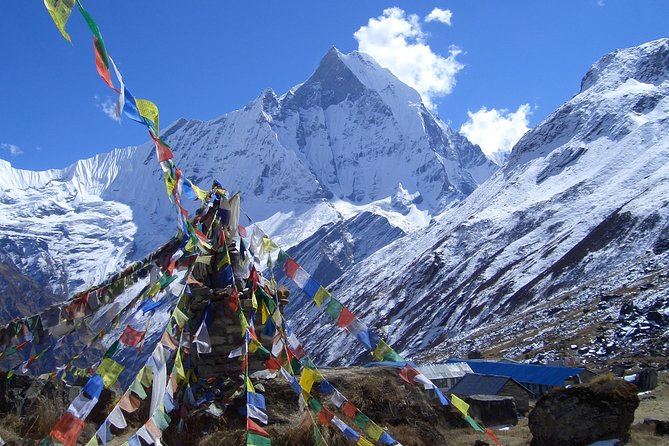
- Annapurna Base Camp at 4,130 meters: You spend a night inside the Annapurna Sanctuary, close to Annapurna I, the world’s tenth-highest mountain.
- Gurung villages and local life: Ulleri, Chhomrong, Ghandruk, and nearby settlements give the trek a human side beyond the mountain views.
- A full Nepal introduction: The trip combines Kathmandu heritage sites, Pokhara and Fewa Lake, and a long mountain trek.
- Personal support: One porter is provided for every two people, with a professional guide and airport transfers included.
- Flexible company service: Guide Raj and the Adventure Thirdpole team have adjusted plans for tight schedules and weather problems, according to the supplied trip accounts.
What the $1,650 Price Really Covers
At $1,650 per person, this is not a bare trail package. The price includes 14 days of arrangements, airport pickup, Kathmandu and Pokhara hotels, land transport, a professional guide, one porter for every two people, TIMS registration, the Annapurna Conservation Area Permit, and many meals.
That bundle matters in Nepal. You are not left to sort out permits, rural transfers, or the first and last hotel nights on your own. You also have a local team handling the route, which can make a major difference when weather affects roads or flights.
Meals are included as nine lunches, 11 dinners, and 11 breakfasts. You will need to pay for meals where not listed, drinks, tips, personal purchases, and other items of personal use. A sleeping bag and down jacket are not included, so check your equipment before departure rather than assuming the package supplies cold-weather gear.
Travel insurance is mandatory, and emergency medical evacuation is excluded. That is an important cost and safety point, not a footnote. You should also budget for personal spending money and any optional flight between Kathmandu and Pokhara on the return journey.
The value is strongest if you want a private trip with transport, permits, lodging, porters, and a guide arranged in one booking. It is less attractive if you already have trekking equipment, prefer independent planning, or want to move at your own pace.
More Annapurna Treks in Kathmandu
- Annapurna Circuit Trek with Tilicho Lake
★ 5.0 · 368 reviews - Annapurna base camp trek 5 Days
★ 5.0 · 252 reviews - 14-Day Private Annapurna Base Camp Trek
★ 5.0 · 180 reviews
Kathmandu Begins With Temples and Trek Preparation
On arrival, staff meet you at the airport and take you to your hotel. The first afternoon is for rest, followed by a welcome dinner and an introduction to the trekking crew.
That easy start is useful. Long flights and airport delays are common reasons to avoid scheduling a hard walk on day one. You have time to meet the team, ask about the route, and check what your porter will carry.
The second day covers four major sites in Kathmandu Valley: Pashupatinath Temple, Kathmandu Durbar Square, Swayambunath, also called the Monkey Temple, and Boudhanath. It is a full sightseeing day, listed at about 12 hours, so expect a busy schedule rather than a slow museum visit.
This day adds useful context before you reach the mountain villages. You see Hindu and Buddhist religious sites, historic squares, and the city’s distinctive spiritual character. The drawback is simple: after international travel, two long Kathmandu days can feel tiring. If you prefer an early start on the trek, take the first afternoon seriously and rest.
Pokhara Adds a Softer Pause Before the Trail
On day three, your guide meets you at 6:00 in the morning and takes you to the tourist bus station. The road follows the Trisuli and Marshyangdi rivers, passing rural villages and mountain scenery before reaching Pokhara.
The bus journey is part of the experience, but it is not a quick transfer. The day is listed at about 12 hours, including the road trip and activities after arrival. Once in Pokhara, you check into your hotel, take a boat on Fewa Lake, and walk a little beside the water.
I like this change of pace. Pokhara gives you time to breathe before the steep trail begins, and Fewa Lake provides a calm contrast to Kathmandu’s temples and traffic. Still, you should not mistake the lake outing for a rest day. The early departure and long road journey make day three another full day.
Ulleri Tests Your Legs From the Start
After breakfast on day four, you drive to Nayapul and begin walking. At Birethanti, trekking permits are checked, then the route continues through waterfalls and forest toward Tikhedhunga and Ulleri.
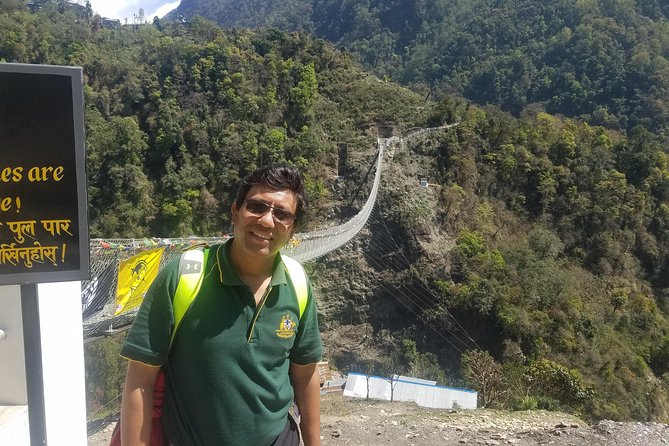
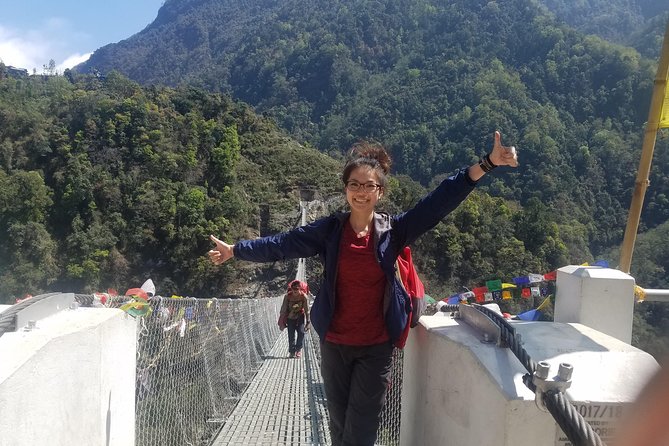
You cross the Modi Khola and Bhurungdi River, use two suspension bridges near Tikhedhunga, and then face the famous climb into Ulleri. The route description puts the climb at nearly 3,000 stone steps. This is the day that tells you what the trek demands.
The scenery begins well, with forest, water, and rural settlements, but the steps are no small warm-up. Keep your pace steady and use the porter arrangement wisely. You carry only what you need for the day, while your larger bag goes with the porter.
The overnight stop is in a rural lodge. Accommodation on this type of route is practical rather than luxurious, and the long walking day means you will value a clean bed and a hot meal more than decorative extras.
Same trailhead, a different route:
- Everest Base Camp Trek – 14 Days
★ 5.0 · 1,499 reviews - Everest Base Camp Trek
★ 5.0 · 842 reviews - Everest Base Camp Helicopter Tour landing at Everest View Hotel
★ 5.0 · 668 reviews - Everest Base Camp Trekking
★ 5.0 · 485 reviews
Ghorepani and Poon Hill Deliver the First Big View
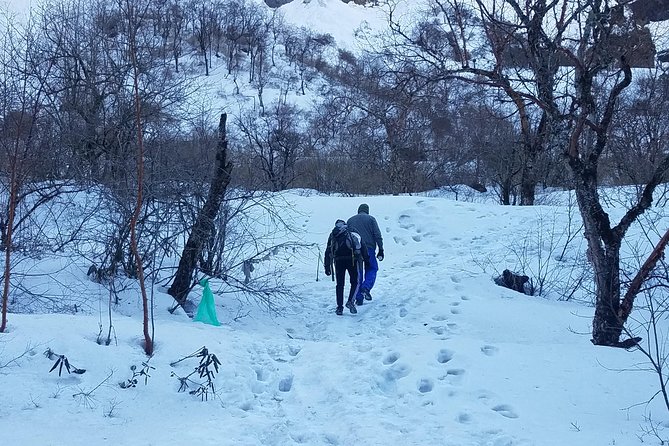
Day five climbs gradually from Ulleri through rhododendron and oak forest. You pass Banthanti and Nangethani before reaching Ghorepani, where views of Annapurna South and Hiunchuli begin to open.
A short walk beyond the village ridge gives you wider views toward the Dhaulagiri and Annapurna ranges. This is one of the most scenic sections of the approach, especially when the forest opens onto mountain views.
The next morning starts before sunrise. You walk for about 45 minutes by torchlight to Poon Hill at 3,210 meters. After roughly half an hour at the viewpoint, you return to the lodge for breakfast.
Poon Hill is worth the early alarm because sunrise gives the peaks changing light and a strong sense of scale. You will see the Dhaulagiri and Annapurna ranges from a broad viewpoint before the trail turns toward the sanctuary.
After breakfast, you continue to Tadapani through Deurali and Banthanti. The route offers forest, monkeys, and birds, with close views of Annapurna South, Hiunchuli, and Machapuchare from Tadapani. This is one of the trek’s best combinations: a short viewpoint walk followed by a longer forest day.
Chhomrong Connects Village Life With the Sanctuary
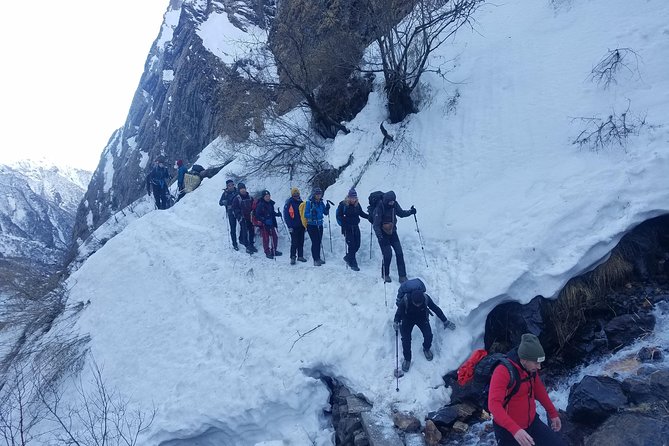
The route to Chhomrong includes a two-hour descent, a stream crossing, and a gradual climb through the Gurung settlement of Gurjung. Chhomrong is a larger Gurung village and an important stopping point on the way toward Annapurna Base Camp.
You should pay attention to the changing rhythm here. The trek is not a simple uphill march. You often descend to a river, then climb again to the next village. That repeated pattern is part of the physical challenge.
Chhomrong also gives you a closer look at local village life and Gurung culture. The setting is practical, social, and tied to the trail economy. You should not expect a long cultural program, but the village stops make the route feel like a journey through lived-in communities rather than a mountain corridor built only for hikers.
The Modi River Gorge Leads Toward Annapurna Base Camp
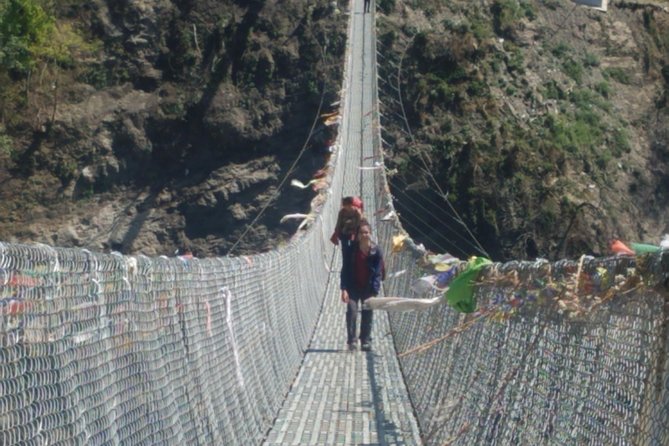
One itinerary entry labels the overnight stop as Ghandruk, while the description says the walk continues through Bamboo and Dovan toward Himalaya. This is a point to clarify with Adventure Thirdpole before departure. The route as described is the approach through the Modi River gorge, not a simple return to Ghandruk.
You walk through a narrow gorge beside the Modi River. The sound of running water and birds becomes part of the day, while the forested route offers chances to see monkeys and Himalayan goats. The setting changes noticeably from the open views around Poon Hill.
This section can feel quieter and more enclosed. That is part of its appeal, but it also means you may have fewer wide mountain views until you reach higher ground. The route remains demanding, with long days listed at around 12 hours.
The next major goal is Annapurna Base Camp. As you climb higher, snow-covered peaks surround the trail. At the base camp, your guide takes you close to views of Annapurna I and the Annapurna glacier, with Annapurna South, Hiunchuli, Machapuchare, and Annapurna III completing the mountain bowl.
The supplied details give several different figures for mountain heights, so treat those numbers as approximate. The important point is the setting: you are inside the Annapurna Sanctuary, with a 360-degree mountain view that feels far more enclosed and dramatic than a distant viewpoint.
Spending a night at base camp is the emotional center of the trip. You are not merely looking at Annapurna from a road or hilltop. You reach the base of the massif after several days on foot, then wake early for the sunrise.
The Return Route Brings a Tough Descent
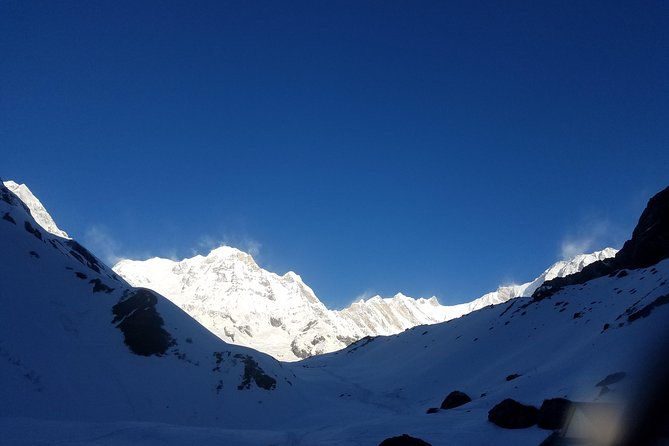
After sunrise at base camp, the return begins toward Bamboo. The route drops almost 2,000 meters over six to seven hours, making this one of the hardest days for knees and thighs.
You should use trekking poles if you have them and take the descent seriously. Downhill walking can feel easier than climbing, but a long drop on stone steps and uneven trail can be punishing. The itinerary again names Ghandruk as the stop while describing Bamboo, so confirm the exact overnight location.
The next day goes from Bamboo toward Khuldighar, Sinuwa, Chhomrong, and Jhinu. The trail first climbs for about 30 minutes to Khuldighar, passes an experimental sheep farm, then follows a mix of gradual trail, flat sections, downhill walking, and another climb.
From Chhomrong, the trail descends steeply for about an hour to Jhinu. You leave your bags there and walk down to the hot springs by the Modi Khola. This is a welcome reward after the steep descent and a good example of why the route feels varied rather than repetitive.
The final trekking day follows a flatter route from Jhinu toward Birethanti and Nayapul, after crossing the river. A vehicle meets you at Nayapul for the drive back to Pokhara.
The day includes about six hours of walking and a one-hour drive. Back in Pokhara, the package describes time at the hotel and a happy hour. Treat this as a recovery evening, not another major sightseeing block.
Returning to Kathmandu and Flying Home
On day 13, you can drive back to Kathmandu or pay extra for a flight listed at about 30 minutes. The road option gives you another long overland day, while the flight saves time at an additional cost.
A farewell dinner follows the successful trek. On day 14, staff take you to Tribhuvan International Airport according to your departure time.
Airport pickup and drop-off are useful benefits, especially after a long trek when you have bags, equipment, and little interest in negotiating transport. The activity begins and ends at Kathmandu Guest House, Saathgumti-16, Kathmandu, although airport transfers are also provided as part of the stated arrangements.
Guides, Porters, and the Human Side of the Trip
The strongest personal thread in the supplied accounts is the Adventure Thirdpole team, especially Raj, with Deepak, Mahila, and Ram also named. Raj is described as handling planning, motivation, and itinerary changes, including a case where a tight schedule required a shorter route beginning from Australian Camp.
That flexibility is useful in Nepal, where weather can affect transport plans. One account describes a planned Everest Base Camp trip changing to Annapurna Base Camp after haze disrupted the Lukla flight. You should not treat that as a promise that every change will be possible, but it shows the value of having a local team that can make decisions quickly.
A porter for every two people is another major benefit. You still need to carry a daypack with water, clothing, and personal essentials, but you do not need to haul your full kit through every climb and descent.
The trip is private, so only your group participates. That gives you more control than a large departure, though the itinerary remains fairly fixed and physically demanding.
Who Should Book This Trek?
You should consider this trip if you want a first serious Himalayan trek with the main practical details arranged. It suits someone who wants Kathmandu culture, Pokhara, Poon Hill, Gurung villages, and Annapurna Base Camp in one 14-day plan.
It also suits couples, families of fit adults, or small private groups that value a guide and porter. The seven supplied ratings are all five-star ratings, and the most praised qualities are planning, hospitality, reliability, motivation, and care for the group.
You should think twice if you dislike early starts, long bus rides, steep stone steps, or repeated uphill and downhill sections. You also need insurance, a sleeping bag, a down jacket, money for drinks and personal costs, and a realistic plan for altitude and fatigue.
Before booking, ask for the exact overnight stops on days eight, ten, and eleven. The written route uses Ghandruk in places where the walking description refers to Bamboo, Himalaya, or the return route. Clearing up that wording will help you understand the daily distances and lodge locations.
Final Verdict: A Strong Package for a Supported Annapurna Trek
I would book this trek if I wanted a well-supported route to Annapurna Base Camp without arranging every permit, transfer, hotel, and porter myself. The combination of Poon Hill sunrise, Pokhara, Kathmandu’s four heritage sites, Gurung villages, the Modi River gorge, and the hot springs gives the trip real range.
The $1,650 price makes the most sense for you if you value private guiding and included logistics. It is not an all-inclusive holiday, since insurance, cold-weather gear, drinks, tips, and some meals remain yours to pay for.
Book it if you are ready for long days and can accept a few itinerary details that need clarification. Do not book it as a relaxed sightseeing tour. Book it as a demanding mountain journey with strong support, memorable views, and a clear final goal at Annapurna Base Camp.
FAQ
How long is the Annapurna Base Camp experience?
The trip lasts approximately 14 days, including arrival and departure transfers, Kathmandu sightseeing, travel between Kathmandu and Pokhara, the trek, and time in Pokhara.
What is the price per person?
The stated price is $1,650 per person.
Is airport pickup included?
Yes. Staff meet you at the airport on arrival and take you to your hotel. Airport transport is also provided for your departure according to your flight schedule.
What major places are visited in Kathmandu?
The sightseeing day includes Pashupatinath Temple, Kathmandu Durbar Square, Swayambunath, also called the Monkey Temple, and Boudhanath.
Is Pokhara included?
Yes. Accommodation in Pokhara, travel to and from the city, boating on Fewa Lake, and a short lakeside walk are included in the planned program.
Does the trek include Annapurna Base Camp?
Yes. The route includes a night at Annapurna Base Camp, with views of Annapurna I, Annapurna South, Hiunchuli, Machapuchare, Annapurna III, and the Annapurna glacier.
Is a porter provided?
Yes. One porter is provided for every two people.
Are meals included?
The package includes nine lunches, 11 dinners, and 11 breakfasts. Meals not specified in the program are excluded.
What happens if bad weather cancels the experience?
If poor weather causes cancellation, you are offered a different date or a full refund. For ordinary cancellations, you must cancel at least 24 hours before the experience starts to receive a full refund.
Just added around Kathmandu
- Everest Base Camp Trek★ 5.0 · 3 reviews
- Everest Base Camp Trek★ 5.0 · 7 reviews
- 15 Days Private Everest Base Camp Trek★ 5.0 · 30 reviews
- Everest Base Camp Trek★ 5.0 · 57 reviews
- 14 Days of Adventure Trekking to Everest Base Camp★ 5.0 · 2 reviews
- 14-Day Everest Base Camp Trek★ 5.0 · 20 reviews
- From Kathmandu: Private 14-Day Everest Base Camp Trek★ 5.0 · 20 reviews
- 14 Days Everest Base Camp Trek★ 5.0 · 4 reviews
Annapurna Base Camp Treks, compared.




Trekking in Annapurna/Langtang/Everest/Upper Mustang regions
Read our review →


Kathmandu to Annapurna Base Camp (ABC) 5-Day Trek
Read our review →Browse the lists this trek appears in