
Review · KATHMANDU
14-Day Annapurna Base Camp Trek from Kathmandu
Annapurna Base Camp gives you a little of everything Nepal does best: lively hill villages, terraced fields, rhododendron forest, suspension bridges, cold alpine air, and a wall of snowy peaks at 4,170 meters. The route feels varied from one day to the next, which helps the long trek pass quickly.
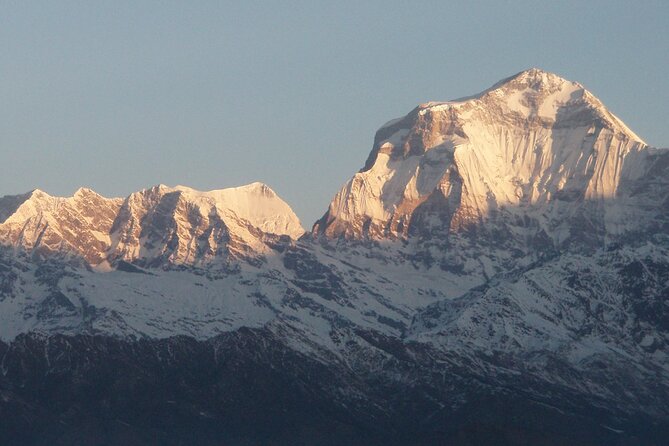
I like the Poon Hill sunrise on Day 6, when Dhaulagiri, Annapurna, Machhapuchhare, and other peaks catch the first light. I also like the gradual change from subtropical forest to the high Annapurna Sanctuary, with stays in villages such as Ghorepani, Tadapani, Chomrong, and Bamboo.
The main consideration is effort. This is not a gentle walking holiday. Several days involve steep stone stairways, and the return from Base Camp still requires long hours on foot. The itinerary builds upward in stages, but it does not include a separate acclimatization day.
Key points to know before booking
- Poon Hill adds a famous sunrise viewpoint before you continue toward Annapurna Base Camp.
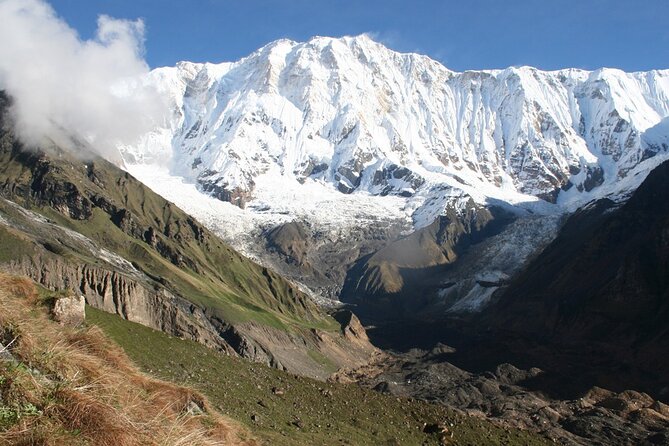
- The highest point is Annapurna Base Camp at 4,170 meters, reached after a steady climb through the Modi Khola valley.
- The trip includes Kathmandu sightseeing, permits, accommodation, transport, and many meals, which keeps planning simple.
- A maximum group size of 14 gives you company without creating a large expedition.
- Porters are not included, so you need to carry your own pack unless you arrange porter service separately.
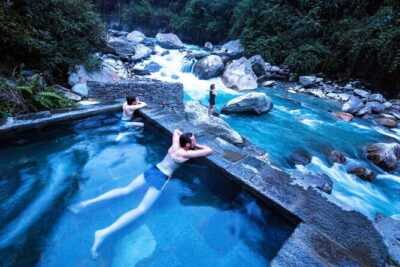
- The final return includes natural hot springs at Jhinu Danda, a welcome reward after the high-country section.
Why this Annapurna route is so rewarding
The Annapurna Base Camp trek is popular for a good reason. You do not spend two weeks staring at the same kind of view. The route begins among busy streets and historic sites in Kathmandu, moves through the lake city of Pokhara, then enters farming country before rising into forests and high mountain valleys.
I especially like the human side of the route. Villages are home to different ethnic communities, including Gurung and Magar people. As you climb, you see prayer flags, chortens, terraced fields, stone paths, and houses adapted to mountain life. The scenery changes, but so does the culture.
Nature keeps changing too. Lower sections include waterfalls, birds, monkeys, and warm forest. Higher up, rhododendron, oak, and bamboo dominate. Near Base Camp, the trees thin out and the valley becomes more open and stark. This steady change gives the trek a strong sense of progress.
The company has used guides including Amrit, Raj, Suraj, Indra, Bhim, and Pralad on different departures. Your own guide is not named in advance in the information provided, so confirm that detail before booking. The strongest pattern is clear: the guide and porter team is central to the experience, helping with pacing, route information, accommodation, and safety.
More Annapurna Treks in Kathmandu
- Annapurna Circuit Trek with Tilicho Lake
★ 5.0 · 368 reviews - Annapurna base camp trek 5 Days
★ 5.0 · 252 reviews - 14-Day Private Annapurna Base Camp Trek
★ 5.0 · 180 reviews
Days 1 and 2: Kathmandu gets you ready
You are met at Tribhuvan International Airport and transferred to your hotel on the first day. The evening is free, which is useful after a long flight. You can rest, adjust to Kathmandu, and sort out any missing trekking gear.
Day 2 brings about six hours of sightseeing in Kathmandu Valley. The route includes Kathmandu Durbar Square, Swayambhunath, commonly called the Monkey Temple, Pashupatinath Temple, and Boudhanath Stupa.
This is a smart start because you get both orientation and culture before walking into the hills. Kathmandu Durbar Square introduces the city’s traditional architecture, while Pashupatinath and Boudhanath show two important sides of religious life in Nepal.
The sightseeing entrance fees are included, with the stated value of about NPR 2,600, or roughly $25. You also have time to buy or rent trekking equipment. Take advantage of it. Once you leave Kathmandu, choices become more limited.
Day 3: The long road from Kathmandu to Pokhara
The drive to Pokhara takes about six hours by tourist bus. The road follows the Trisuli and Marsyangdi rivers, with views of rural settlements, terraces, gushing water, and mountain ridges. Ganesh Himal and Manaslu may appear along the way.
This is a scenic transfer, but it is still a long road day. If you dislike winding drives, keep that in mind. The payoff is Pokhara, a relaxed lakeside city with a very different feel from Kathmandu.
Pokhara is more than a place to sleep before the trek. It has lakes, caves, temples, and mountain views, though this schedule gives you limited free time there. The city works as a useful pause between the city tour and the walking route.
Days 4 and 5: First steps through villages and forest
On Day 4, you drive about an hour and a half from Pokhara to Nayapul. From there, you walk toward Tikhedunga via Birethanti. This opening section is comparatively easy, with a mostly flat trail through small villages and settlements before a gentler climb to the night’s stop.
That first walking day is valuable because it lets you settle into the rhythm of the trek. You are not thrown straight into the highest stairways. You get a look at village life, farmland, and the busy trail culture of the lower Annapurna region.
Day 5 is harder. The trail climbs steeply for about two hours, passing Ulleri and Banthanti. You then continue through rhododendron and shaded forest, with views toward Machhapuchhare, Hiunchuli, and Annapurna South.
This is where you begin to understand the physical cost of the trek. The trail is not technically described as climbing or scrambling, but the stairs and sustained uphill walking demand steady legs. Keep your pace controlled early in the day rather than racing ahead.
Same trailhead, a different route:
- Everest Base Camp Trek – 14 Days
★ 5.0 · 1,499 reviews - Everest Base Camp Trek
★ 5.0 · 842 reviews - Everest Base Camp Helicopter Tour landing at Everest View Hotel
★ 5.0 · 668 reviews - Everest Base Camp Trekking
★ 5.0 · 485 reviews
Day 6: Poon Hill sunrise, then a full day to Tadapani
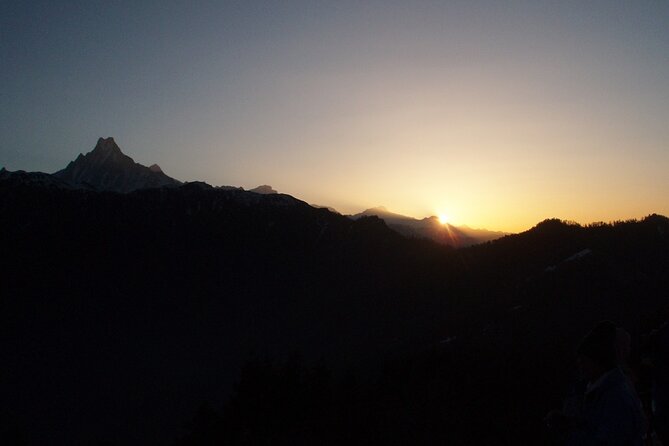
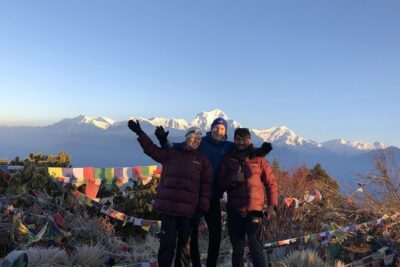
Day 6 is one of the best and busiest days of the route. You rise early for the walk to Poon Hill at 3,232 meters. From the viewpoint, you can see Dhaulagiri, Tukuche Peak, Nilgiri, Varaha Shikhar, Annapurna I, Annapurna South, Annapurna III, Machhapuchhare, Annapurna IV, Annapurna II, Lamjung Himal, and other snow-covered peaks.
The sunrise is the main event, but do not treat Poon Hill as a quick photo stop. The range of peaks is what makes it special. You see the mountains from a broad viewpoint before entering the narrower valleys that lead toward Base Camp.
After returning to Ghorepani for a hot breakfast, you continue to Tadapani at 2,650 meters. Much of the path passes through rhododendron forest. In spring, the flowers add strong color to the route.
The drawback is the length. You climb to Poon Hill before breakfast, descend, eat, and then walk on. If you are tired by afternoon, that is normal. This is one of the days when a guide’s pacing matters.
Days 7 and 8: Chomrong and the stone stairways
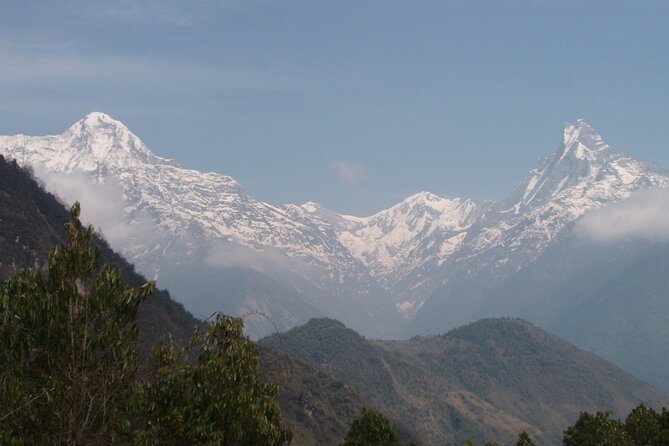
From Tadapani, the trail descends through rhododendron and oak forest toward Kimrung Khola. Then comes a steep climb and a series of gentler sections before Chomrong, the gateway to Annapurna Base Camp.
Chomrong sits at the base of the Himalchuli area and is one of the route’s key villages. It is also where the trek begins to feel more serious. You are higher, the valley is more enclosed, and the next days lead into the Annapurna Sanctuary.
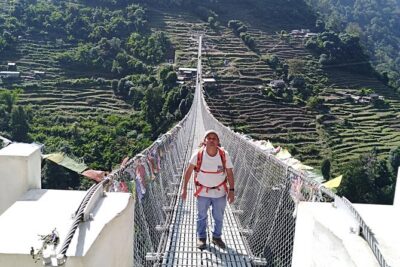
Day 8 starts with a long descent on stone steps. You cross the Chhomrong Khola by suspension bridge, climb toward Sinuwa, and continue through bamboo, rhododendron, and oak forest. The trail then drops on another long, steep staircase into the forest before reaching Bamboo, Dovan, and Himalaya.
This section is beautiful but tough on the knees. Downhill walking is not automatically easier than uphill walking, especially on uneven stone. Trekking poles can be useful, though the tour does not list them as provided equipment.
The forest is a highlight. You hear birds, see changing vegetation, and follow the Modi Khola valley rather than simply walking through open mountain scenery. The route feels enclosed and atmospheric before the trees begin to thin.
Day 9: Entering the Annapurna Sanctuary
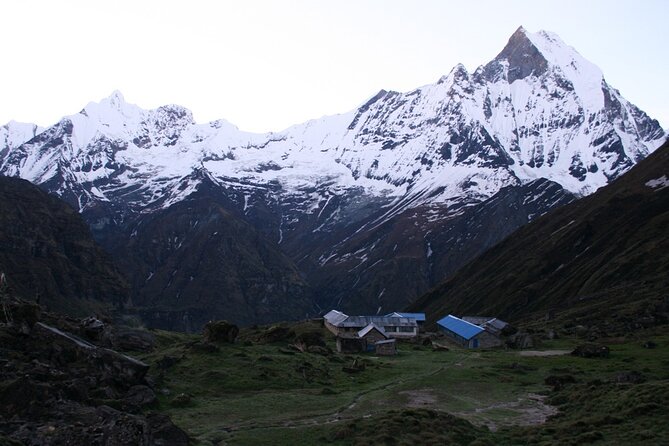
The valley widens as you continue higher. The trail crosses avalanche tracks and follows a narrow path below steep cliffs. You pass Bagar, an alpine meadow at about 3,310 meters, then continue through open meadows toward the sanctuary.
The final approach to Annapurna Base Camp is gradual but demanding. At 4,170 meters, the air is much thinner than it was in Pokhara or Kathmandu. The itinerary allows you to reach the base camp after a staged ascent through lower villages and forest, but there is no extra rest day built into the plan.
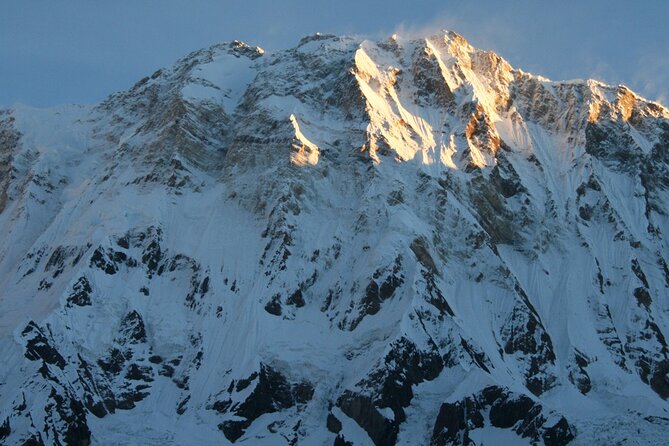
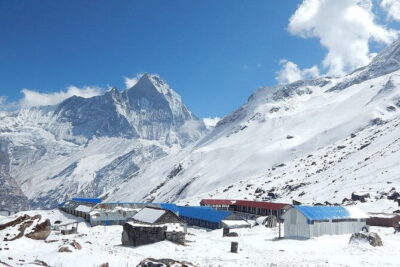
At Base Camp, the reward is not one single peak. You are surrounded by a great mountain amphitheater, with Annapurna and Machhapuchhare among the major sights. The setting gives the trek its emotional high point, but it also makes Day 9 a day to take slowly.
Drink what is available, walk at a controlled pace, and follow your guide’s advice. The tour is designed for people with moderate physical fitness, but that phrase should not be mistaken for easy. You need to be comfortable walking for several hours on steep and uneven trails.
Day 10: A cautious descent from Base Camp
After breakfast, you have time to visit the base camp area and take in the mountain views. You then descend toward Dovan, with about six hours of walking.
The schedule deliberately breaks up the return rather than forcing a single long descent to Sinuwa. That is a sensible choice because tired legs can become unsteady on stone steps. Downhill movement may feel easier for your lungs, but it can be demanding on knees and balance.
This is a good example of how the itinerary favors a steady pace over the fastest possible return. You give up some free time, but you gain a more manageable walking day.
Days 11 and 12: Forest, hot springs, and the road back
Day 11 continues through rhododendron, oak, and bamboo forest to Bamboo and Sinuwa. You then descend toward the Chhumrong Khola and climb stone steps to Chhomrong before dropping steeply to Jhinu Danda.
The stop at Jhinu is one of the route’s nicest practical touches. You can visit the natural hot springs and soak in warm water after days of stairs and long descents. The information provided does not specify whether any hot spring entry fee is included, so ask your guide locally.
Day 12 begins with more walking toward Birethanti. After lunch there, you continue for about 30 minutes to Nayapul, where a vehicle takes you back to Pokhara.
This day marks the return to roads and town life. You may find the transition abrupt after the quiet of the sanctuary, but Pokhara gives you a comfortable change of pace before the final bus journey.
Days 13 and 14: Return to Kathmandu and home
The tourist bus leaves Pokhara at 7 a.m. for Kathmandu. The drive takes around six hours and passes satellite towns, rural settlements, terraces, rivers, and green countryside.
Road conditions and traffic can affect the timing, so do not plan an important international connection immediately after reaching Kathmandu. The final day is reserved for airport transfer and departure.
The airport transfer is included as part of the arrangement described, but your international airfare is not. You also need a Nepal entry visa, which is excluded.
What the $950 price really covers
At $950 per person, this is a strong package if you want the main logistics handled for you. It includes 13 nights of accommodation, an experienced guide, Annapurna Conservation Area entry, the TIMS permit, Kathmandu sightseeing, sightseeing entrance fees on Day 2, and tourist bus transport between Kathmandu and Pokhara.
The meal allowance is specific rather than unlimited: 12 breakfasts, 9 lunches, and 8 dinners. Other meals are not included, and neither are alcoholic or nonalcoholic drinks. Check each day’s meal plan so you know when you will pay separately.
The price does not include international flights, Nepal’s entry visa, travel insurance, tips, or a porter. A porter can make a major difference on a long stair-heavy trek, but you must arrange and pay for that service separately if you want one.
The group can include up to 14 people. That is small enough for a guide to keep an eye on the pace, while still giving you company on long walking days. Group discounts are offered, though the amount is not stated.
Who should book this trek
I would choose this trip if you want a classic Annapurna route with strong mountain scenery, village life, a famous sunrise, and a clear support structure. It suits someone with moderate fitness who is prepared for long days, repeated stairs, and basic trekking accommodation.
It is also a good fit if you prefer not to arrange permits, airport pickup, city sightseeing, road transfers, and tea-house stops yourself. The guide is especially useful when energy drops or trail conditions make the day slower than expected.
I would think twice if you want luxury hotels, private transport throughout, or a relaxed walking schedule. The package includes accommodation, but the route itself is physically demanding. You also need to budget for drinks, extra meals, tips, insurance, visa costs, and possibly a porter.
Cancellation is generous only if you act early: cancel at least six full days before the start time for a full refund. Two to six full days gives a 50 percent refund, and cancellation less than two full days before departure is nonrefundable.
FAQ
Where does the Annapurna Base Camp trek begin?
The experience begins with pickup at Tribhuvan International Airport in Kathmandu, Nepal.
How long does the tour last?
The tour lasts approximately 14 days and includes 13 nights of accommodation.
What is the highest point of the trek?
The highest point is Annapurna Base Camp, at approximately 4,170 meters.
Is Poon Hill included?
Yes. The itinerary includes an early morning hike to Poon Hill at 3,232 meters for sunrise mountain views.
Is a porter included?
No. A trekking porter is not included, but you can arrange one separately if needed.
Are meals included?
Breakfast is included 12 times, lunch 9 times, and dinner 8 times. Meals not specified in the itinerary, along with alcoholic and nonalcoholic drinks, are extra.
Is travel insurance required?
Yes. Travel insurance is compulsory, and it is not included in the tour price.
Should you book it?
Book this trek if you want the full Annapurna Base Camp experience in a practical 14-day format, with Kathmandu sightseeing, Poon Hill, village routes, forest walking, mountain views, and a hot spring stop. The strongest value comes from having permits, transport, guiding, accommodation, and many meals arranged at one price.
Before paying, confirm the assigned guide, ask about porter availability, and check exactly which meals and lodging stops apply to your departure. If you are ready for steep stairs and long walking days, this route offers a memorable way to reach one of Nepal’s great mountain viewpoints without having to organize every detail yourself.
Just added around Kathmandu
- Everest Base Camp Trek★ 5.0 · 3 reviews
- Everest Base Camp Trek★ 5.0 · 7 reviews
- 15 Days Private Everest Base Camp Trek★ 5.0 · 30 reviews
- Everest Base Camp Trek★ 5.0 · 57 reviews
- 14 Days of Adventure Trekking to Everest Base Camp★ 5.0 · 2 reviews
- 14-Day Everest Base Camp Trek★ 5.0 · 20 reviews
- From Kathmandu: Private 14-Day Everest Base Camp Trek★ 5.0 · 20 reviews
- 14 Days Everest Base Camp Trek★ 5.0 · 4 reviews
Annapurna Base Camp Treks, compared.
Trekking in Annapurna/Langtang/Everest/Upper Mustang regions
Read our review →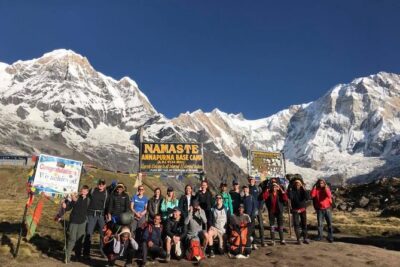
Kathmandu to Annapurna Base Camp (ABC) 5-Day Trek
Read our review →Browse the lists this trek appears in