
Review · KATHMANDU
Manaslu Circuit Trek:
The Manaslu Circuit saves its biggest test for the middle of the trip: crossing Larkya La Pass at roughly 5,106 meters, then dropping toward Bhimtang with Himlung, Cheo Himal, Kang Guru, and Annapurna II in view. Before that, you walk from hot-spring villages and rice terraces into dry Tibetan-style country around Mount Manaslu.
I like the steady change in scenery, from bamboo and rhododendron forest to bare high country. I also like the human scale of the trip: tea houses, small farming villages, monasteries, and guides who help you set a sensible pace. The main drawback is the effort required. Long walking days, rough road transfers, altitude, and a demanding pass crossing make this a serious trek, not a soft adventure holiday.
Key points to know
- Larkya La is the main challenge: The pass crossing reaches about 5,106 meters and requires an early start from Dharmasala.
- The scenery keeps changing: You move through subtropical valleys, terraced farmland, forest, alpine country, and Tibetan-influenced villages.
- The trip is genuinely remote: Tea-house facilities are basic, and personal costs such as hot showers, bottled water, charging, and laundry are extra.
- Acclimatization is built in: A rest day at Sama Gaon helps before you continue toward Samdo and the pass.
- The price covers important essentials: At $1,099 per person, the package includes transport, permits, meals, lodging, a guide, and Kathmandu hotel nights.
- Guide support is a major part of the value: Guides named in recent bookings include Suman, Suraj, Rajan Gole, Laku, Indako, and Santa Gurung, though your assigned guide can vary.
Why the Manaslu Circuit feels different
The Manaslu Circuit circles the world’s eighth-highest mountain, Mount Manaslu, which rises to 8,163 meters. The route covers about 177 kilometers and usually takes 10 to 15 days, with this program allowing about 14 days from airport arrival to departure.
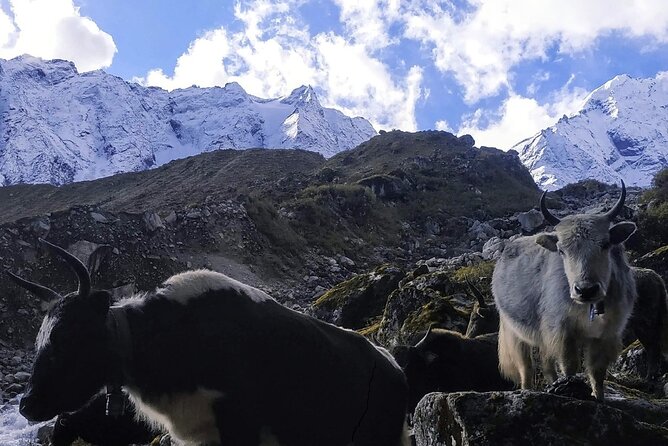
You are not simply walking toward one viewpoint and turning around. The route changes character day by day. Lower sections pass through warm valleys, farm plots, suspension bridges, and villages where wheat, barley, millet, and other crops are grown. Higher up, trees thin out, buildings take on a Tibetan look, and the air becomes noticeably drier.
The Manaslu region is also a restricted trekking area. That means permits matter, and this package includes the Manaslu special permit, TIMS Card, and Annapurna Conservation Area Permit. You get the scenery of a major Himalayan trek without the same level of development found on Nepal’s most famous routes.
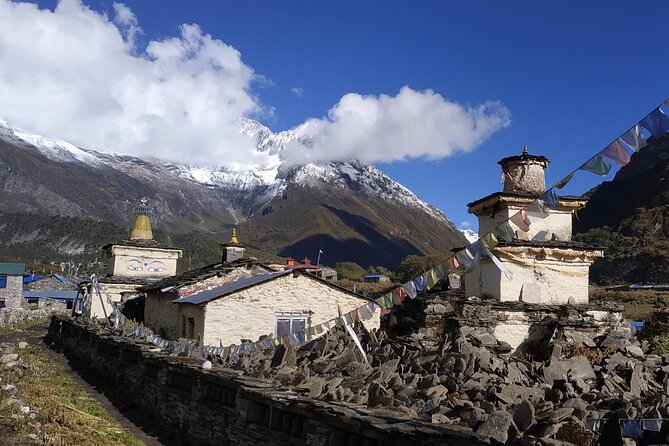
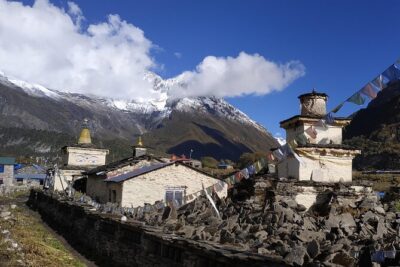
The cultural side is not decorative window dressing. Gurung, Tamang, and Bhote communities live along the route, and villages such as Sama Gaon and Samdo reflect strong Tibetan influence. Monasteries, prayer flags, stone walls, and traditional houses give the trek a sense of place that a faster, road-based tour cannot provide.
More Manaslu Treks in Kathmandu:
- Manaslu Circuit Trek
★ 5.0 · 292 reviews - Manaslu Circuit Trek
★ 5.0 · 184 reviews - Manaslu Circuit Trek (15 Days)
★ 5.0 · 50 reviews
Days 1 and 2: Kathmandu to Machha Khola
You are met at Tribhuvan International Airport and taken to your Kathmandu hotel. The first evening includes a group briefing covering practical rules and conduct, followed by dinner at a Nepali restaurant.
That first night matters. You can meet the guide, check the general plan, and ask about food, clothing, altitude, and the long transfer ahead. Two nights of Kathmandu hotel accommodation with breakfast are included, one before and one after the mountain section.
Day 2 begins with a long road journey toward Arughat and then Machha Khola. The route reaches the warmer Gorkha district, where the climate is subtropical and the road becomes rougher. The final approach is on dirt roads, and the journey is part of the Manaslu experience rather than a minor transfer.
Machha Khola is a small farming settlement that has grown with improved road access. Expect a basic overnight stop, not a polished resort town. This is a day for patience, snacks, and a good book.
Days 3 and 4: Hot springs, Jagat, and bamboo forest
From Machha Khola, you follow the Buri Gandaki River upstream toward Khorla Beshi and Tatopani. Tatopani means hot water or hot spring, and, if time allows, you can take a warm bath before continuing uphill.
The walk then reaches Jagat, a larger village with shops, stocked stores, and simple lodges. Jagat feels like an important gateway into the restricted region. The route is already becoming more demanding, but the village comforts are still relatively easy to find.
The next day leads past rural farm settlements, bridges, and terraced fields. At Philim, the trail passes golden fields of wheat and barley before climbing through bamboo forest and along a rocky ridge toward Deng.
This is one of the first sections where the trip earns its reputation for variety. You get farmland, river corridors, forest, and steep mountain paths in a short span. The listed walking time for this day reaches about 12 hours, so you should be prepared for a full day on your feet.
Days 5 and 6: From Deng to Lo Gaon and Sama Gaon
From Deng, the route enters cooler country. You pass Bihi Bazaar and continue beside the Buri Gandaki, crossing the river and moving through cultivated fields of barley, wheat, and millet.
The trail passes Banjham, Lhi, and Sho before climbing toward Lo Gaon. The climb takes effort, but Lo Gaon offers an excellent view of Manaslu’s north face. This is the sort of place where a slower pace pays off. Stop, look up, and let the mountain do the talking.
The following day takes you higher, beyond regular tree cover. Juniper and willow replace the thicker forest, and the views open toward the surrounding peaks. You finish at Sama Gaon, one of the larger settlements in this remote part of Nepal.
Sama Gaon is important for two reasons. It is a cultural highlight, with Tibetan-style traditions and buildings, and it is the key acclimatization point before the higher section. The village also lies along routes toward Manaslu Base Camp, Larkya La, and the Tibet border.
A few more treks around Kathmandu worth a look
- Everest Base Camp Trek – 14 Days
★ 5.0 · 1,499 reviews - Everest Base Camp Trek
★ 5.0 · 842 reviews - Everest Base Camp Helicopter Tour landing at Everest View Hotel
★ 5.0 · 668 reviews - Everest Base Camp Trekking
★ 5.0 · 485 reviews
The Sama Gaon rest day and a small planning issue
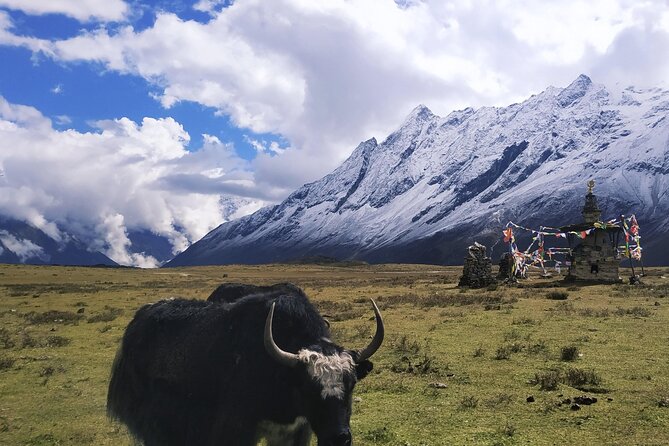
A rest day is scheduled at Sama Gaon before you continue upward. The purpose is not simply to take a holiday from walking. It gives your body time to adjust before Samdo, Dharmasala, and the pass.
You may use the day to explore the village or make an outing toward Manaslu Base Camp, described in the program at about 4,800 meters. The exact activity should be confirmed with your guide, since the schedule also contains a duplicated Sama Gaon description and inconsistent walking-time figures.
That is worth mentioning before you book. The broad route is clear, but some daily times are plainly overstated or repeated. Ask for the final operational schedule, expected walking hours, and the plan for the Sama Gaon rest day.
Days 8 and 9: Samdo and the last village before the pass
After acclimatization, you walk toward Samdo. The distance is not especially great, but high altitude slows everything. Dry air, thinner oxygen, and the gradual climb make a short day feel longer than it looks on paper.
Samdo is the last village before the Larkya La base area. Its strong Tibetan influence comes from its closeness to the border, and trade across the region has shaped local life. This is a fine place to notice the difference between the lower farming villages and the high settlements.
You should treat this section seriously. Headaches, nausea, unusual fatigue, and poor coordination are not problems to hide. The guides highlighted in this program, including Suman, Suraj, Rajan Gole, Laku, and others, are there to help manage the pace and watch your condition. Their value is not just navigation. It is judgment.
Day 10: Dharmasala and the blue sheep country
The route drops to the Budhi Gandaki River, crosses it, then climbs through Larkya Bazaar and the Salka Khola Valley toward Dharmasala, also called Larke Phedi.
The walk is described as about seven kilometers and roughly four hours under normal conditions, but the high altitude can make it slower. Dharmasala is not a conventional lodge town. Accommodation is basic, and you spend the night there before the pass.
This is where your packing choices begin to matter. Keep warm layers, gloves, a headlamp, water, and anything you need for the early morning in an easy-to-reach place. The package provides a down jacket and sleeping bag if needed, but you should confirm sizes and availability before departure.
Blue sheep may be seen in this section. Wildlife is never guaranteed, but the dry valley and open slopes give you a chance to notice more than just the trail.
Day 11: Crossing Larkya La
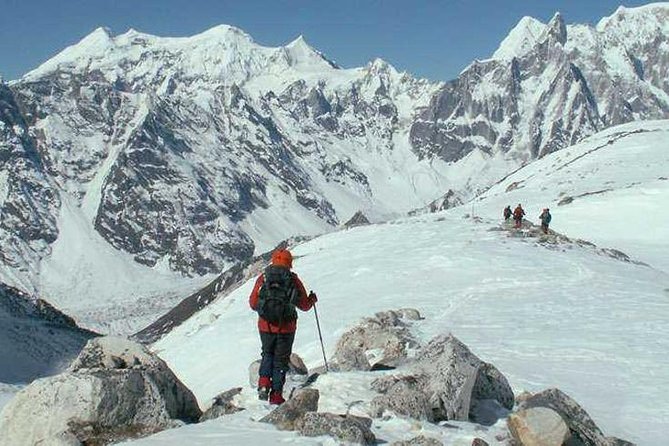
The pass day starts early. From Dharmasala, the path climbs gradually at first, then becomes steeper as it winds toward Larkya La.
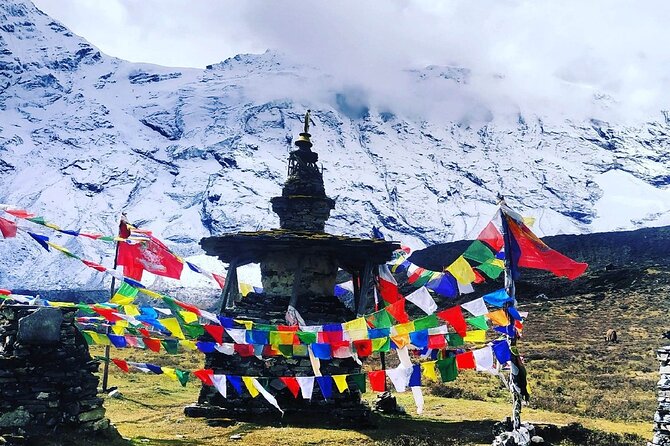
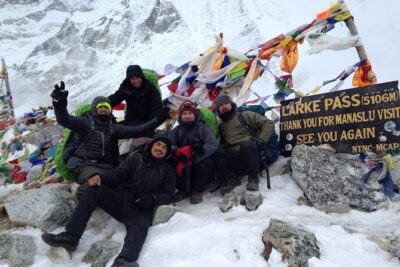
At the top, prayer flags and piles of stones mark the high point. The reward is a broad view toward Himlung, Cheo Himal, Kang Guru, and Annapurna II. This is the defining moment of the circuit, but it is not a casual photo stop. Snow, loose scree, cold, altitude, and fatigue can all slow you down.
After the pass, the trail drops a long way toward Larcia, then continues over moraine to Tambuche at about 3,900 meters. The day ends at Bhimtang, a beautiful valley with several good lodges.
The descent can be as tiring as the climb. Your knees will feel the difference, and walking poles can be useful, though they are not listed as included equipment. Plan on about 11 hours for this day, with flexibility for snow and weather.
Days 12 to 14: Forest, Dharapani, and the road back
From Bhimtang, the trail descends through forest, passes small summer settlements, and reaches terraced fields near Karche La. You then follow the Marysangdi River toward Tilje and Thonje.
At Dharapani, you join the main Annapurna Circuit route. This changes the feel of the trip. The isolated Manaslu section is finished, and road access becomes more prominent.
After Tilje, a shared jeep takes you to Besisahar, a journey of about four hours. The day can run to around 15 hours once walking and driving are combined, so do not expect a gentle final stroll.
The next morning, you drive from Besisahar to Kathmandu, passing farm villages and terraced fields before reaching the capital on a better road. The final night is free for rest, food, or last-minute shopping. On Day 14, airport transfer is arranged according to your international flight time.
What the $1,099 price really covers
At $1,099 per person, the price is strong for a guided Himalayan trek because it includes several costs that can quickly add up:
- Airport and other ground transportation
- Two Kathmandu hotel nights with breakfast
- Eleven tea-house nights during the trek
- Breakfast, lunch, and dinner during the mountain section
- Manaslu, TIMS, and ACAP permits
- A registered trekking guide
- Tea or coffee three times during the trek
- Seasonal fruit
- First-aid supplies
- A down jacket and sleeping bag if needed
The lodging is twin-sharing, with one room for every two clients. Tea houses are practical rather than luxurious. You should expect simple rooms and changing standards as you climb.
The price does not include travel or rescue insurance, Kathmandu meals, personal drinks, hot water, showers, laundry, phone use, battery charging, or tips for the guide and porter. It also does not cover extra costs caused by delays, strikes, canceled transport, an early return from the mountains, or extra Kathmandu hotel nights.
This is good value if you use the included meals, permits, transport, and equipment. It is less of a bargain if you expect private rooms, unlimited hot showers, or a large personal spending allowance.
Guides, porters, and the human side of the trek
The strongest part of this experience is the guiding support. Specific guides associated with this operator include Suman, Suraj, Rajan Gole, Laku, Indako, Santa Gurung, Buddhi, and Surya. Assignments can change, so do not book solely around one name unless the company confirms that person.
The practical pattern is clear: the guides help with pacing, breaks, health checks, route decisions, and daily logistics. Suman is particularly associated with patient support and attention to group health, while guides such as Suraj, Rajan, and Laku are praised for keeping difficult days manageable.
Porters also make a major difference. Names connected with these trips include Bibash, Bardan, Kami, Dambar Lama, and Saila. If you use porter support, pack with respect for weight limits and remember that tips are not included.
The tour is described as private, so your group participates on its own rather than being placed into a large public departure. That gives you more room to discuss pace and rest, though the actual group size is not stated.
Who should book this trek?
You should consider it if you want a serious Himalayan route with cultural contact, changing scenery, and a major pass crossing. It suits people with a moderate physical fitness level who are comfortable walking for many hours, sleeping in basic tea houses, and handling uncertain mountain weather.
You should think twice if you dislike rough roads, long transfers, limited facilities, or high-altitude exertion. The pass is demanding even for fit walkers, and the final walk-and-jeep day is especially long.
Travel insurance with trekking and rescue coverage is essential. It is not included, and the remote setting makes this a poor place to rely on a basic policy.
Should you book the Manaslu Circuit Trek?
I would choose this trip if your priority is a varied, less developed Himalayan circuit with strong village culture and a clear high point at Larkya La. The included permits, meals, tea-house rooms, Kathmandu hotels, transport, and guide support give the $1,099 price real value.
Before paying, confirm the final day-by-day schedule, the exact walking hours, your guide assignment if important, porter arrangements, equipment sizes, and how weather or road delays will be handled. Book it if you are ready for a demanding trek and accept basic conditions. Skip it if you want a relaxed holiday with short walks and dependable comfort.
Cancellation is free up to 24 hours before the local start time. Inside 24 hours, the payment is not refunded. The departure also requires a minimum number of participants, with an alternative date or full refund offered if the operator cancels for that reason.
FAQ
How long is the Manaslu Circuit Trek?
This program lasts about 14 days, including arrival and departure days in Kathmandu. The walking route itself is commonly completed in about 10 to 15 days.
What is the highest point of the trek?
The highest point is Larkya La Pass, listed at about 5,106 meters. One section gives the elevation as about 5,160 meters, so you should confirm the exact figure with the operator.
Is airport pickup included?
Yes. Pickup from Tribhuvan International Airport is offered, and ground transportation is included in the package.
Are permits included?
Yes. The package includes the Manaslu special permit, TIMS Card, and Annapurna Conservation Area Permit.
Are meals included during the trek?
Yes. Breakfast, lunch, and dinner are included during the mountain section. Food in Kathmandu is not included.
What accommodation is provided?
The package includes two Kathmandu hotel nights with breakfast and 11 nights in local tea houses. Tea-house rooms are twin-sharing, with one room for every two clients.
Is a guide included?
Yes. A government-registered trekking guide is included. The specific guide can vary, with Suman, Suraj, Rajan Gole, Laku, Indako, and others associated with different departures.
Is there a rest day for acclimatization?
Yes. A rest day is scheduled at Sama Gaon before the higher section toward Samdo and Larkya La.
Are insurance and rescue included?
No. Travel and rescue insurance are not included. You need to arrange them separately.
What personal costs are extra?
Phone calls, laundry, battery charging, bottled water, hot water, showers, Kathmandu meals, tips, extra hotel nights, and unplanned expenses are extra.
Can I cancel for a full refund?
Yes, if you cancel at least 24 hours before the experience start time. Cancellations or changes made within 24 hours are not refunded.
Just added around Kathmandu
- Everest Base Camp Trek★ 5.0 · 3 reviews
- Everest Base Camp Trek★ 5.0 · 7 reviews
- 15 Days Private Everest Base Camp Trek★ 5.0 · 30 reviews
- Everest Base Camp Trek★ 5.0 · 57 reviews
- 14 Days of Adventure Trekking to Everest Base Camp★ 5.0 · 2 reviews
- 14-Day Everest Base Camp Trek★ 5.0 · 20 reviews
- 14 Days Everest Base Camp Trek★ 5.0 · 4 reviews
- From Kathmandu: Private 14-Day Everest Base Camp Trek★ 5.0 · 20 reviews
Manaslu Circuit Treks, compared.
Experience the Thrill of a Lifetime:12-Days Manaslu Circuit trek
Read our review →
Browse the lists this trek appears in