
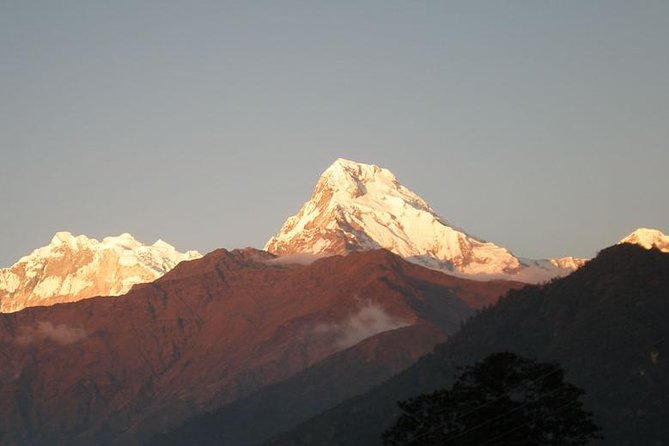
Review · POKHARA
Annapurna Panorama trek
The best part of this trip is the way it pairs Poon Hill sunrise views with a slower route through Ulleri, Ghorepani, Tadapani, Ghandruk, and Pothana. You get Annapurna scenery without committing to a long, high-altitude expedition, and your private guide keeps the pace personal.
I like that permits, meals, snacks, porters, and basic gear are covered. I also like the mix of mountain walking with Kathmandu’s temples and Pokhara’s lakeside setting. The catch is the price does not cover city meals, entrance fees, insurance, hot showers, Wi-Fi, or device charging, and several trail days involve long stone staircases.
Key points to know before booking
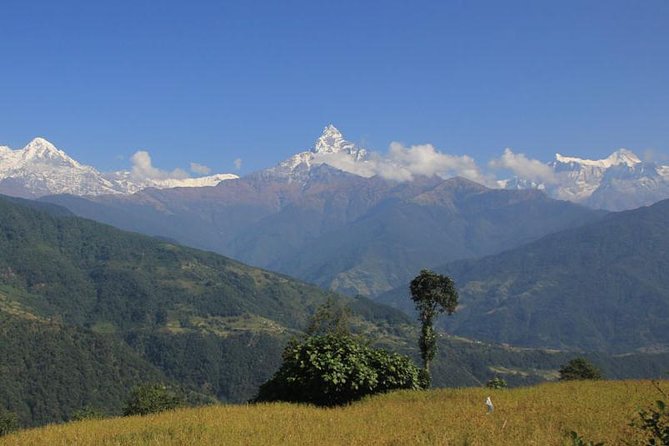
- Poon Hill reaches 3,210 meters: The sunrise climb is the trip’s main mountain highlight, with Annapurna views from a manageable altitude.
- Six days on foot: The route includes steep steps, forest trails, downhill sections, and one potentially slippery red-mud stretch in monsoon.
- Private means flexible pacing: Only your group participates, so the guide can respond to your walking speed and energy.
- Mountain costs are mostly covered: Lodging, three daily meals, snacks, tea, coffee, bottled water, permits, porters, and guide services are included.
- The Kathmandu and Pokhara portions add context: You visit major temples and squares before and after the trek, rather than treating the mountains as a stand-alone trip.
- Guide quality matters here: Mountain Mart guides praised in the supplied feedback include Ram Bhandari, Yukumar Magar, and Nabin, though your assigned guide should be confirmed before departure.
Why this Annapurna route works so well
This is a sensible choice if you want a real Himalayan trek but do not want to spend two or three weeks at extreme altitude. The highest point is Poon Hill at 3,210 meters, and the route returns through villages and forest rather than pushing toward Annapurna Base Camp.
You still need a moderate level of fitness. The hard part is not technical climbing. It is the repeated uphill and downhill walking, especially the stone steps between Nayapul, Tikhedhunga, and Ulleri. You should be comfortable walking for five to seven hours on several days.
The private format is useful. You are not tied to a large group’s pace, and a registered English-speaking guide leads the way. That removes much of the worry about route finding and helps with practical matters such as lodging, meals, permits, and porter arrangements.
Mountain Mart’s feedback places particular emphasis on guides taking care of people when plans become difficult. Ram Bhandari is repeatedly praised for patience, warmth, and personal attention, while Yukumar Magar and Nabin also receive strong comments for safety, organisation, and family support. These comments cover several Mountain Mart treks, so ask who will lead your departure rather than assuming a particular guide.
More Annapurna Treks in Pokhara
- Trekking in Annapurna/Langtang/Everest/Upper Mustang regions
★ 5.0 · 161 reviews - Pokhara: Annapurna Foothills Day Hike with Transfers
★ 5.0 · 100 reviews - Kathmandu/Pokhara: 5-Day Annapurna Base Camp (ABC) Trek
★ 4.9 · 72 reviews
Days 1 and 2: Kathmandu temples, squares, and Thamel
Your first day begins with an airport pickup and a transfer to your Kathmandu hotel. An afternoon walk through Thamel gives you an easy first look at the city, with shops, restaurants, trekking stores, and a good place to sort out any last-minute needs.
The second day is a full sightseeing day by private transport. The route includes Pashupatinath Temple, Boudhanath Stupa, Patan Durbar Square, Krishna Temple, Kumbheshwar Temple, the Golden Temple, Swayambhunath Stupa, and Kathmandu Durbar Square.
That is a lot for one day, but it gives you useful cultural context before the mountains. Patan’s courtyards and temples show a different side of the Kathmandu Valley from the hilltop view at Swayambhunath, while Boudhanath provides a calmer, more spacious stop.
Entrance fees are not included, so budget separately for the city sites. This is also one of the days when lunch and dinner are your responsibility. The three nights of boutique hotel accommodation in Kathmandu are covered, but the included meals listed for the trek do not extend to your city stay.
Day 3: The long road from Kathmandu to Pokhara
The drive to Pokhara takes about five to six hours, following the Trishuli River. The stated time is approximate, since traffic and road conditions can affect the journey.
Pokhara gives you a softer transition into the trek. Your hotel is in Lakeside near Fewa Lake, a convenient base for the evening before the walking begins. You can use this time to check your daypack, arrange your borrowed equipment, and have a relaxed meal, though that meal is not included.
The road transfer is practical rather than scenic sightseeing. If you prefer to fly between Kathmandu and Pokhara, that is not part of this package, so the road journey is an important part of the schedule. It also means the first and last travel days are fairly long.
Day 4: Nayapul to Ulleri, your first serious climb
A private vehicle takes you from Pokhara to Nayapul, about 45 kilometers away. From there, you walk through Birethanti and Sudame before reaching Tikhedhunga and climbing to Ulleri.
The day combines roughly one and a half hours of driving with five to six hours of trekking. The final ascent to Ulleri is the test. Stone staircases make the route clear, but they also make the climb feel steady and repetitive.
This is where the private guide and porter setup earns its keep. One porter is provided for every two trekkers, and your luggage is carried while you walk with only the items you need during the day. A duffel bag is included, along with walking poles and a down-filled sleeping bag if required.
Mountain accommodation is described as comfortable private rooms with shared toilets. That is a useful distinction: you have privacy for sleeping, but you should not expect a private bathroom in the mountain lodges.
Same trailhead, a different route:
- Poon hill Trek 3 days
★ 5.0 · 176 reviews - Pokhara: 4-Day Ghorepani, Poonhill & Ghandruk Mountain Trek
★ 5.0 · 132 reviews - Ghorepani – Poon Hill Trek 3N-4D
★ 5.0 · 125 reviews - From Pokhara: 3-Day Ghorepani Poon Hill Trek with Guide
★ 4.9 · 68 reviews
Day 5: Ulleri to Ghorepani through oak and rhododendron
The route from Ulleri to Ghorepani takes about five to six hours and covers roughly 11 kilometers. You continue through rhododendron and oak forest, with the trail rising toward Upper Ghorepani, also called Deurali.
This is a beautiful section, but it is not a gentle stroll. The scenery helps, yet the climb remains the main job of the day. You should keep your pace even and avoid racing early in the morning.
Ghorepani is important because it sets up the next day’s Poon Hill walk. Staying in Upper Ghorepani puts you close to the early start, though an early morning departure is still necessary for the best chance of reaching the viewpoint around sunrise.
Day 6: Poon Hill sunrise and the trail to Tadapani
You climb to Poon Hill at 3,210 meters, then return to Ghorepani before continuing to Tadapani. The full day takes about six to seven hours.
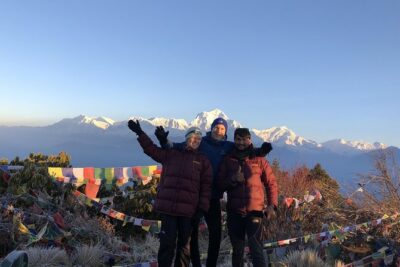
Poon Hill is the visual high point of the route. From here, you look toward the Annapurna range from a famous Himalayan viewpoint, with the changing morning light providing the main reward for the early climb.
The return to Ghorepani is followed by a forested walk through pine and rhododendron toward Tadapani. The day has a clear rhythm: an early uphill push, a descent, and then more walking through forest. If your legs are tired from the previous two days, this will likely be the most demanding day.
At the same time, it is less intimidating than a high pass trek. You reach the route’s highest point without the extreme altitude concerns found on much higher Himalayan itineraries. Travel insurance and evacuation insurance are not included, so arranging both is a sensible part of preparation.
Day 7: A shorter walk into Ghandruk
The trek from Tadapani to Ghandruk takes about three to four hours and follows a pleasant downhill forest path. After several long days, this shorter stage gives you time to enjoy Ghandruk and its surrounding area.
Ghandruk is one of the route’s best village stops. The itinerary allows time to explore rather than simply arrive, eat, and sleep. The shorter walking day also makes this a good point to recover before the longer route toward Pothana.
Keep in mind that downhill walking can be hard on knees, especially after the stairs near Ulleri and the Poon Hill climb. Walking poles are included and are worth using, particularly on descents.
Day 8: Ghandruk to Pothana, with mixed trail conditions
The walk to Pothana takes about five to six hours. You descend by stone steps toward the Modi Khola, climb to Landrung, continue through Tolkha, and then make a steady ascent toward Deurali.
The final section descends through forest toward Pothana. During the monsoon, this red-mud trail can be slippery. That detail matters when choosing your footwear and travel dates. Shoes with reliable grip are more important here than lightweight trainers.
This is a varied day, with village paths, stone staircases, forest, descents, and climbs. You should not read the stated distance and times as a promise of an easy walk. The terrain changes often, and wet conditions can slow progress.
Day 9: Pothana to Pokhara
The last walking day takes three to four hours from Pothana to Phedi, followed by a roughly 40-minute drive to Pokhara. The trail follows a ridge toward Dhampus and offers views toward the Annapurna range before descending to the road.
Compared with the previous days, this is an easier finish. You have one more chance for mountain views, then return to the comfort of your Pokhara hotel. The drive means you do not have to walk all the way into the city.
Your Pokhara accommodation and city meals are separate from the trek inclusions, so plan for those costs. The package includes breakfast, lunch, and dinner during the trekking section, plus supplementary snacks such as cookies, energy bars, and seasonal fruit.
Day 10: Return to Kathmandu and farewell dinner
The return drive to Kathmandu takes about five to six hours. Like the journey to Pokhara, it is a transport day rather than a sightseeing day, and traffic can change the timing.
An evening farewell dinner is included in the schedule, although the supplied details do not clearly state whether the dinner itself is covered in the price. It is wise to confirm this before booking.
You spend the night in Kathmandu, with your final departure scheduled for the following day. This extra night is useful because it avoids combining a long road journey with an international flight on the same date.
What the $1,045 price really covers
At $1,045 per person, the price is strongest for people who value a package with fewer loose ends. You are paying for three nights in a Kathmandu boutique hotel, mountain lodging, trekking permits, private transfers on the trailhead sections, a guide, porters, meals, snacks, bottled water, tea, coffee, taxes, and equipment.
The gear loan is especially helpful if you do not want to buy or transport a sleeping bag, down jacket, or walking poles. The duffel bag also fits the porter arrangement, where one porter carries luggage for two trekkers.
The package does not cover everything. You need to allow extra money for:
- Kathmandu entrance fees
- Lunch and dinner in Kathmandu and Pokhara
- Hot showers in the mountains
- Wi-Fi and electronic charging
- Boiled water
- Bottled drinks beyond the stated provision
- Personal expenses
- Travel and evacuation insurance
- Tips
This is still a solid value for a private 11-day trip, but it is not an all-inclusive holiday. The biggest practical question is how much independence you want. If you want a guide, porter support, permits, meals, and lodging arranged together, the price is reasonable. If you already own trekking equipment and prefer to arrange simple lodging yourself, you may find a shorter independent trek costs less.
What to pack and what to expect in the lodges
Pack light, since porters carry the main luggage, but keep a daypack with water, rain protection, warm layers, snacks, and personal medication. A down jacket, sleeping bag, and walking poles can be borrowed, which reduces the amount of specialized gear you must bring.
Mountain rooms are private but toilets are shared. Hot showers, Wi-Fi, and device charging cost extra and may not be available at every stop. Bottled water is listed as included, while boiled water is not, so clarify the daily water arrangement before setting out.
Good footwear matters most. You will walk on stone steps, forest trails, ridge paths, and possibly slippery red mud. The supplied feedback includes an account of a guide lending shoes when a participant had trouble with footwear. That shows the value of attentive support, but it is not a reason to arrive with poor shoes. Bring footwear you have already used.
Who should book this Annapurna Panorama trek
I would choose this trip if you want a moderately challenging mountain route with cultural sightseeing at both ends. It suits couples, friends, and families with older children who can manage long walking days. Children must be accompanied by an adult, and the minimum booking requirement is two people.
The route is also a good fit if you want privacy rather than a large group. You can walk at your own group’s pace and ask the guide to explain local culture, plants, villages, and route conditions. The supplied feedback gives particular weight to guides who were patient with families and careful about food, lodging, and safety.
I would think twice if you dislike long road transfers, shared bathrooms, steep steps, or basic mountain facilities. This is not a luxury walking holiday. It is a supported trek with comfortable enough lodging, but the trail still demands effort.
The booking can be cancelled for a full refund up to six full days before the start time. Cancelling two to six days before gives a 50 percent refund, while cancelling less than two days before gives no refund. The cut-off uses local time.
Should you book it?
Book this trek if you want the famous Poon Hill view but also want a fuller route through Annapurna villages and forests. The combination of permits, meals, porters, equipment loans, and private guiding gives you a practical package for a first Himalayan trek.
Before paying, confirm your guide’s name, exactly what the farewell dinner includes, the expected group luggage allowance, and current arrangements for drinking water. If you accept the steep stairs, shared facilities, and long drives, this is a well-balanced introduction to Nepal’s mountains, with enough time in Kathmandu and Pokhara to make the trip feel like more than a walk.
FAQ
How long is the Annapurna Panorama trek?
The full trip lasts approximately 11 days. It includes three days in Kathmandu, travel and time in Pokhara, six days of trekking, and the return to Kathmandu before departure.
What is the highest point on the route?
The highest point is Poon Hill at 3,210 meters, or 10,528 feet.
Is this a private trek?
Yes. Only your group participates, and a private English-speaking, government-registered trekking guide leads the trek.
Are meals included?
Breakfast, lunch, dinner, snacks, bottled water, tea, and coffee are included during the trek. Lunch and dinner in Kathmandu and Pokhara are not included.
Is trekking equipment provided?
A down-filled sleeping bag, walking poles, and duffel bag are provided. The tour also states that down jackets can be borrowed if needed.
Are permits included?
Yes. The Annapurna Conservation permit, TIMS, and other necessary paperwork are included.
What fitness level is required?
A moderate level of physical fitness is required. Walking days range from about three to seven hours and include steep stone steps, uphill sections, downhill trails, and potentially slippery mud during monsoon.
What is not included in the price?
City entrance fees, city lunches and dinners, boiled water, hot showers, Wi-Fi, electronic charging, bottled drinks, personal expenses, travel and evacuation insurance, and tips are not included.
Just added around Pokhara
- Pokhara: Sarangkot Sunrise & Panoramic Annapurna View Tour★ 4.8 · 10 reviews
- Pokhara: Majestic Mardi Base Camp Guided Trek with HotSpring★ 5.0 · 6 reviews
- Pokhara: Bungee Jumping Experience Near Annapurna★ 5.0 · 9 reviews
- Pokhara: Annapurna Day Hike with Panoramic Views★ 4.3 · 7 reviews
- Pokhara: 9-Day Annapurna Base Camp Trek with Poon Hill★ 5.0 · 6 reviews
- Pokhara: 7-Day Annapurna Base Camp Trek & Hot Spring★ 4.0 · 3 reviews
- Pokhara: 5-Day Trek to Annapurna Base Camp and Hot Springs★ 5.0 · 4 reviews
- Pokhara: 5-Day Ghorepani and Poon Hill Private Trek★ 5.0 · 4 reviews
Annapurna Base Camp Treks, compared.
Trekking in Annapurna/Langtang/Everest/Upper Mustang regions
Read our review →
Kathmandu to Annapurna Base Camp (ABC) 5-Day Trek
Read our review →Browse the lists this trek appears in