
Review · ITALY
Via Ferrata Rio Sallagoni
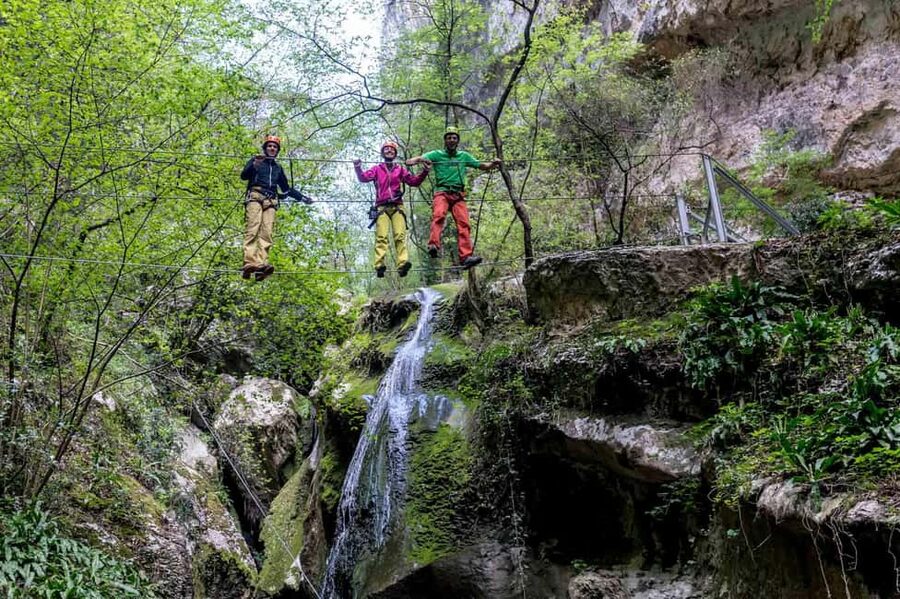
The Via Ferrata Rio Sallagoni threads through a narrow gorge beneath the Castle of Drena, with waterfalls, dark rock walls, and a rope bridge that asks you to trust your balance. It feels closer to a canyoning trip than a normal hike, but you stay above the water.
I like the fairy-tale setting and the fact that the route keeps changing: iron brackets, steep rock, shadowy ravine, and the Tibetan bridge all bring a different challenge. I also like that a guide supplies the harness, helmet, and ferrata set, so you do not need to assemble your own technical kit.
The main caution is exposure. Some sections are high above the gorge, and the iron brackets can be far apart. You need moderate fitness, a head for heights, and a minimum height of 140 centimeters.
Key points
- Waterfalls without getting wet: The route has a canyoning feel, but you move along the gorge walls rather than through the water.
- A real balance test: The Tibetan rope bridge adds a short but memorable challenge.
- Technical gear included: Your harness, helmet, and ferrata set are provided.
- Small group format: A maximum of eight people allows the Alpine Guide to give more direct help.
- Guide Marco’s patient approach: His calm coaching can make difficult passages feel manageable, including for older hikers.
- Castle of Drena finish: The upward route leads toward this striking historic landmark above the gorge.
Entering the Rio Sallagoni gorge
The meeting point is Ferrata Rio Sallagoni at Località Lavini in Dro, in Trentino-Alto Adige. The activity begins at 9:00 am and returns to the same place, which keeps the day simple. You do not need to arrange a separate pickup or figure out where the route ends.
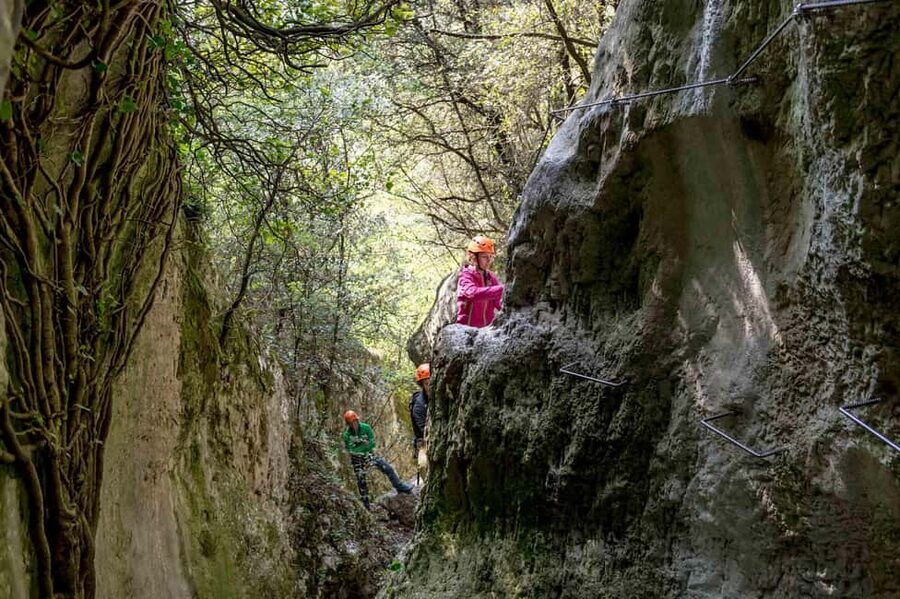
The gorge is the star from the first serious section onward. Light filters between the rock walls, while water and waterfalls add sound and movement below. The setting is wild and romantic, but this is not a passive viewpoint walk. You are there to work your way upward along the sides of the ravine.
The route has the character of canyoning, with one important difference: you stay out of the water. That makes the outing appealing if you want the drama of a wet gorge without committing to a fully aquatic activity. You should still expect a physical outing, not a gentle stroll.
Your guide provides the harness, helmet, and ferrata set before you take on the protected sections. Those items matter because the route depends on fixed ironwork and safety attachments. The included Alpine Guide Service also gives you instruction and support as the terrain becomes more demanding.
More Via Ferrata Routes in Italy
- Dolomites Via Ferrata Experience
★ 5.0 · 58 reviews - Via Ferrata Cima Capi
★ 5.0 · 27 reviews - Lake Garda: Cima Capi Via Ferrata
★ 4.9 · 14 reviews
Iron brackets on steep rock
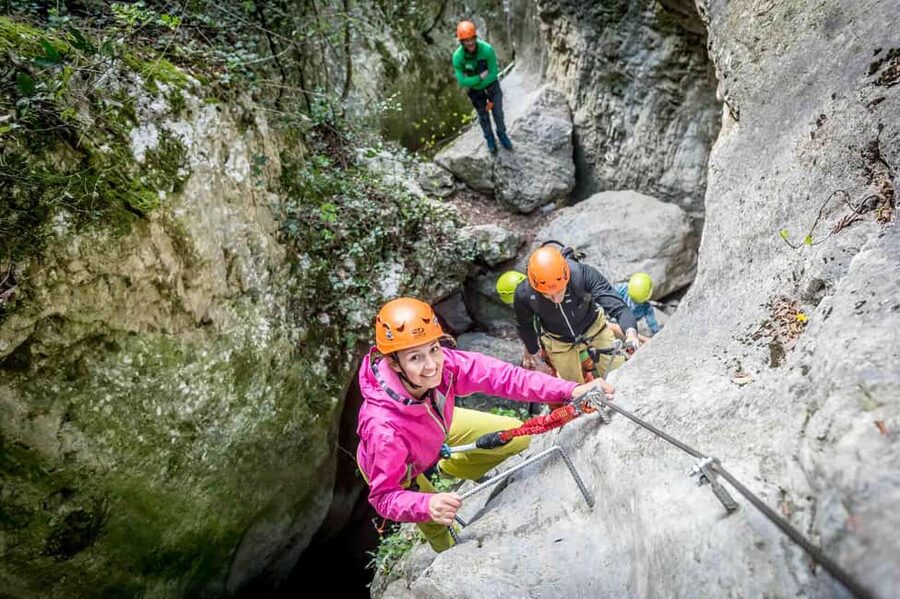
A via ferrata uses fixed metal aids to help you cross rock that would otherwise require climbing skills. On Rio Sallagoni, the brackets carry you along the sides of the gorge, sometimes with steep walls rising close beside you and open space below.
The route is not especially long in overall time, but it packs several kinds of movement into roughly three and a half hours. You may pull yourself along iron steps, reach across to the next bracket, and pause to place your feet carefully. The point is not speed. A steady rhythm will serve you better.
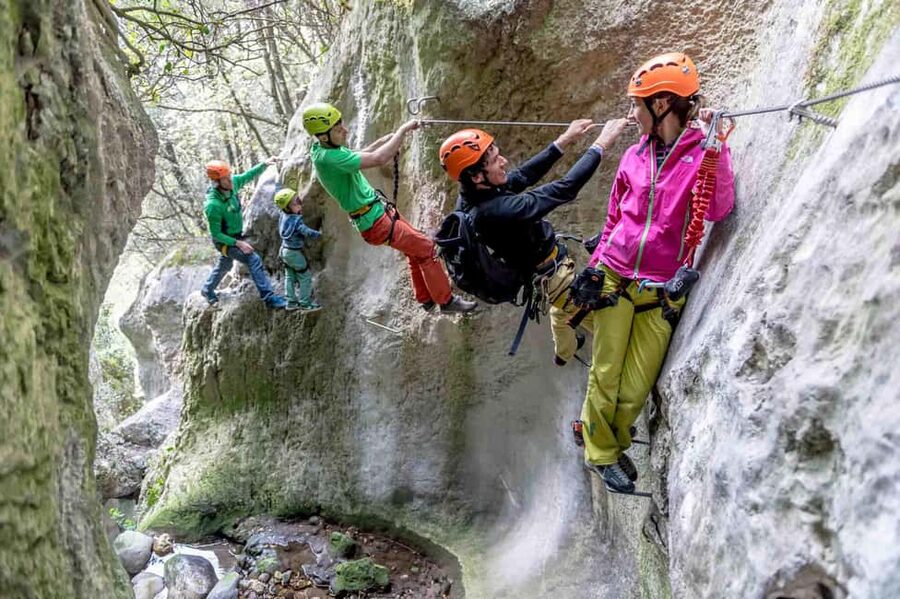
Some protruding sections and longer gaps between brackets put your arms and legs to work. This is where moderate fitness becomes important. You do not need to be an advanced climber based on the information provided, but you do need enough strength and coordination to manage your body on the fixed aids.
I would pay attention to the guide’s instructions and keep your movements controlled. The gear gives you protection, but it does not remove the need for balance or effort. If heights make you uncomfortable, the gorge walls and exposed sections may feel more serious than they look in photographs.
The compact group size helps here. With no more than eight people, the Alpine Guide can keep an eye on the group and offer practical help when someone reaches a tricky section. That is particularly useful for first-time via ferrata participants, who may need a moment to work out how to move from one iron point to the next.
Waterfalls, shade, and the canyoning feel
The best part of Rio Sallagoni is the contrast between the technical route and the setting. One moment you are concentrating on the next metal step. The next, you are looking into the gorge at falling water or watching sunlight move across the rock.
The route is described as a refreshingly cool summer activity, and the gorge setting helps explain why. The walls create shade, while the waterfalls bring a sense of coolness even though you are not entering the stream. That makes a morning start at 9:00 am a sensible choice for a physically active outing.
The water also changes the mood of the route. This is not simply a climb with scenery placed around it. The sound of the falls and the play of light give the passage a more atmospheric quality. You get the feeling of moving through a natural corridor rather than crossing a series of unrelated obstacles.
Still, do not confuse the romantic setting with an easy outing. The technical parts remain central. You will need to focus on your footing and on the ironwork, especially when the route moves away from the gorge floor or presents a longer reach.
Snacks are not included. For a three-and-a-half-hour activity, you should plan ahead rather than assume food will be supplied. The supplied information does not specify a meal or refreshment stop, so handle your own food needs before or after the activity.
The Tibetan bridge tests your nerve
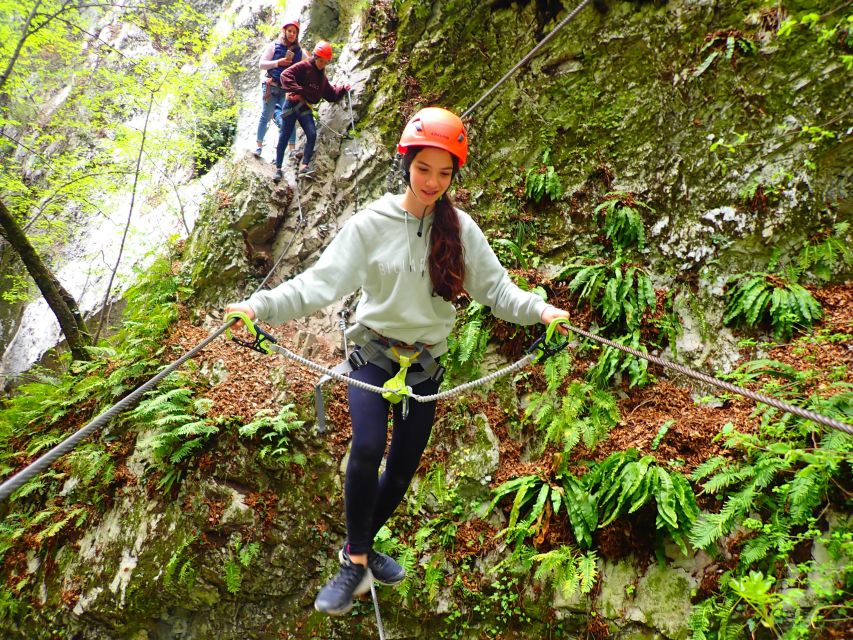
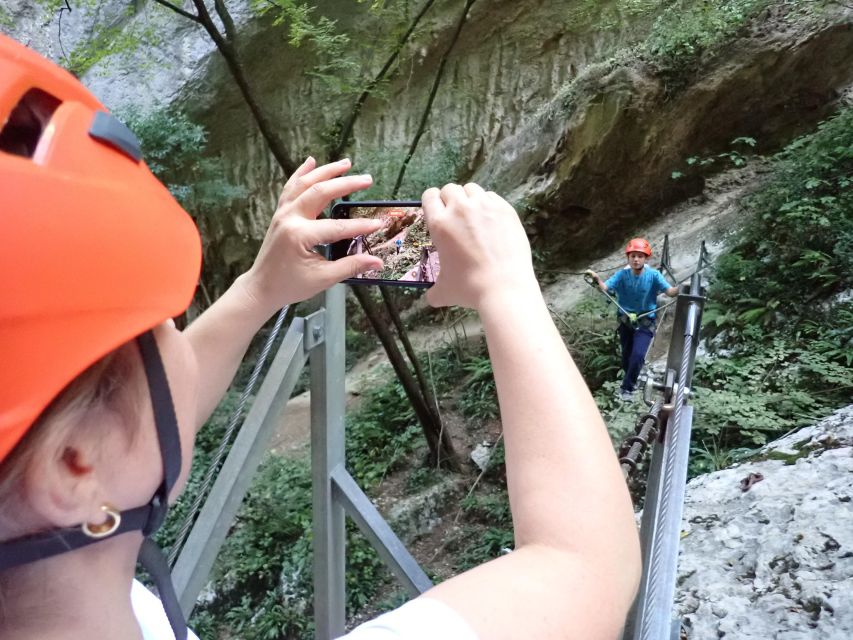
The Tibetan bridge is the route’s most obvious balance challenge. Made from ropes, it asks you to cross rather than simply climb. The bridge brings a different kind of tension because your feet and balance become the focus.
You may find this easier if you look ahead and keep your pace calm. It is natural to stare down, but the gorge setting and open space can make that a poor habit. The guide is there to help you manage the obstacle, and a small group means you are not facing it in a large crowd.
This section adds variety to the route. Without it, the outing would rely mainly on iron brackets and steep walls. With it, the experience has a clear moment of balance, courage, and concentration.
If you are afraid of heights, take the warning seriously. The activity is specifically not recommended for people who fear heights. A person who enjoys mountain paths but dislikes exposure may find the bridge and cliffside sections too stressful, even with the safety equipment.
Same trailhead, a different route:
- Mount Etna: Trek to 3000m with cable car and 4×4
★ 4.6 · 3,823 reviews - Mount Etna: Summit Crater Trek with Cable Car
★ 4.8 · 1,875 reviews - Etna: summit craters trekking with volcano guide 3350mt
★ 4.7 · 1,712 reviews - Catania: Mount Etna Trekking Tour Beyond the Tourist Trails
★ 4.9 · 1,596 reviews
Climbing toward Castle of Drena
As you work upward through the gorge, the route leads toward the magnificent Castle of Drena. The castle gives the outing a destination and adds a cultural note to what could otherwise be a purely athletic activity.
The information does not provide a detailed castle visit or promise entry inside, so you should treat it as the landmark toward which the route climbs, not automatically as a separate castle tour. Its presence still gives the ascent a strong sense of direction. You are not just completing obstacles; you are moving toward a recognizable place above the ravine.
That combination is one of the tour’s strengths. You get natural drama from the waterfalls and rock walls, physical challenge from the via ferrata, and a historic feature at the upper end. It is a well-shaped half-day experience, even though the route itself is not long.
The activity ends back at the meeting point. That return arrangement is practical if you are planning more time in the Dro area afterward. It also means you can leave your day open without needing to coordinate a different final pickup point.
What the guide adds to the experience
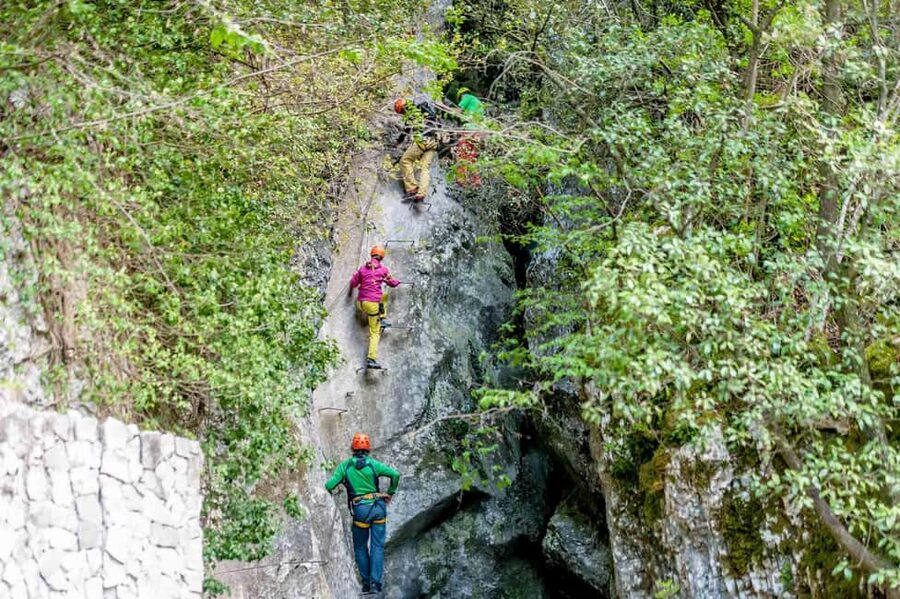
The Alpine Guide Service is included in the price, and here it is more than a formal escort. A fixed route can still feel confusing when you are clipped into equipment and facing a steep section for the first time. Guidance helps you understand where to place your feet, how to approach the next obstacle, and when to slow down.
Marco receives particular praise for his patience and for mixing encouragement with a healthy level of challenge. That detail matters more than a generic promise of a guide. A route like this needs someone who can help without turning every difficult moment into a rush or removing all the adventure.
One published account describes the experience as a 66th birthday present that remained manageable because of Marco’s patient approach. That suggests the activity can suit an older, fit participant, but it does not make the route suitable for everyone of that age. Your own strength, comfort with heights, and prior experience matter more than the number on your birthday cake.
The guide also makes the small group limit useful. A maximum of eight participants is not private guiding, but it is far more personal than a large outing. You will have a better chance of receiving direct help and moving at a pace the group can handle.
Is $84.02 a fair price?
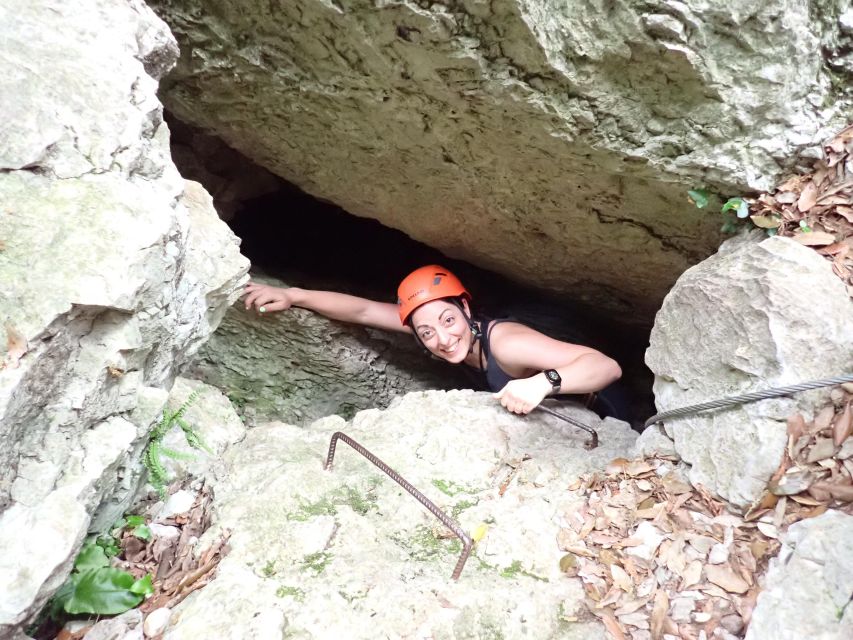
At $84.02 per person, the price covers the parts of this activity that are costly and important to arrange yourself: the harness, helmet, ferrata set, liability insurance, and Alpine Guide Service. You are paying for access to a technical route with proper equipment and supervision, not simply for a walk through a gorge.
I see the value most clearly if you are new to via ferrata or do not own the equipment. Buying or hiring a complete set separately would add both cost and planning. A guide also lets you focus on the route instead of worrying about whether your gear is correctly arranged.
The price is less compelling if you already have suitable equipment and strong via ferrata experience. In that case, the main benefit becomes the organized route, insurance, and local guide rather than the kit itself. You should also remember that snacks are not included.
With a five-star rating from 22 published ratings and full recommendation from those ratings, the experience has a strong record. Still, a perfect score cannot change the basic nature of the activity. This is a technical, exposed outing, and value depends on wanting that challenge.
Who should book this route?
I would recommend Rio Sallagoni to you if you want more than a standard mountain walk and like the idea of using your hands as well as your feet. It suits fit adults and older hikers with moderate fitness, a willingness to follow instructions, and no serious fear of heights.
It may also work well as a first guided via ferrata. The supplied equipment and small group remove much of the usual planning burden, while Marco’s patient style can help you build confidence. You still need to participate actively. The guide cannot carry you across the longer bracket sections or balance for you on the rope bridge.
The minimum height is 140 centimeters, and the activity is not recommended for children below that mark. The information does not give a broader age range, so families should judge suitability by height, fitness, and comfort with exposed terrain rather than age alone.
I would skip it if you want a relaxed nature walk, dislike heights, or prefer not to deal with sustained physical effort. The scenery may be beautiful, but the route asks you to earn those views.
Timing, weather, and cancellation planning
The activity starts at 9:00 am and lasts about three hours and 30 minutes. It is usually booked around 10 days ahead, so making plans early is sensible, especially if your schedule in Trentino is tight.
You can cancel for a full refund up to 24 hours before the local start time. Changes or cancellations made less than 24 hours before the start do not qualify for a refund, so check your plans before that deadline.
Weather matters for a route involving rock, fixed metal aids, and a gorge. If poor weather causes a cancellation, you will be offered another date or a full refund. The activity also requires a minimum number of participants. If that minimum is not reached, you will be offered another date or experience, or a full refund.
The activity is offered in English. That is useful if you need instructions in English while handling the ferrata equipment and negotiating the more exposed sections.
Should you book the Via Ferrata Rio Sallagoni?
Book it if you want a compact adventure with a strong setting, real physical involvement, and a guide who can help you handle the difficult moments. The waterfalls, narrow gorge, Tibetan bridge, and climb toward Castle of Drena give the route more character than a simple equipment-based climbing session.
The strongest reasons to choose it are the small group, included safety gear, and Marco’s patient guiding style. The strongest reasons to hesitate are the exposure, longer iron-bracket sections, and need for moderate fitness.
For the right person, $84.02 is a fair price for a guided half-day route with equipment and insurance. For a hesitant hiker, no scenic setting can make heights disappear. Know which type of outing you want, and Rio Sallagoni becomes an easy call.
FAQ
Where does the Via Ferrata Rio Sallagoni start?
It starts at Ferrata Rio Sallagoni, Località Lavini, 38074 Dro TN, Italy.
What time does the activity begin?
The start time is 9:00 am.
How long does the experience last?
The activity lasts approximately three hours and 30 minutes.
What equipment is included?
The price includes a harness, helmet, and ferrata set.
Is a guide included?
Yes. Alpine Guide Service and RC insurance are included.
Is the activity suitable for children under 140 centimeters?
No. The activity is not recommended for children under 140 centimeters.
What happens if bad weather cancels the activity?
You will be offered a different date or a full refund. Free cancellation is also available if you cancel at least 24 hours before the local start time.
Just added around Italy
- Wild Walk – Discovering the hidden paths★ 5.0 · 31 reviews
- Wine Hiking Sip & Trek★ 5.0 · 3 reviews
- Innerkofler-De Luca via ferrata to Monte Paterno★ 4.0 · 4 reviews
- Dolomites Trekking Experience★ 4.5 · 3 reviews
- Trekking an Island of Palmaria★ 4.5 · 6 reviews
- BarCa Winery Cinqueterre Trekking & Wine Tasting & Pesto Class★ 5.0 · 48 reviews
- Trekking in the morning on Mount Etna★ 5.0 · 2 reviews
- Mount Etna Advanced Trekking: Private Full-Day Tour from Catania★ 5.0 · 21 reviews
Via Ferrata Routes, compared.
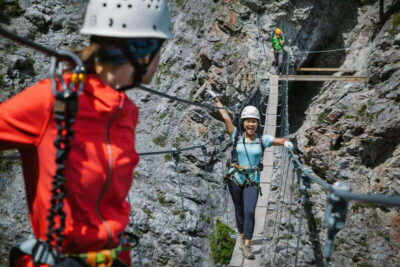
Banff: Mount Norquay 2.5 or 4-Hour Guided Via Ferrata Climb
Read our review →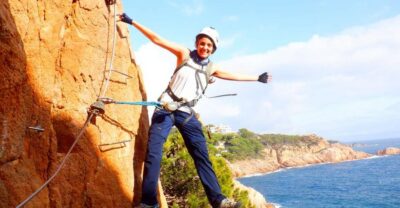
Sant Feliu de Guixols: Climb Via Ferrata Cala del Molí
Read our review →
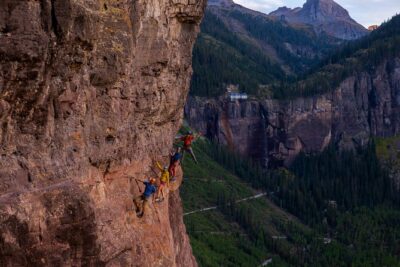
Small-Group Guided Via Ferrata Climbing with Banff’s Best Views
Read our review →
Via Ferrata in Gran Canaria. Vertical adventure park. Small groups
Read our review →Browse the lists this trek appears in