
Review · CHIANG MAI
Chiang Mai: Mae Ya Waterfall & Pha Dok Siew Trail Trek
Mae Ya Waterfall is the day’s grand finale, but the best part of this outing is the way it links three very different water stops with a forest walk and a visit to Ban Mae Klang Luang. You get roaring water, hillside farms, layered rice fields, and a locally grown coffee in one long day.
I especially like the small-group or private format, since guides such as Tom, Austin, and Phon Phon have time to explain plants, adjust the pace, and leave you longer at a waterfall. I also like the meal in the White Karen village, which has been singled out as generous and unusually good. The main drawback is the price: at $80 per person, it costs more than a simple waterfall transfer, and the full 570-minute day includes plenty of driving.
Key points at a glance
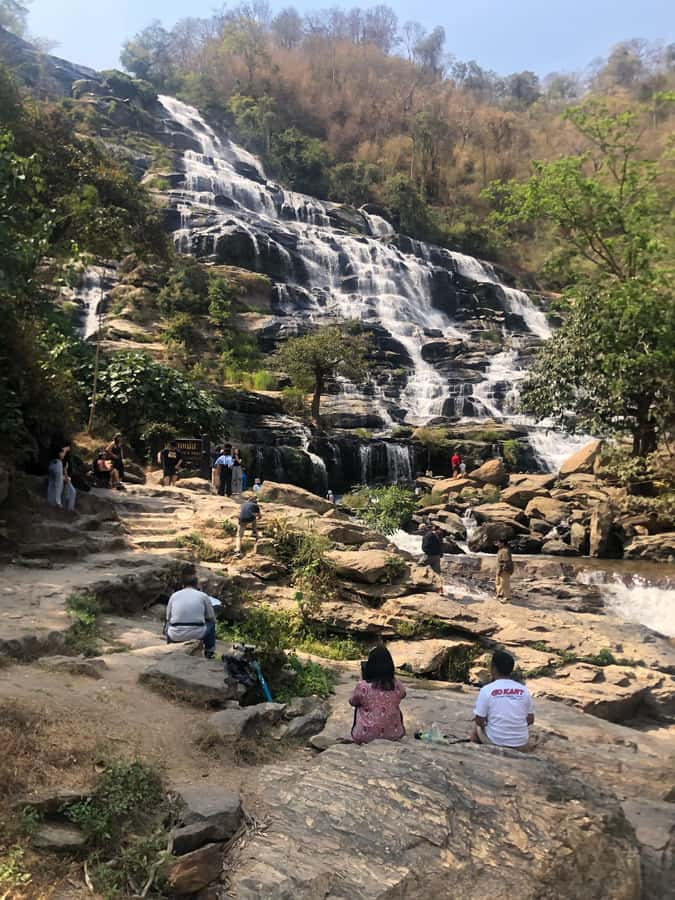
- Mae Ya Waterfall finishes the day with scale: Water drops from a 280-meter, roughly 30-storey cliff.
- Pha Dok Siew takes about two hours: The walk passes through forest, small farms, and seasonal rice fields.
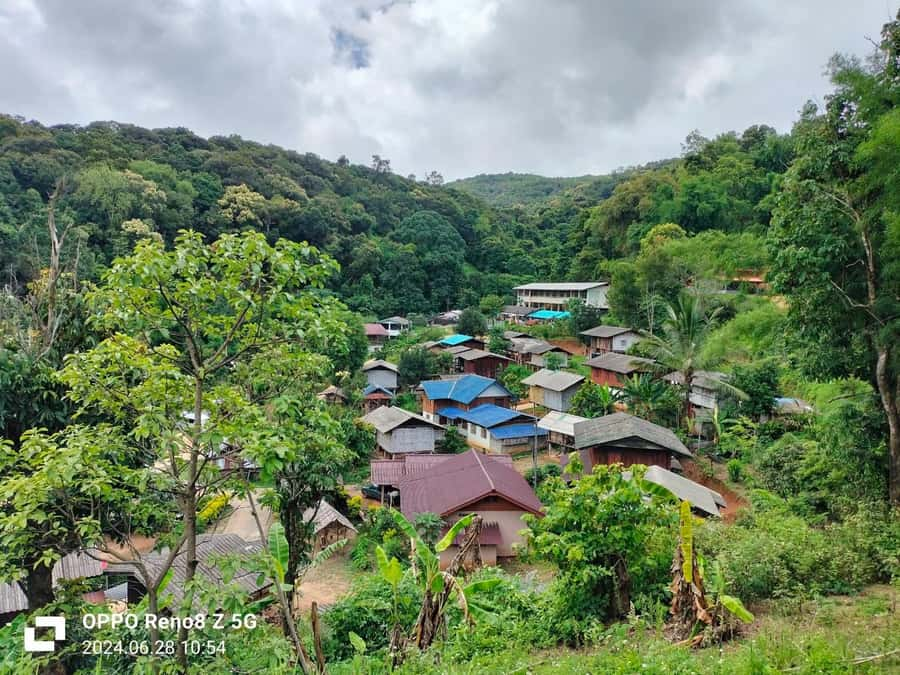
- Ban Mae Klang Luang adds local contact: You stop for lunch, village walking, and coffee grown nearby.
- Swimming depends on conditions: You may swim at Rak Jung Waterfall and Mae Ya if weather and water levels allow.
- Guide quality matters here: Tom, Austin, Phon Phon, and driver-guide Pnoom have all been praised for patience and clear English.
- Pickup has a tight range: Hotel pickup covers Chiang Mai accommodations within 2.5 kilometers of the old city wall.
Why this Chiang Mai day trip works
This is not a quick waterfall photo stop. It is a mountain day built around contrasts. You start with a scenic drive, see the force of Wachirathan Waterfall, walk a forest trail, cross through local farming country, eat in a Karen village, then finish at Thailand’s famously tall Mae Ya Waterfall.
That sequence gives the day a useful rhythm. You are not hiking for nine hours, but you are not sitting in a vehicle all day either. The Pha Dok Siew section takes about two hours, and the rest of the time is split between transport, short walks, meal time, coffee, and waterfall visits.
The guides can make a real difference. Tom has been praised for explaining plants along the route, staying patient, and allowing people time at each stop. Austin has led private-feeling outings for very small groups. Phon Phon and driver Pnoom have also been noted for creating a friendly atmosphere and communicating well in English. Names are not guaranteed when you book, but this gives you a useful sense of the service style to expect.
The catch is that the day is long and the $80 price is not bargain transport. You are paying for an air-conditioned vehicle, a guide, entrance fees, lunch, drinking water, and accident insurance. If you want one major waterfall with minimal walking, choose something simpler. If you want a full day with several kinds of scenery and local contact, the cost makes more sense.
More Waterfall Treks in Chiang Mai
- Chiang Mai: 2-Days Jungle Trek, Waterfalls and Karen Village
★ 4.8 · 103 reviews - Chiang Mai ATV & White Water Rafting & Trekking to Waterfall
★ 4.7 · 84 reviews - Chiang Mai Untouched Elephant: Nature Walk & Waterfall Trek
★ 4.7 · 77 reviews
Wachirathan Waterfall sets the pace
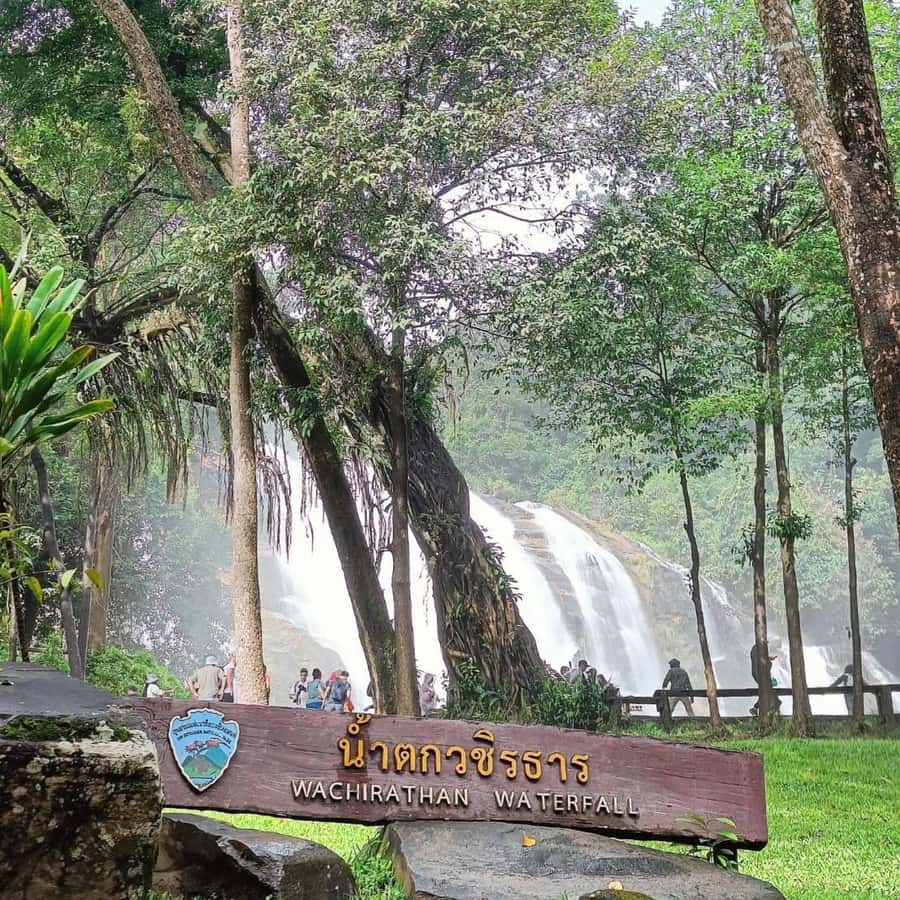
Expect roughly an hour and a half of driving before the first major stop, Wachirathan Waterfall. That transfer is part of the tradeoff. Chiang Mai’s mountain sights are spread out, and getting to them takes time, but an air-conditioned vehicle is welcome in Thailand’s heat.
Wachirathan is a strong opening stop because it gives you an immediate sense of the water and terrain before the hike begins. You can visit, walk around, and take photographs without spending your energy on a long trail right away.
It is also the most tourist-oriented of the three waterfall stops, so do not expect complete solitude. One useful approach is to treat Wachirathan as a short orientation stop rather than the emotional peak of the day. Save your attention for the smaller details on Pha Dok Siew and the scale of Mae Ya.
Your guide can help keep the stop moving at a sensible pace. Since the overall schedule is described as flexible, you may have some room to take photographs or pause, but the day still has several fixed pieces and a long return drive.
Pha Dok Siew is the active heart of the day
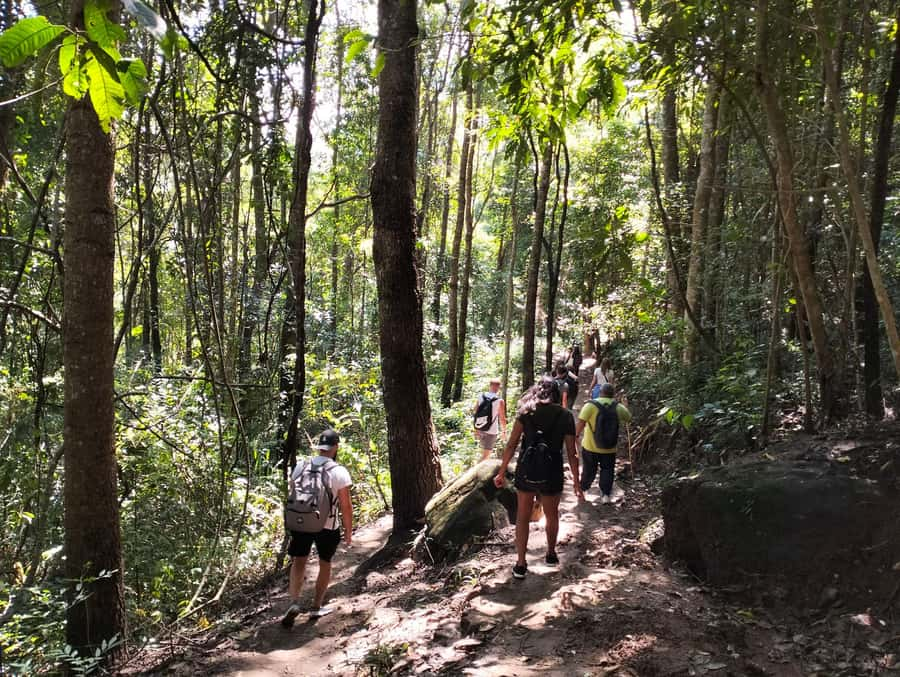
After Wachirathan, you meet a local hilltribe guide for the Pha Dok Siew Nature Trail. The trek lasts about two hours, with some descriptions placing it closer to an hour and a half. It is presented as manageable rather than strenuous, and one family group found it suitable even for children.
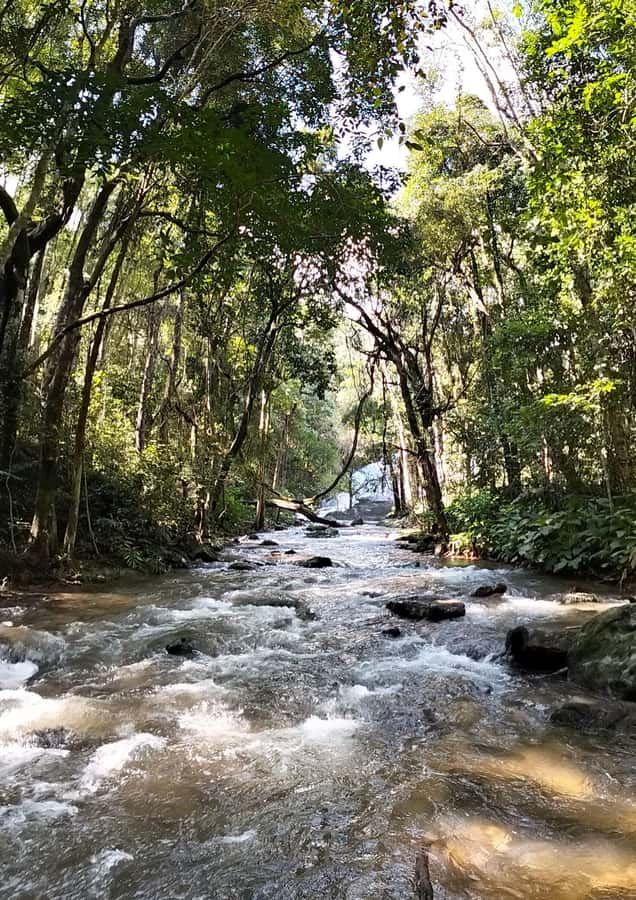
Still, this is a real forest walk. Wear long pants and sensible walking shoes, and bring insect repellent. The trail passes through trees, hillside farms, and smaller local growing areas, so you get more than a standard path through woodland.
The guide’s explanations are part of the value. You can learn about different plants and trees as you walk, with the natural setting providing the lesson. Tom, in particular, has been praised for pointing out plant life during the hike. This turns the trail from a simple route between stops into a chance to understand how people use and live alongside the forest.
Rak Jung Waterfall is a possible swimming stop along the way. Swimming is not guaranteed. Weather and water levels decide whether it is safe or practical, so pack swimwear, a towel, and a change of clothes, but do not build your whole day around getting in the water.
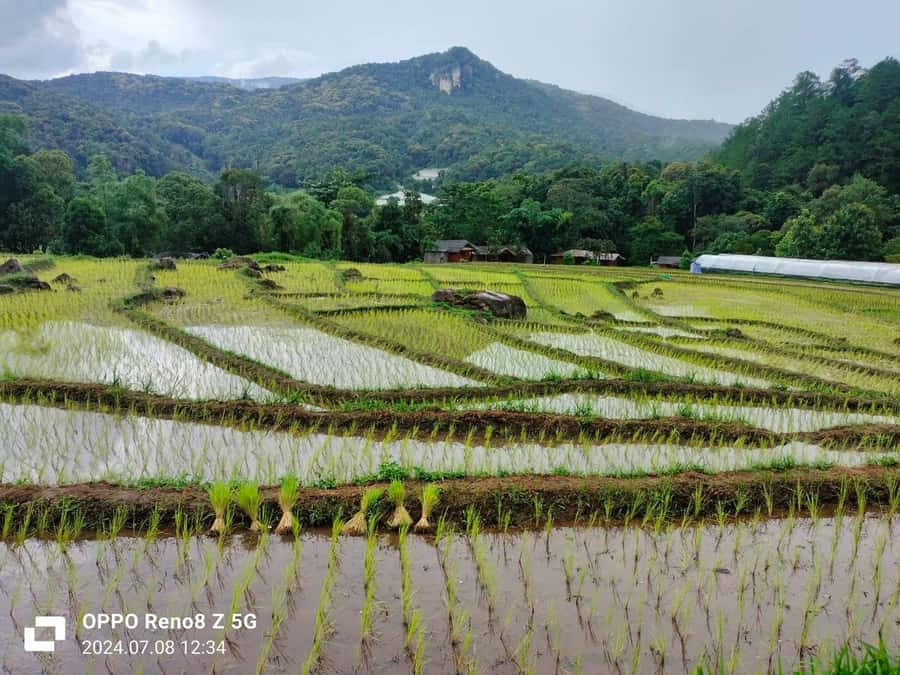
The walk also reaches views of the rice fields around Ban Mae Klang Luang. These fields change with the season, so the appearance will not be identical every month. At the right time, the layered fields climbing the hills are one of the most memorable sights of the day. In another season, you may see less planting or a different stage of cultivation.
That seasonal change is worth understanding. This is not a polished garden made for viewing from one platform. It is working farm country, and the fields reflect real planting cycles. The view may be at its best when the rice is green, but every season tells you something different about the village.
Ban Mae Klang Luang brings coffee and a good lunch
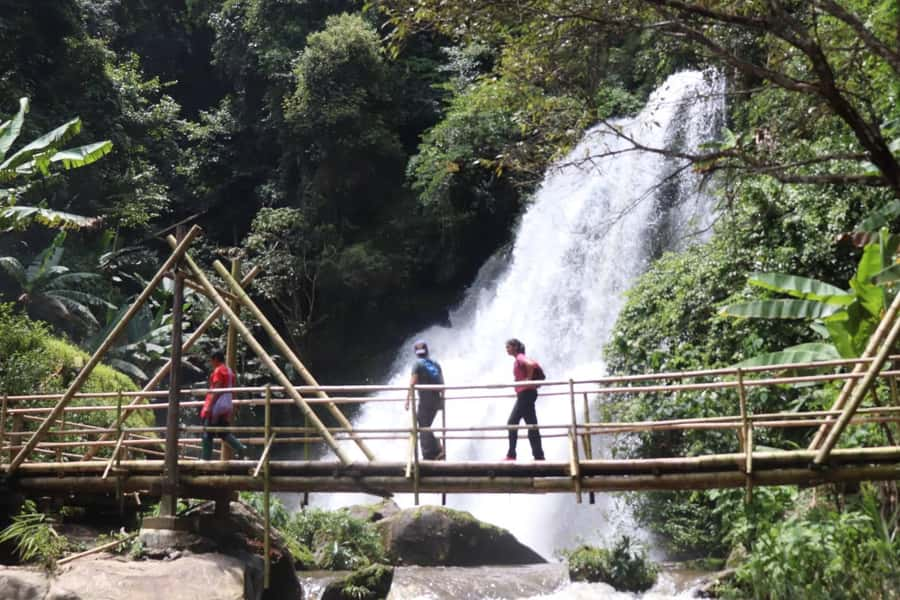
The trek finishes in the White Karen village of Ban Mae Klang Luang. Here, the day shifts from walking to eating, coffee, and a village stroll.
The included lunch is more important than it may sound. After two hours on the trail, you will appreciate a proper meal, and the food has been praised as generous, delicious, and one of the strongest parts of the outing. You should not need to budget separately for lunch, though personal expenses are not included.
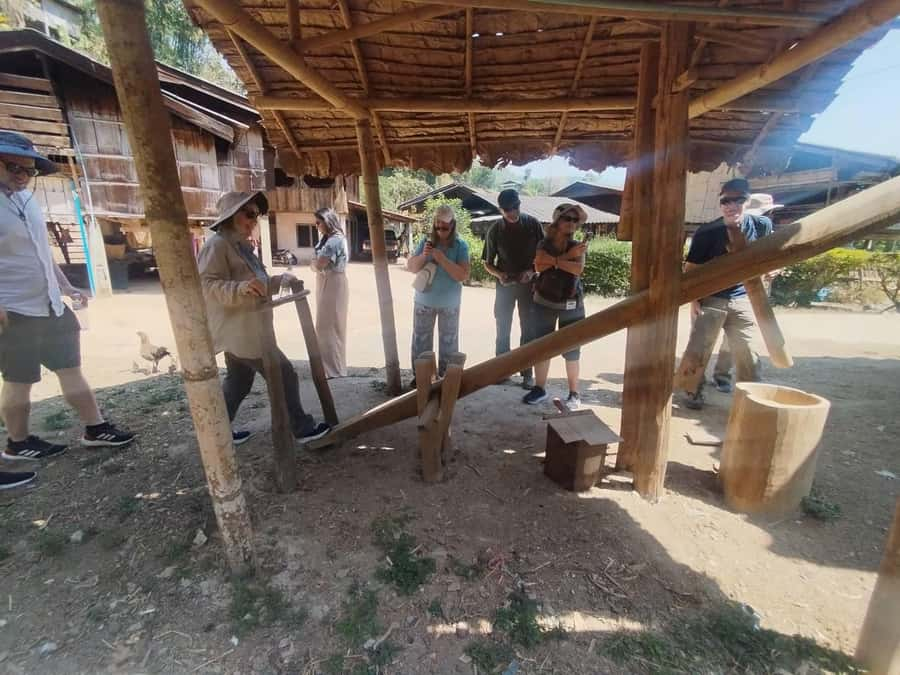
You also receive a cup of freshly ground coffee made from locally grown beans. This is a modest experience, not a formal coffee tasting with a long presentation, but it connects the drink to the place. You have just walked through hillside farms and rice-growing country, then get to taste something produced in the same broader mountain area.
Take time for the village walk after eating. The stop is not just a restaurant break. It gives you a chance to see the setting of the Karen community and appreciate how farming, coffee, and tourism overlap here. Keep your behavior respectful: walk calmly, ask before photographing people, and remember that this is a lived-in village, not a stage set.
The village stop also helps break up the day. Without it, the outing would be mostly waterfalls and vehicle time. With it, you get a meal, a local product, and a human element that gives the mountain scenery more meaning.
More Waterfall Treks in Thailand
- Chiang Mai: Whitewater Rafting and Waterfall Trekking Tour
★ 4.9 · 58 reviews - Chiang Mai Adventure: Trekking, Tubing & Waterfall Slide
★ 4.9 · 20 reviews - Chiang Mai: Elephant Sanctuary & Jungle Trek w/ Waterfall
★ 4.5 · 18 reviews - Trek to a Jungle Waterfall
★ 5.0 · 14 reviews
Mae Ya Waterfall supplies the big finish
Mae Ya Waterfall is saved for last, and that is a smart choice. It is described as one of Thailand’s most beautiful waterfalls, with water falling from a 280-meter cliff that reaches roughly 30 storeys. The height gives it a different character from Wachirathan and Rak Jung.
You can walk around the area and take photographs, and swimming may be possible if weather and water levels permit. Again, treat swimming as a bonus, not a promise. Conditions can change, and the safe choice is to follow your guide’s advice.
Mae Ya can be especially impressive after a day of smaller details. You have spent hours noticing plants, farms, coffee, and rice fields. Then the final stop gives you a broad, dramatic view of water and rock. It is a satisfying close to the route, although it can also be a busy stop at times.
The stop is not an alpine summit or a high viewpoint. This matters because the tour does not visit the summit of Doi Inthanon National Park. You are getting a nature and village route in the park area, not a summit excursion. If reaching the highest point is your main goal, this is the wrong product. If waterfalls and a forest trail matter more, the omission is not a problem.
How the price and schedule stack up
The advertised price is $80 per person for a 570-minute day, or about nine and a half hours. That is a full schedule, with pickup, mountain transport, three waterfall visits, the trail, lunch, coffee, and the return to Chiang Mai expected around 5:30 p.m.
The value depends on how you would otherwise arrange the day. A private vehicle, driver, guide, park entrances, food, and a local trail guide could easily become complicated to organize separately. Here, those parts are combined, and you have an English-speaking guide to help with the route.
The value is strongest for a private booking or a very small group. A small party can feel almost like a private excursion, and your guide has more time to explain the plants or adjust the pace. One person found the price a little high even while enjoying a two-person outing, so do not assume the small-group format automatically makes the cost cheap.
The schedule is flexible, but flexible does not mean leisurely from start to finish. You have a long drive at the beginning, several stops, and a return trip. If you dislike early starts or long days, ask for the exact pickup time before booking. Starting times depend on availability.
Pickup is available from accommodations in downtown Chiang Mai and within 2.5 kilometers of the old city wall. If you stay farther away, select the meeting-point option. The operator asks for a WhatsApp number or Thai telephone number so it can contact you, which is worth arranging before the day.
Free cancellation is available up to 24 hours before the activity for a full refund, and you can reserve now and pay later. Those terms give you some flexibility, but they do not change the basic need to check the weather before a waterfall and trail day.
What to bring for the forest and waterfalls
Pack for two different parts of the day. The trail calls for long pants, insect repellent, a hat, and comfortable walking clothes. A jacket is also listed, which makes sense for a mountain day where conditions may differ from Chiang Mai city.
For the water stops, bring swimwear, a towel, and dry clothes. You may be able to swim at Rak Jung or Mae Ya, but conditions control the decision. Keep your camera protected around spray, and carry any personal medication you need.
Drinking water is included, but you should still arrive ready for heat and walking. The activity is not suitable for wheelchair users. Children aged one to three can join free without their own seat, but a parent must care for them on the same seat, so this arrangement is not the same as having a separate child seat.
The trek is described as manageable for children, but families should still judge their own child’s comfort with a roughly two-hour forest walk, uneven ground, heat, and changing conditions. The guide can help with pace, yet parents remain responsible for very young children.
Who should choose this experience
I would choose this day if you want more than a waterfall photo. It suits you if you like a moderate walk, local food, village scenery, and guides who explain what you are seeing. It is also a good match if you want several highlights in one day and do not want to arrange transport between scattered mountain sights.
The tour is especially appealing to couples, families with active children, and small groups. The walk is not described as hard, and the flexible timing can help a private or small party pause when needed. An English-speaking guide is included, and the best guide reports point to clear explanations and a patient manner.
I would hesitate if you need wheelchair access, dislike long vehicle rides, or want the Doi Inthanon summit. I would also think twice if your only goal is swimming, since both water stops depend on weather and water levels.
Should you book this Chiang Mai waterfall day?
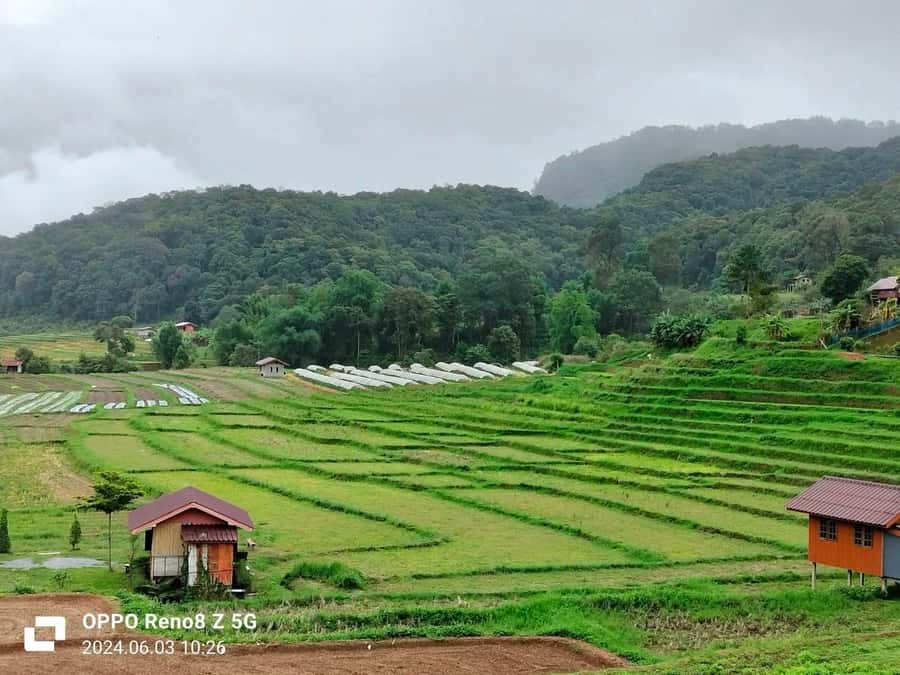
Book it if you want a well-rounded mountain day rather than a single attraction. The mix of Wachirathan, Pha Dok Siew, Ban Mae Klang Luang, and Mae Ya gives you waterfalls, forest, farms, coffee, rice fields, and a substantial lunch in one organized outing.
The strongest reasons to go are the local trail guide, the village meal, and the chance to see Mae Ya after a more intimate walk through the hills. The main reasons to pass are the $80 price and the long nine-and-a-half-hour schedule.
For the best fit, request a small group or private option, bring the full list of practical gear, and confirm pickup details if you stay outside central Chiang Mai. If that sounds like your kind of day, this is a worthwhile way to see the mountain side of the province without reducing it to a quick photo stop.
FAQ
How long does the Chiang Mai waterfall and trail experience last?
The activity lasts 570 minutes, or about nine and a half hours. The planned return to the hotel is approximately 5:30 p.m.
How long is the Pha Dok Siew walk?
The trek takes about two hours, though the walking time may be closer to an hour and a half depending on the pace and conditions.
Can I swim during the tour?
Swimming may be possible at Rak Jung Waterfall and Mae Ya Waterfall, but it depends on weather conditions and water levels.
Does the tour visit the summit of Doi Inthanon National Park?
No. This experience visits waterfalls, the Pha Dok Siew Nature Trail, and Ban Mae Klang Luang, but it does not visit the park summit.
Is hotel pickup included?
Pickup is available from accommodations in Chiang Mai downtown and within 2.5 kilometers of the old city wall. If you stay farther away, you should choose the meeting-point option.
What is included in the price?
The price includes hotel pickup and drop-off where available, an air-conditioned vehicle, entrance fees, lunch, drinking water, an English-speaking guide, and accident insurance. Personal expenses are not included.
Just added around Chiang Mai
- Trek to a Jungle Waterfall★ 5.0 · 14 reviews
- Trekking at the Monk Trail and Doi Suthep Temple Private Tour★ 5.0 · 3 reviews
- Small Group : Trekking Trip in Chiang Mai (Doi Suthep Area) with Market Tour★ 5.0 · 4 reviews
- Full-Day Trekking and Sightseeing Tour in Mae Kampong★ 5.0 · 46 reviews
- 11km Scred Mountain Hike★ 5.0 · 2 reviews
- One day Doi Inthanon National Park & Trekking on Kew Mae Pan★ 5.0 · 12 reviews
- Private Tour 2 Difference Trails Trekking at Doi Inthanon National Park★ 5.0 · 19 reviews
- 8KM White Water Rafting and 3HRS Jungle Trekking Adventure★ 5.0 · 9 reviews
Waterfall Treks, compared.

Glacier Hike, Waterfalls and Black Sand Beach
Read our review →

Glacier Hike, South Coast Waterfalls & Black Sand Beach
Read our review →
Reykjavík: Iconic Glacier Hike, South Coast & Waterfalls
Read our review →
Munduk Waterfalls Trek, Twin Lakes and Temple Tour
Read our review →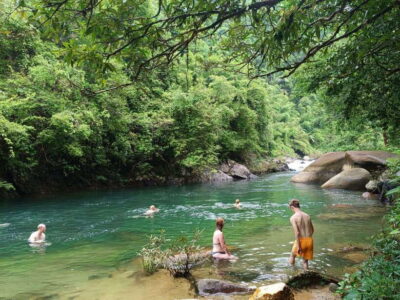
Khao Sok: Private Waterfalls and Wildlife Half-Day Trek
Read our review →
South Coast, Waterfalls & Glacier Hike Small-Group
Read our review →
Selogriyo Temple and Trekking Java Rice Terraces, hidden waterfall -Nature Java
Read our review →Browse the lists this trek appears in